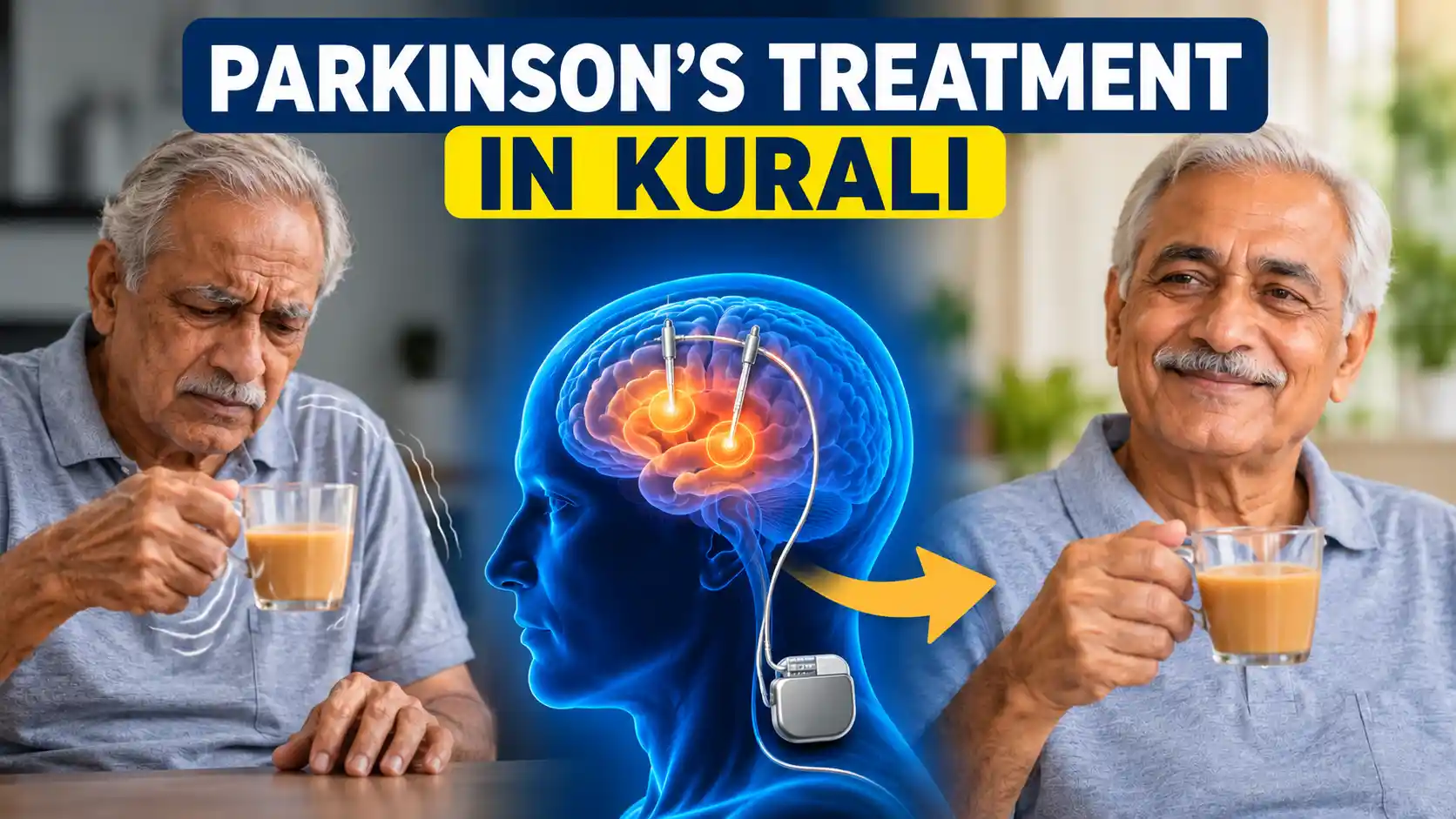
Your father takes his tablets on time, every single day. Yet by evening, his hand shakes so much that he cannot hold a cup of tea. On some days he freezes at the door. On other days his body twists and wriggles on its own.
Many families from Kurali walk into our clinic with this exact story. The medicine that once worked well now fades in a few hours. If you are searching for Parkinson’s treatment in Kurali, you should know that tablets are not the only option. For the right person, deep brain stimulation (DBS) can bring back steady, more predictable days.
Who this is for: people living with Parkinson’s, and the family members who care for them, who feel the medicine is no longer doing enough.
Key Takeaways
- Parkinson’s is rising fast. Over 8.5 million people had it worldwide in 2019, and cases have doubled in 25 years.
- Medicine comes first. Trouble starts when doses wear off early or cause wriggly, unwanted movements (dyskinesia).
- DBS treats movement symptoms. It helps tremor, stiffness, slowness and “off” periods. It does not cure Parkinson’s or stop it from progressing.
- The evidence is strong. In a trial of 251 patients, DBS plus medicine improved quality of life by about 26% over two years. Medicine alone showed no gain.
- Levodopa response predicts success. Symptoms that improve with your best dose usually improve with DBS. Tremor is the exception, as it can respond even when tablets fail.
- Serious risks are low but real. One NHS service quotes about 1 in 200 for stroke, 1 in 20 for infection and 1 in 500 for death.
- Fine-tuning takes patience. Finding the best device settings can take 4 to 6 months.
- Most people still take some medicine. After DBS, doses are often lowered, but rarely stopped.
Understanding Parkinson’s Symptoms Beyond the Shaking
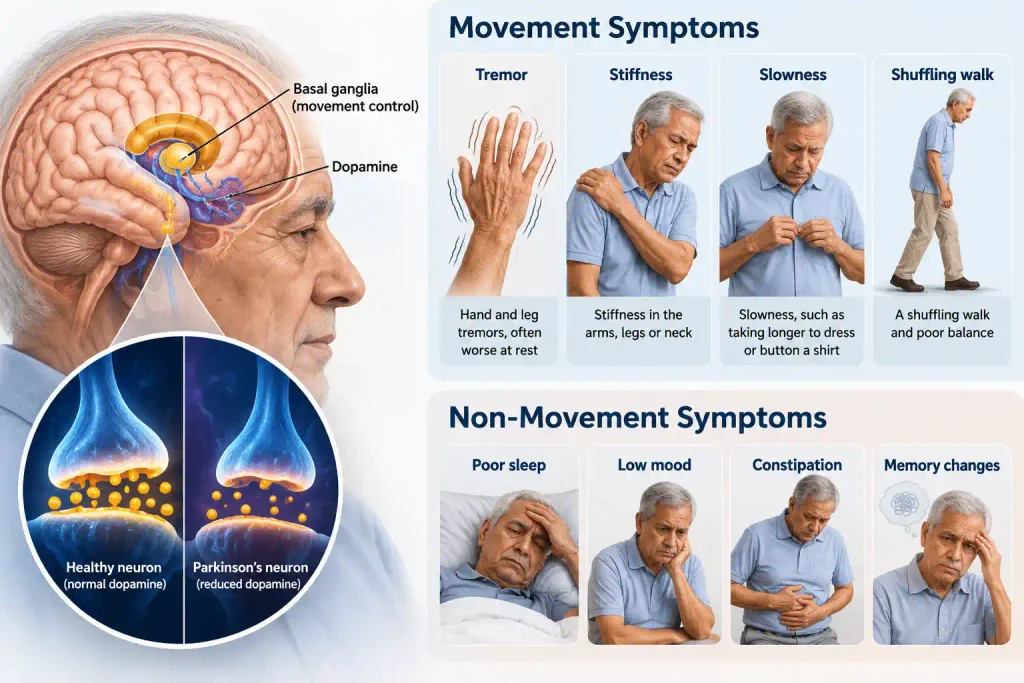
Parkinson’s starts when brain cells that make dopamine slowly fade. Dopamine helps your brain send smooth, quick movement signals. As it drops, movement becomes harder.
The main Parkinson’s symptoms include:
- Hand and leg tremors, often worse at rest
- Stiffness in the arms, legs or neck
- Slowness, such as taking longer to dress or button a shirt
- A shuffling walk and poor balance
- Non-movement problems like poor sleep, low mood, constipation and memory changes
Not every shaking hand means Parkinson’s. Essential tremor is a different tremor disorder, and it needs a different plan. A correct diagnosis matters, because DBS targets a different spot in the brain for each condition.
When Medicine Starts to Fall Short
For the first few years, levodopa and similar tablets often work very well. Doctors call this the “honeymoon” phase. Over time, the brain stores less dopamine, and each dose lasts a shorter time.
Watch for these signs of reduced medication effectiveness:
- Symptoms return before the next dose is due (“wearing off”)
- Sudden “off” spells, when the body feels stuck
- Twisting or jerky movements at peak dose (dyskinesia)
- Needing tablets five, six or more times a day
- Good days and bad days with no clear pattern
- A tremor that keeps going even on a full dose
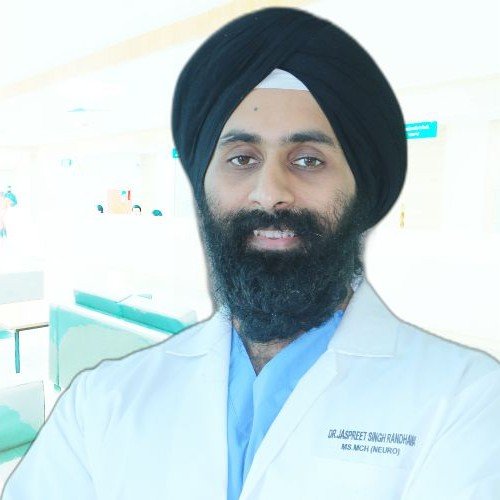
“When a patient tells me the tablets still work, but only for two hours, that is useful news. It means the brain still responds to levodopa, but the effect has become too short. That is exactly the situation where DBS can help.” Dr Jaspreet Singh Randhawa
The first step is always a careful medicine review with your neurologist. Changing dose times, spacing protein meals, or adding a helper drug can smooth out the day. If the day still feels like a roller coaster after that, it is time to ask about DBS.
What Is DBS Surgery and How Does It Work?
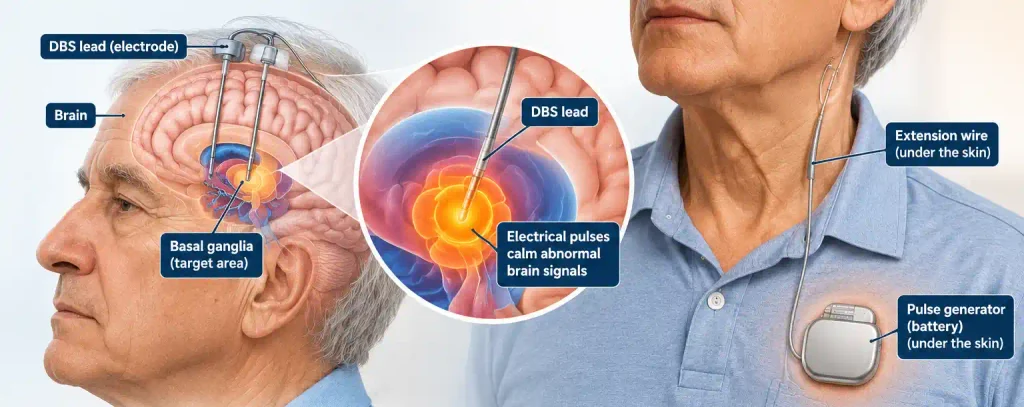
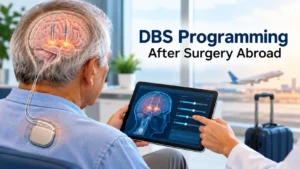
DBS surgery is a planned form of brain surgery. A neurosurgeon places one or two very thin wires, called leads, in a small target deep in the brain. A battery device, similar to a heart pacemaker, sits under the skin of the chest.
The device sends gentle, steady pulses. These pulses calm the faulty signals that cause tremor, stiffness and slowness. Nothing is removed from the brain, and the settings can be changed at any time.
What Happens on Surgery Day
- An MRI and CT scan help plan the exact path of each lead
- A head frame or guidance system keeps the head perfectly still
- You may stay awake for part of the surgery, so the team can test the effect on your tremor
- The battery is placed under the chest skin, on the same day or a few days later
- Most people go home within a few days
The device is often switched on and programmed a few weeks later. Settings are then adjusted over several visits.
DBS vs Medicine: A Side-by-Side Comparison
| Feature | Medicine-based treatment | DBS surgery |
|---|---|---|
| How it works | Replaces or boosts dopamine | Electrical pulses calm faulty brain signals |
| Control through the day | Rises and falls with each dose | Steady, round the clock |
| Best stage | Early and middle Parkinson’s | When medicine causes swings or side effects |
| Tremor control | Good early, may fade | Often very good, even for stubborn tremor |
| Dyskinesia | Can get worse with higher doses | Often improves, partly through lower doses |
| Surgery needed | No | Yes |
| Adjustments | Dose and timing changes | Device programming plus medicine changes |
| Cure or slows disease | No | No |
Who Is a Good Candidate for DBS?
DBS works best when the right person has it at the right time. A good candidate often has:
- Typical Parkinson’s disease, present for four years or more
- A clear, strong response to levodopa
- Disabling “off” periods, dyskinesia, or tremor that medicine cannot control
- Memory and thinking that are largely intact
- Stable mood, or depression that is well treated
- Good enough general health for surgery
- Family support for follow-up visits
“DBS works best for the symptoms that your best levodopa dose already improves. I often tell families to think of it as giving you your best ‘on’ time for more of the day. It will not create a benefit the medicine never gave, except for tremor.” Dr Jaspreet Singh Randhawa
Who Should Not Have DBS?
DBS is not right for everyone. It is often not advised for people with:
- Significant memory loss or dementia
- Severe depression, hallucinations or psychosis that are not under control
- Atypical parkinsonism, such as MSA or PSP, which respond poorly to levodopa
- Falls, freezing or speech problems that stay bad even at the best “on” time
- Serious heart, lung or bleeding problems that make surgery unsafe
The Tests Before DBS
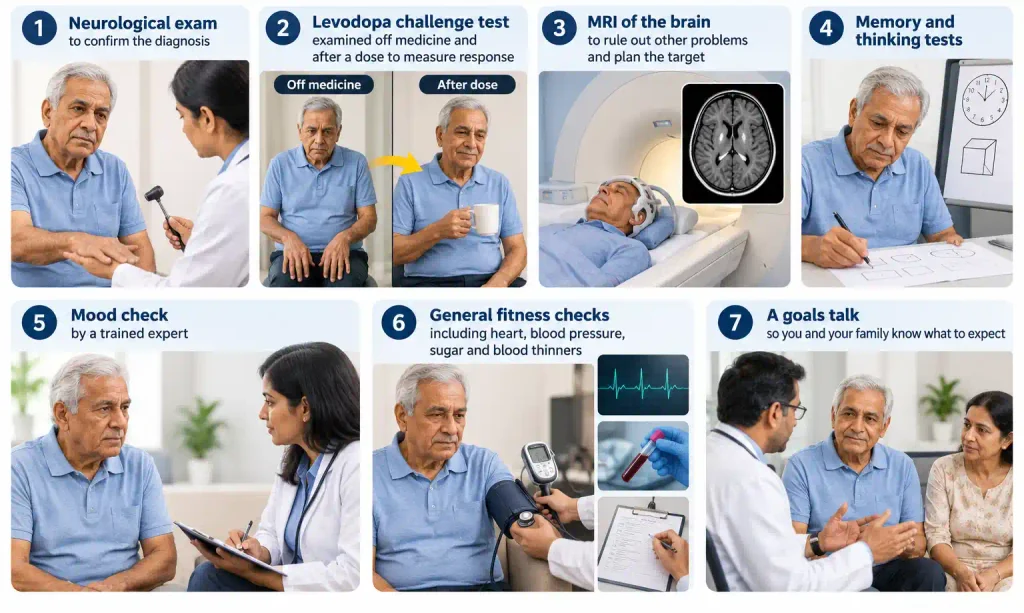
A good team never rushes this choice. The tests take a few visits and include:
- Neurological exam to confirm the diagnosis
- Levodopa challenge test, where we examine you off medicine and again after a dose to measure the response
- MRI of the brain to rule out other problems and plan the target
- Memory and thinking tests
- Mood check by a trained expert
- General fitness checks, including heart, blood pressure, sugar and blood thinners
- A goals talk, so you and your family know what to expect
What DBS Can and Cannot Improve
1. Symptoms That Often Improve
- Tremor of the hands and legs
- Stiffness and slowness
- Long or sudden “off” periods
- Dyskinesia, often because medicine can be lowered
2. Symptoms That May Not Improve
- Balance problems and freezing that persist even when medicine works best
- Speech and swallowing
- Memory, mood and sleep
- Constipation and other non-movement symptoms
Walking often improves if it already gets better with your tablets. If walking stays poor even at your best dose, DBS is unlikely to fix it.
Results, Risks and Realistic Expectations
1. What the Research Shows
The EARLYSTIM trial followed 251 people for two years. Those who had DBS plus medicine reported about 26% better quality of life, while the medicine-only group did not improve. The DBS group also had less disability and more good “on” time. You can read more about DBS success rates in our detailed guide.
Benefits for tremor and stiffness often last many years. Parkinson’s itself keeps slowly progressing, so balance and speech may change later.
2. Risks You Should Know
Like any surgery, DBS has risks. One NHS service lists about a 1 in 200 chance of stroke from bleeding and a 1 in 20 chance of infection. Other possible issues include:
- Lead movement or a broken wire
- Skin wearing thin over the device
- Battery replacement every few years (rechargeable ones last longer)
- Tingling, slurred speech, balance or mood changes from stimulation
Most stimulation side effects ease when the settings are changed.
“Every surgery carries risk, and I discuss these numbers openly with every family. Most stimulation side effects can be reduced by adjusting the settings. What matters most is choosing the right patient and planning the surgery carefully.” Dr Jaspreet Singh Randhawa
Getting Parkinson’s Treatment in Kurali and Mohali
Many families in Kurali travel far for expert care and face long waits. DBS is not a one-time event. It needs regular tuning visits in the first six months, so a centre close to home helps.
Medisyn in Kharar, Mohali, is a short drive from Kurali. Here you can:
- Find out if DBS suits you
- Discuss your medicines and recent changes
- Understand the DBS surgery cost and planning involved
- Return easily for device programming and follow-up
Bring your medicine list, old scans, and a short diary of your “on” and “off” times. That diary often tells us more than any single test. You can book an appointment online.
Final Thought
Parkinson’s changes over time. So should its care. If your tablets no longer carry you through the day, that is not the end of the road. It may simply be a sign that it is time to explore the next step.
DBS is not a cure, and it is not for everyone. For the right person, though, it can turn a day full of swings into a day you can plan. If you are weighing Parkinson’s treatment in Kurali, an honest, unhurried assessment is the best place to start.
Frequently Asked Questions
1. How do you know when Parkinson’s medication is no longer controlling symptoms effectively?
The clearest sign is wearing off, where symptoms return before the next dose is due. Other signs include sudden “off” spells, twisting movements at peak dose, and needing tablets more and more often. A simple diary of good and bad hours helps your doctor see the pattern clearly.
2. Can DBS surgery stop Parkinson’s tremors when medication fails to provide enough relief?
Yes, tremor is one of the symptoms DBS controls best. It can often reduce a tremor even when tablets do not fully control it. A full check first confirms the tremor comes from Parkinson’s, not another tremor disorder.
3. Is deep brain stimulation worth considering if Parkinson’s symptoms are worsening despite treatment?
Yes, if the decline comes from medicine swings, dyskinesia or stubborn tremor. If the decline is mostly in memory, speech, or balance at your best dose, DBS helps less. A specialist can tell these two situations apart.
4. Can DBS help patients whose hands shake even when they are taking their medicines regularly?
Often, yes. Hand and leg tremors that persist despite regular doses are a common reason people choose DBS. Many patients notice a clear calming of the tremor once the device is programmed.
5. What is the difference between DBS surgery and medication-based treatment for Parkinson’s disease?
Medicine boosts dopamine, so its effect rises and falls with each dose. DBS sends steady pulses round the clock, which smooths out the highs and lows. Most people use both together, often with a lower medicine dose after surgery.
6. Who should not undergo DBS surgery for Parkinson’s disease?
DBS is often not advised for people with dementia, uncontrolled depression or psychosis, or atypical parkinsonism such as MSA or PSP. It is also unsuitable if serious heart, lung or bleeding problems make surgery unsafe. People whose main problem does not improve with levodopa are also poor candidates.
7. Can DBS improve walking, stiffness, and slowness of movement in Parkinson’s patients?
Stiffness and slowness often improve well. Walking improves if it already gets better on your best medicine dose. Freezing and balance problems that persist even when tablets work best tend to respond less.
8. Why do some Parkinson’s patients respond well to DBS while others do not?
Results depend on the right diagnosis, a strong levodopa response, exact lead placement and careful tuning. People with memory problems or symptoms that never responded to medicine tend to gain less. Picking the right patient matters most.
9. Is DBS surgery a good option for Parkinson’s patients over the age of 70?
Age alone does not rule anyone out. What matters more is overall health, memory and how well levodopa still works. Risks can be somewhat higher after 70, so we check this group with extra care.
10. What happens if Parkinson’s symptoms return after DBS surgery?
First, the team checks the device, battery and settings, because simple programming changes often bring control back. Medicines may also be adjusted. If new symptoms appear because Parkinson’s has progressed, the plan is updated to match.
11. Can patients reduce their Parkinson’s medication after deep brain stimulation?
Many people can lower their dose after DBS, which also helps reduce dyskinesia. Very few stop medicine completely. Never cut down tablets on your own, as changes must be made slowly under your doctor’s guidance.
12. How risky is DBS surgery, and what complications should patients understand before deciding?
Serious complications are uncommon but real. One NHS service quotes about 1 in 200 for stroke, 1 in 20 for infection and 1 in 500 for death. Device problems and short-term side effects can also occur, but most can be fixed.
13. How long do the benefits of DBS surgery last for people with Parkinson’s disease?
Benefits for tremor, stiffness and slowness often last many years. Parkinson’s keeps progressing, so balance, speech and memory may change over time. Regular programming visits help keep the device working at its best.
14. What evaluations are needed before a neurologist recommends DBS surgery?
The usual tests include a neurological exam, a levodopa challenge test, a brain MRI, memory and thinking tests, and a mood check. Health checks make sure surgery is safe. A goals talk with your family completes the picture.
15. When should patients from Kurali or Mohali consult a specialist about advanced Parkinson’s treatment?
Book a review if your medicine wears off early, your tremor stays despite regular doses, or dyskinesia disrupts daily life. An early review, while memory and health are still good, gives you more choices. For Parkinson’s treatment in Kurali, Medisyn in Mohali is a short drive away for tests and follow-up.
Connected Movement Disorder Pathway: Families in Kurali and Ropar district can also review ongoing Parkinson’s medication optimization near Kurali, learn when to schedule a formal DBS surgical evaluation, and explore Deep Brain Stimulation surgery with Dr. Jaspreet Singh Randhawa in Mohali.