Your morning tablet used to last all day. Now it fades by lunch. Your hand shakes, your feet feel stuck to the floor, and you plan every outing around the next dose. Many people in this stage start asking about deep brain stimulation, or DBS.
The real question is not “Does DBS work?” It is “Will DBS work for me?” A careful DBS evaluation near Kurali answers that with tests, not guesswork. Many of my patients come from Kurali, Morinda and Ropar with exactly this doubt. Below, I explain who qualifies, which tests we use, what the results mean, and what happens if DBS is not the right fit.
Key Takeaways
- Parkinson’s is rising fast. Global cases have doubled in 25 years, with over 8.5 million people living with it in 2019.
- DBS is for symptoms that medicine no longer controls well. It eases symptoms but does not cure Parkinson’s, and most people still take some medicine.
- The levodopa challenge test is the key screen. A drop of more than 30% in motor scores after a levodopa dose is generally seen as a positive sign for DBS.
- Below 30% is not always a “no”. Select patients with severe dyskinesia, ON/OFF swings or tremor that resists medicine can still benefit.
- The benefit is real in trials. In a trial of 156 patients, the DBS group improved daily-living scores by 39%, while the medicine-only group declined by 5%.
- Safety checks matter as much as benefit. An MRI brain and a neuropsychological assessment check that surgery is safe and that memory and mood can handle it.
- DBS works best on tremor, stiffness, slowness and OFF time. Balance, speech and freezing that do not improve with levodopa usually improve less.
What DBS Does for Parkinson’s
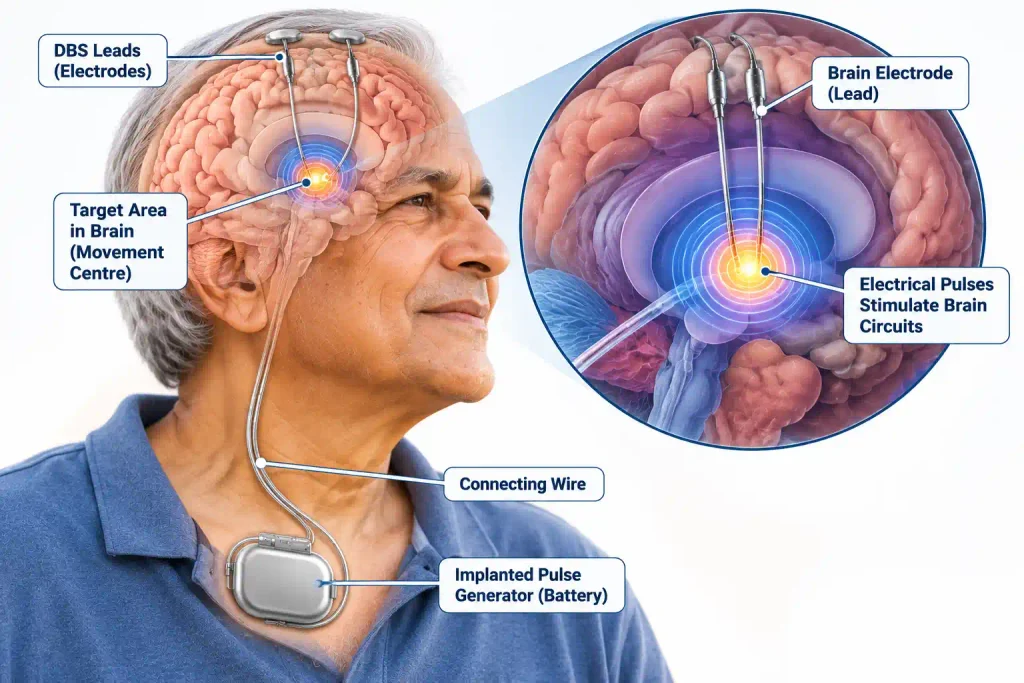
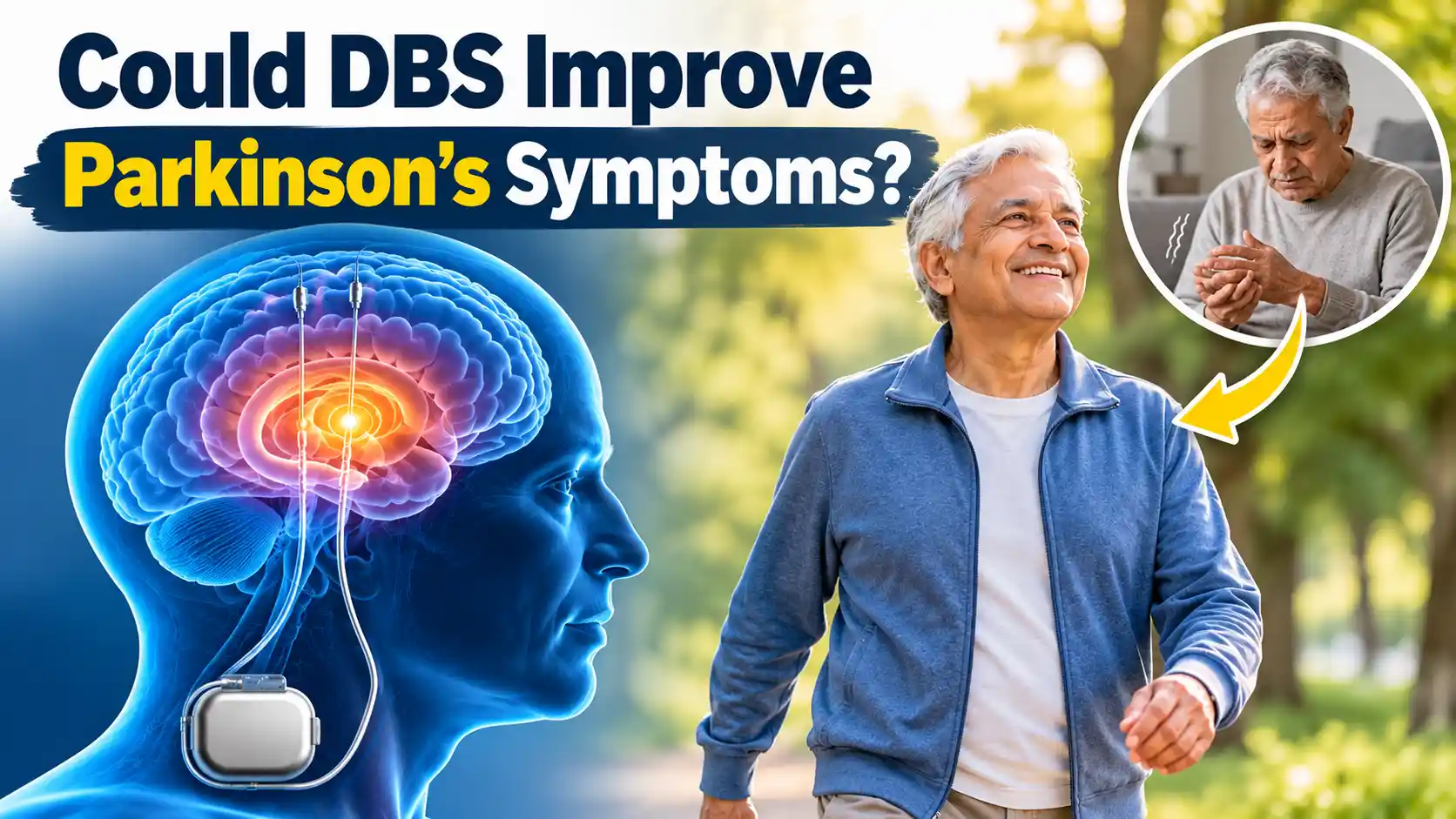
DBS places two thin wires, called leads, deep in the brain’s movement centres. A small battery device under the collarbone sends steady, gentle pulses through them. Think of it as a pacemaker for the circuits that control movement.
Unlike older brain surgeries, DBS does not destroy tissue. We can adjust it, and switch it off if needed. You can read about real outcomes in our guide to DBS success rates.
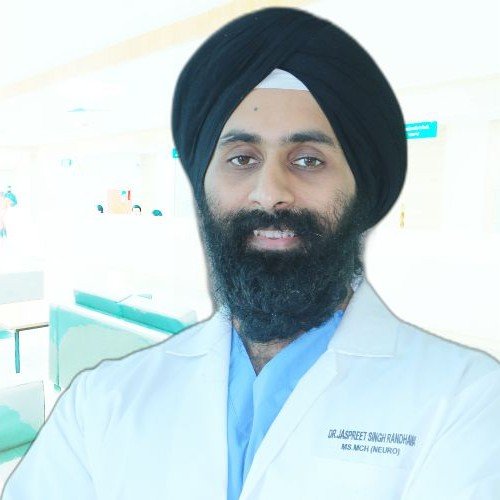
“DBS works best on the symptoms your levodopa already helps. If a good dose lets you move well for a few hours, DBS can often stretch that good time across your day. It cannot fix symptoms that medicine never touched.” Dr Jaspreet Singh Randhawa
Signs It May Be Time to Think About DBS
DBS is not a first step. It is for people who have had a fair trial of medicine and still struggle. Common signs include:
- Your dose wears off before the next one is due, leaving you stiff or slow
- You switch between ON and OFF without warning
- You get dyskinesia, the twisting or dancing movements at peak dose
- Your tremor stays strong despite good doses
- Side effects like nausea, dizziness or hallucinations stop you from taking more medicine
- You have had Parkinson’s for at least four to five years
If your tablets seem to be failing, it helps to understand why. Our page on Parkinson’s medicine not working explains the common reasons.
Good Candidate or Poor Candidate? A Quick Comparison
DBS eligibility depends on the whole person, not one test. There is no strict age limit. Overall health matters more than the number on your birth certificate.
| Factor | More likely to benefit | Less likely to benefit |
|---|---|---|
| Diagnosis | Typical Parkinson’s confirmed by a specialist | Atypical parkinsonism such as MSA or PSP |
| Levodopa response | Clear improvement, usually 30% or more | Little or no response |
| Main problem | Tremor, stiffness, slowness, OFF time, dyskinesia | Falls, balance, speech or freezing in the ON state |
| Memory and thinking | Normal or mild changes | Dementia |
| Mood | Stable or well treated | Severe untreated depression or psychosis |
| General health | Fit for a planned operation | Uncontrolled heart, lung or bleeding problems |
| Support | Family help and able to attend follow-up visits | No one to help with care and programming |
| Expectations | Wants better daily control | Expects a cure |
The DBS Screening Process: Tests That Decide Eligibility
A proper DBS evaluation near Kurali is team work. A neurosurgeon, a neurologist, a psychologist and sometimes a psychiatrist and physiotherapist all give their view. Each test answers a different question.
1. Neurology Review and Medicine History
We first confirm that you truly have Parkinson’s disease. We also check your full medicine timetable. Sometimes better dose timing helps so much that surgery can wait.
2. The Levodopa Challenge Test
This test shows how much of your movement problem levodopa can reverse. It is the best single guide to how much DBS may help.
- You skip your Parkinson’s tablets from the night before, so you arrive in the OFF state
- The doctor scores your movement using a standard scale and records a video
- You take a dose a little higher than your usual morning dose
- We repeat the scoring as the medicine peaks, usually over one to two hours
An improvement of 30% or more is a good sign. A lower score does not always rule you out. One PubMed study found that select patients below 30% still improved after DBS when tremor or dyskinesia was the main problem.
“Many patients worry about coming in OFF medicine for this test. That worry is natural. We keep you safe, a family member can stay with you, and those few hours give us the most honest answer about whether surgery will help.” Dr Jaspreet Singh Randhawa
3. MRI Brain
An MRI brain checks for problems that could make surgery unsafe or less useful. These include old strokes, a tumour, fluid build-up or marked shrinkage. It can also show signs of other parkinsonian conditions. Later, the same scan helps the surgeon plan the exact path for each lead.
4. Neuropsychological Assessment
This is a detailed check of memory, attention, planning, language and mood. It takes a few hours and feels like a series of puzzles and questions. It matters for three reasons:
- Dementia makes good results less likely, so we need to know your starting point
- DBS can sometimes affect word-finding a little, so a baseline helps us track changes
- Depression and anxiety are common in Parkinson’s and should be treated before surgery
Mild memory changes do not always rule you out. If memory is a worry, read our article on whether DBS can slow dementia.
5. Other Checks
- Blood tests, ECG and a heart check if needed
- Review of blood thinners and diabetes control
- Walking, balance and speech assessment
- A discussion of your goals, so we judge success by what matters to you
DBS Risks and Benefits: An Honest Look
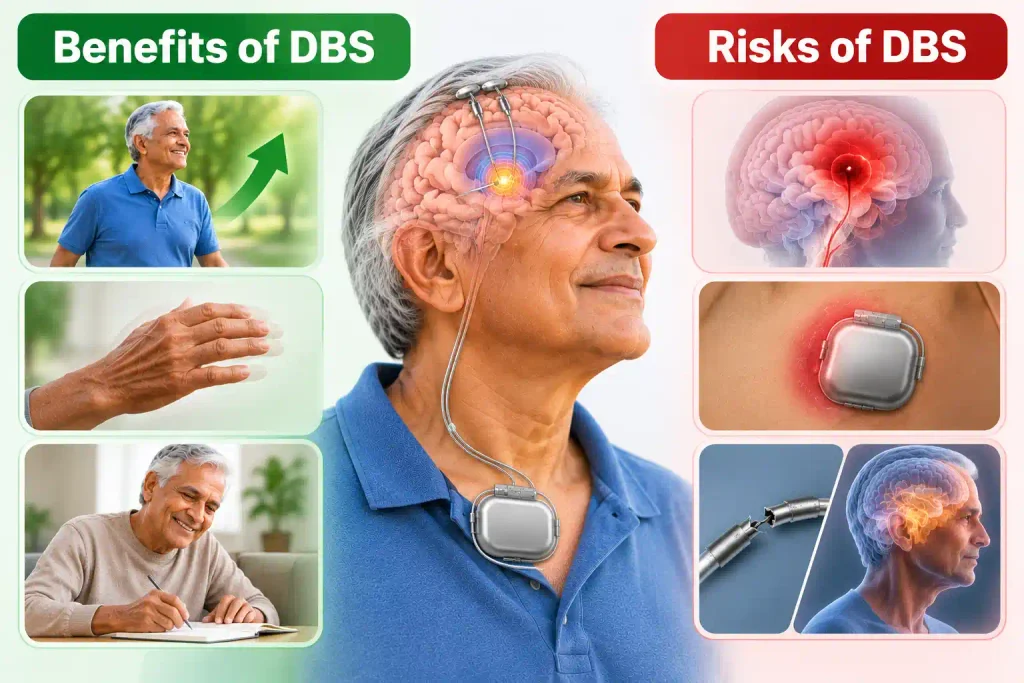
Every patient deserves a clear picture of DBS risks and benefits before deciding.
1. Possible benefits
- More good ON time and fewer OFF periods
- Less tremor, stiffness and slowness
- Less dyskinesia, often because the medicine dose can come down
- Better daily living. In one NEJM trial, daily-living scores improved by 39% with DBS
2. Possible risks
- Bleeding in the brain or stroke, which is uncommon but serious
- Infection around the device, which may need its removal
- Wire or battery problems that need a small repeat procedure
- Stimulation side effects such as tingling, slurred speech, poorer balance or mood changes, which are often fixed by adjusting settings
The Mayo Clinic lists similar risks and stresses that DBS lessens symptoms rather than curing them.
“I ask families to judge DBS by your best ON hours. If your best ON is good, DBS can give you more of it. If balance is poor even in your best ON, DBS will not make balance better than that.” Dr Jaspreet Singh Randhawa
If DBS Is Not the Right Fit
A “not now” is still useful news. It means surgery would likely not be worth the risk for you at this stage. Other options include:
- Fine-tuning medicine timing, doses and add-on drugs
- Pump therapies that give medicine steadily through the day
- Physiotherapy, speech therapy and fall prevention work
- A repeat review later, as needs change
Getting a DBS Evaluation Near Kurali
Medisyn in Kharar is a short drive from Kurali along the Chandigarh road, so families do not need to travel to Delhi for answers. You can learn more about DBS surgery in Mohali before your visit.
Please bring these to your first visit:
- All prescriptions, with the exact times you take each tablet
- Your first diagnosis notes and any neurologist letters
- Old MRI or CT films, reports and CDs
- A simple ON/OFF diary for three to five days
- Short phone videos of your worst OFF time or dyskinesia
- Recent blood tests and a list of other illnesses and blood thinners
- A family member who knows your daily routine
You can book an appointment online or by phone.
Final Thought
DBS is not a last resort, and it is not a cure. It is a well-tested tool that can give many people back hours of good movement each day. The only way to know if it suits you is a careful, honest assessment.
If your medicine no longer lasts the day, do not wait until falls or memory changes close the window. Book a consultation and get answers based on your own test results.
Frequently Asked Questions
1. How do I know if my Parkinson’s symptoms are severe enough to consider DBS surgery?
The key sign is that symptoms disrupt daily life even though your medicine is well adjusted. If you spend several hours a day OFF, have troublesome dyskinesia, or cannot raise your dose due to side effects, it is worth a specialist review.
2. Can DBS help if levodopa works well but its effects wear off too quickly?
Yes, this is one of the best reasons to consider DBS. A strong but short levodopa response shows your brain can still respond, and DBS can help smooth out the gaps between doses.
3. What makes someone a good or poor candidate for deep brain stimulation (DBS)?
Good candidates have typical Parkinson’s, a clear levodopa response, stable memory and mood, and fair general health. Poor candidates usually have atypical parkinsonism, dementia, severe untreated mental health problems, or main symptoms that levodopa does not help.
4. Which tests determine DBS eligibility for Parkinson’s disease?
The core tests are a neurology review, a levodopa challenge test, an MRI brain and a neuropsychological assessment. Blood tests, a heart check and sometimes a psychiatry, speech or physiotherapy review complete the picture.
5. What happens during a levodopa challenge test, and what results indicate that DBS may help?
You arrive without your morning tablets, and we score and video your movements. You then take a levodopa dose and we score you again at its peak. An improvement of about 30% or more suggests DBS is likely to help those symptoms.
6. Can an MRI brain scan rule out DBS surgery or affect electrode placement?
Yes, it can do both. Findings such as large strokes, a tumour or severe shrinkage may make surgery unsafe or less useful. The same scan is also used to map the exact target and a safe path for each lead.
7. Why is a neuropsychological assessment necessary before DBS surgery?
It checks memory, thinking and mood before surgery. Significant memory loss lowers the chance of a good result, and a baseline lets us spot any change after surgery.
8. Can I undergo DBS if I have memory loss, depression, anxiety, or mild cognitive impairment?
Mild memory changes do not always rule you out, but dementia usually does. Depression and anxiety are common in Parkinson’s and are often treated first, then surgery is reconsidered once mood is stable.
9. Does DBS help with freezing of gait, balance problems, speech difficulties, and falls?
Freezing that improves with levodopa often improves with DBS too. Balance, speech and falls usually respond less, and speech can sometimes worsen slightly, so these need honest discussion before surgery.
10. How long does the DBS evaluation process take, from the first consultation to the final decision?
Most evaluations take about two to six weeks. Tests can often be grouped into one or two visits, and the team then meets to agree on a final decision with you.
11. Can someone with advanced Parkinson’s disease still qualify for DBS?
Many people with long-standing Parkinson’s do qualify, as long as levodopa still helps and memory is reasonably preserved. In very late stages, when falls and memory loss dominate, the benefit is usually too small to justify surgery.
12. What are the main risks and potential benefits of DBS for Parkinson’s disease?
Benefits include more ON time, less tremor and stiffness, and less dyskinesia. Risks include a small chance of bleeding, stroke or infection, plus hardware problems or stimulation side effects that are often adjustable.
13. If I qualify for DBS, will I still need Parkinson’s medication after surgery?
Most people still need some medicine. Many can lower their dose, especially after targeting the subthalamic nucleus, which often reduces dyskinesia.
14. What happens if the DBS screening team decides I am not a suitable candidate?
You will get a clear reason and a plan. That may include medicine changes, pump therapy, rehabilitation, or a repeat review later.
15. Where can patients near Kurali seek a DBS evaluation, and which medical reports should they bring?
Families looking for a DBS evaluation near Kurali can visit Medisyn in Kharar, a short drive away. Bring your prescriptions with dose timings, diagnosis notes, old MRI or CT scans, an ON/OFF diary and short videos of your symptoms.
After Your DBS Candidacy Evaluation: Once ON/OFF motor testing and brain MRI confirm suitability, review how DBS surgery and post-op programming work for Kurali patients, long-term Parkinson’s follow-up care, and our main service overview for Deep Brain Stimulation surgery at Medisyn.
Not sure whether shaking or cramping is Parkinson’s, essential tremor, or dystonia? Compare tremor evaluation and treatment near Kurali and dystonia treatment options near Kurali.