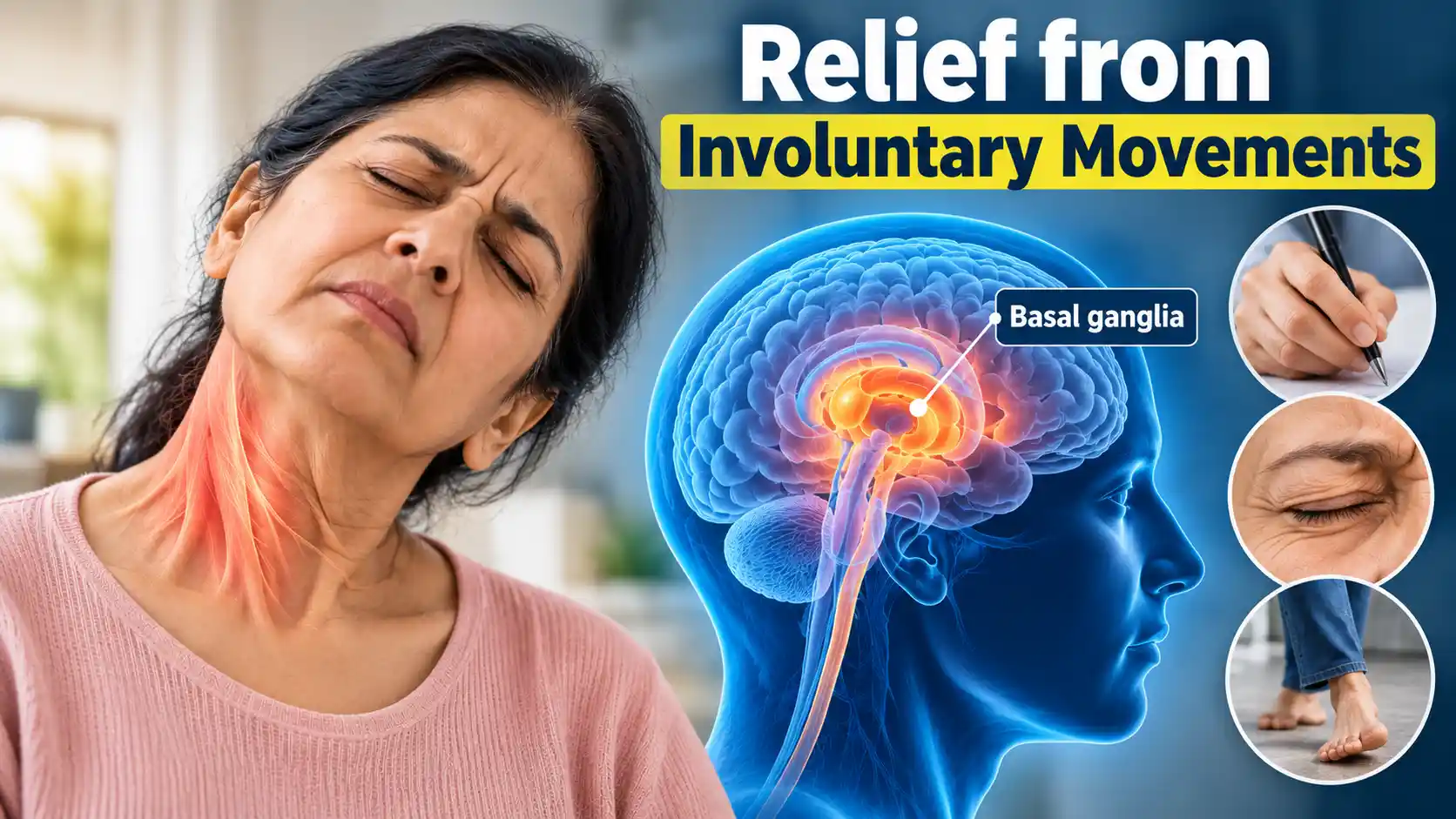
Your neck keeps pulling to one side. Your hand cramps after writing two lines. Your eyelids squeeze shut while you drive. When nobody can explain why, these moments feel confusing and even frightening.
Many of these patterns point to dystonia, a brain-based movement disorder that often goes unnamed for years. If you live in Kurali, Morinda or nearby villages and need dystonia treatment near Kurali, expert care is a short drive away in Mohali. Below, I explain the signs, the tests, and the treatments that genuinely help.
Key Takeaways
- Dystonia causes involuntary muscle contractions because of faulty signals from the brain, not a fault in the muscles.
- Focal dystonia, which affects one body part, is about 10 times more common than generalised dystonia.
- Cervical dystonia is the most common adult-onset form, seen in about 5 per 100,000 people in a large meta-analysis.
- Botox injections are the first-line treatment for dystonia in one or two body areas and are usually repeated every three months.
- In a pooled analysis of early-onset dystonia, GPi DBS improved movement scores by about 60.6%.
- Stress, tiredness, caffeine and alcohol can make symptoms worse.
- Primary dystonia is usually lifelong, but most people control it well with the right plan from a movement disorder specialist.
What Is Dystonia?
Dystonia is a movement disorder. Muscles tighten on their own and pull the body into twisting, repeated or stuck positions. The person is not doing it on purpose, and willpower alone cannot stop it.

1. Why Do Muscles Contract Without Your Control?
The problem starts in the brain, mainly in a group of deep structures called the basal ganglia. These areas act like a traffic controller for movement. In dystonia, the controller sends mixed signals, so opposing muscles fire at the same time.
The result is a pull in one direction that you cannot easily switch off. Causes fall into a few groups:
- Primary (isolated) dystonia: no clear cause found, sometimes linked to genes
- Secondary dystonia: caused by stroke, head injury, brain infection, Wilson’s disease or certain medicines
- Drug-induced dystonia: sudden spasms after some anti-sickness or psychiatric medicines, which need urgent care
2. Early Signs of Dystonia
Early dystonia is often subtle. Many people blame posture, stress or a “catch” in the neck. Watch for these signs:
- Neck turning or tilting to one side, especially while driving or reading
- Hand cramping or curling only while writing or typing
- Frequent blinking or eyelids closing on their own
- A foot that turns inward while walking, but not while walking backward
- A voice that sounds strained or breaks mid-sentence
- Symptoms that ease when you touch your chin or face (a “sensory trick”)
Dr Jaspreet Singh Randhawa says: “The sensory trick is one of the clearest clues I look for. If lightly touching your chin straightens your neck, that points strongly towards dystonia rather than arthritis or a muscle strain. Patients are often surprised that such a small detail helps us reach the diagnosis.”
3. Common Types You Should Know
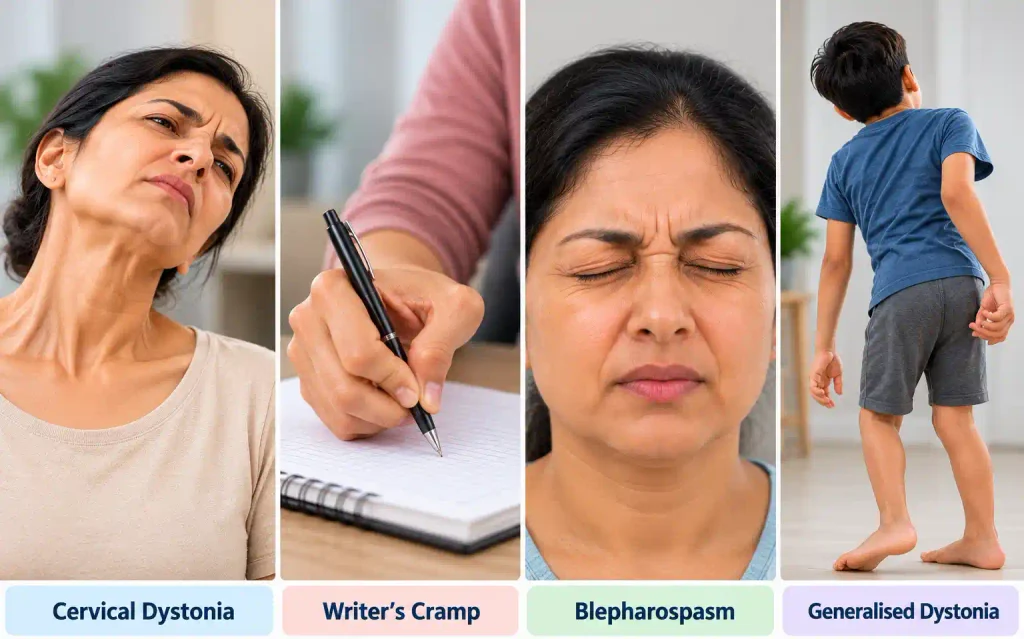
1. Cervical Dystonia
Cervical dystonia affects the neck muscles. The head may turn, tilt, jerk or pull forward or back. Most people also have neck pain, and many get headaches from the constant strain. It is the most common adult form and is often misread as cervical spondylosis.
2. Writer’s Cramp
Writer’s cramp is a task-specific focal dystonia. The hand works normally for most jobs but cramps, curls or tremors during writing. Students, clerks and shopkeepers who write all day often notice it first.
3. Blepharospasm and Generalised Dystonia
Blepharospasm causes forced eye closure and can make driving unsafe. Generalised dystonia affects the trunk and several limbs, usually starts in childhood or teenage years, and needs a more complete treatment plan.
How Is Dystonia Diagnosed?
There is no single blood test or scan that confirms dystonia. Diagnosis is clinical. A trained specialist watches how you move, sits with you while you write or walk, and checks for sensory tricks and patterns.
Tests help find a cause and rule out look-alike conditions. Depending on your age and symptoms, these may include:
- MRI brain: to look for stroke, tumour or other structural changes
- Blood tests: copper and ceruloplasmin for Wilson’s disease in younger patients, plus thyroid and metabolic checks
- EMG (electromyography): to map which muscles are overactive
- Levodopa trial: for childhood or young-onset cases, since one rare form responds dramatically to it
- Genetic testing: when dystonia starts early or runs in the family
Misdiagnosis is common. Cervical dystonia is often treated as a stiff neck or arthritis, and blepharospasm as dry eyes. A second look by an experienced neurosurgeon in Mohali can save months of the wrong treatment.
When Should You See a Movement Disorder Specialist?
Book an assessment if any of these apply:
- Abnormal pulling or twisting lasting more than a few weeks
- Neck pain that physiotherapy and painkillers have not fixed
- Hand cramps that appear only with one task
- Symptoms spreading to a new body part
- Botox or tablets that have stopped working well
Seek emergency care for sudden spasms of the jaw, tongue, eyes or neck after starting a new medicine. Also go straight to the emergency room for weakness, facial droop or slurred speech, as these may be stroke signs.
What Are the Most Effective Treatments for Dystonia?
The best treatment depends on which body parts are affected, how severe the symptoms are, and what is causing them. Most people do best with a combined plan rather than one single fix.
1. Botox for Dystonia
Botulinum toxin is the first choice for focal dystonia, such as cervical dystonia, blepharospasm and writer’s cramp. Tiny doses are injected into the overactive muscles. The toxin calms the nerve signal reaching that muscle, so the pulling eases.
- Effect starts within about 3 to 10 days
- Peak benefit comes at around 4 to 6 weeks
- Relief usually lasts close to three months, so injections are repeated
- EMG or ultrasound guidance improves accuracy in deep or small muscles
Side effects are usually mild and short-lived. They can include local soreness, slight weakness of nearby muscles, or brief swallowing difficulty after neck injections.
2. Medicines
Tablets help some people, especially when dystonia affects larger areas. Common options include trihexyphenidyl, baclofen and clonazepam. In young-onset cases, a trial of levodopa is essential, because dopa-responsive dystonia can improve almost completely.
3. Physiotherapy and Self-Care
Physiotherapy does not cure dystonia, but it supports every other treatment. A good therapist teaches stretching, posture retraining and sensory tricks. It works best alongside Botox, not as a replacement when symptoms are moderate or severe.
4. GPi DBS (Deep Brain Stimulation)
When medicines and Botox no longer give enough control, GPi DBS is the leading surgical option. Thin electrodes are placed in the globus pallidus internus, a key movement centre. A small battery under the collarbone sends gentle, adjustable pulses.
Research supports its use. In a PubMed meta-analysis, people with isolated inherited or idiopathic dystonia improved significantly after GPi DBS. Unlike Parkinson’s disease, dystonia improves gradually over weeks to months after the stimulator is switched on. You can read more on our DBS for dystonia page.
Dr Jaspreet Singh Randhawa says: “I always tell families that DBS for dystonia is a slow improvement, not an overnight switch. Most of my patients notice steady gains over three to six months as we fine-tune the settings. Patience during this phase makes a real difference to the final result.”
Comparing Your Treatment Options
| Treatment | Best suited for | How fast it works | How long it lasts | Main limits |
|---|---|---|---|---|
| Botox injections | Focal dystonia (neck, eyes, hand) | 3 to 10 days | About 3 months per dose | Needs repeat sessions |
| Oral medicines | Wider or young-onset dystonia | Days to weeks | While taken daily | Drowsiness, dry mouth, memory effects |
| Physiotherapy | All types, as support | Several weeks | Ongoing with practice | Rarely enough alone |
| GPi DBS | Severe or generalised dystonia not helped by other options | Gradual, over months | Long term, with battery checks | Brain surgery, careful selection needed |
If you want to understand outcomes in more depth, see our guide on DBS success rates.
Choosing Dystonia Treatment Near Kurali or Mohali
For families in Kurali, the hardest part is often the travel to big city hospitals for every Botox cycle and check-up. Having a specialist nearby in Mohali makes long-term care far easier to keep up. When you compare options, look for:
- A doctor with real experience in movement disorders and DBS
- EMG or ultrasound-guided Botox, not just surface injections
- Access to MRI and lab tests without long waits
- A clear follow-up schedule and a way to reach the team between visits
- Honest advice about what each treatment can and cannot do
You can learn more about Dr Jaspreet Singh Randhawa and his work in DBS and movement disorders before your visit.
1. What Happens at Your First Consultation?
The first visit is about listening and observing. You can expect:
- A detailed history of when symptoms began, what triggers them and what eases them
- A full neurological exam, often watching you write, walk or turn your head
- A review of your current medicines, as some can cause dystonia
- A decision on which tests, if any, you need
- A first treatment plan, with clear goals and timelines
Bring old reports, scans and a list of medicines. A short phone video of your symptoms at their worst is very helpful, because spasms sometimes settle in the clinic.
Dr Jaspreet Singh Randhawa says: “Many patients worry their symptoms will disappear in front of me and I won’t believe them. A 30-second video recorded at home solves that problem completely. It often tells me more than a long description.”
2. Do Stress and Daily Habits Affect Dystonia?
Yes. Dystonia often worsens with stress, poor sleep, tiredness, caffeine and alcohol. Symptoms usually ease during sleep and at rest. Simple habits help:
- Keep a regular sleep routine
- Cut down on tea, coffee and energy drinks if they trigger spasms
- Take short breaks during long writing or screen tasks
- Practise slow breathing or relaxation before stressful events
3. Life After Treatment
Most people with focal dystonia return to work, driving and family life once their Botox schedule is stable. People who undergo GPi DBS often regain walking, sitting comfort and independence they had lost. Regular follow-up keeps those gains steady over time.
Final Thought
Dystonia can make your own body feel unfamiliar. Yet it is a real, well-understood brain condition, and it is very treatable. The biggest step is getting the right diagnosis early, before months pass with the wrong treatment.
If you or a family member needs dystonia treatment near Kurali, you do not have to travel far or wait long for expert care. A clear assessment, an honest plan and steady follow-up can help you take back control of your movements and your day.
Ready to talk to a specialist? Book an appointment with Dr Jaspreet Singh Randhawa at Medisyn, Mohali.
Frequently Asked Questions
1. What are the early signs of dystonia, and when should you see a neurologist?
Early signs include a neck that pulls to one side, a hand that cramps only while writing, frequent blinking, or a foot that twists while walking. See a specialist if these last more than a few weeks or begin to spread. Get urgent help if spasms start suddenly after a new medicine.
2. Why do involuntary muscle contractions happen without conscious control?
They happen because movement control centres deep in the brain send faulty signals. Opposing muscles then contract together instead of taking turns. The muscles themselves are healthy, which is why stretching or massage alone rarely fixes the problem.
3. Can cervical dystonia cause neck pain, headaches, and abnormal head movements?
Yes. Most people with cervical dystonia have neck or shoulder pain, and many get tension-type headaches from the constant pull. The head may turn, tilt, jerk or shake, and these movements often worsen with stress or tiredness.
4. Is writer’s cramp a type of dystonia, and how is it treated?
Yes, writer’s cramp is a task-specific focal dystonia of the hand and forearm. Guided Botox injections into the overactive muscles are usually the most effective option. Pen grips, writing retraining and occupational therapy can add further benefit.
5. How is dystonia diagnosed, and which tests may be needed?
Diagnosis is based on a careful examination by an experienced specialist. MRI, blood tests for copper, EMG, a levodopa trial or genetic tests may be ordered to find the cause. The choice of tests depends on your age and how the symptoms began.
6. What are the most effective treatment options for dystonia?
Botox is the most effective option for focal dystonia, while medicines help some wider forms. GPi DBS is the leading choice for severe or generalised dystonia that has not responded to other treatments. Physiotherapy supports all of these.
7. How does Botox for dystonia work, and how long do the results last?
Botox blocks the nerve signal to the overactive muscle, so it relaxes and stops pulling. Benefit usually starts within 3 to 10 days and lasts about three months. Injections are then repeated, and doses are adjusted based on your response.
8. Can dystonia symptoms improve with medication and physiotherapy alone?
Mild dystonia and some young-onset types can improve well with tablets and physiotherapy. Dopa-responsive dystonia may almost disappear with levodopa. Moderate or severe focal dystonia usually needs Botox as well for good control.
9. When is GPi DBS recommended for patients with severe dystonia?
GPi DBS is considered when dystonia is severe, disabling, and not controlled by medicines or Botox. It works especially well in generalised and some genetic forms. A detailed assessment with MRI and a team review comes first to make sure surgery is right for you.
10. Can dystonia be cured, or can treatment only control the symptoms?
Primary dystonia is usually lifelong, so treatment aims to control symptoms rather than cure them. Some secondary forms, such as drug-induced dystonia, can settle fully once the cause is treated. With good care, most people lead active, productive lives.
11. Can stress, fatigue, and daily activities make dystonia symptoms worse?
Yes. Stress, poor sleep, fatigue, caffeine and alcohol commonly make spasms stronger. Repetitive tasks such as writing or typing can trigger task-specific dystonia, so regular breaks and good sleep habits help.
12. When should you consult a movement disorder specialist for dystonia?
Consult one when your diagnosis is unclear, symptoms keep worsening, or current treatment has stopped working. A specialist is also important before considering DBS. Early review often prevents years of ineffective treatment.
13. How do you choose the right dystonia treatment near Kurali or Mohali?
Choose a doctor with experience in movement disorders, guided Botox and DBS. Check that MRI, lab tests and regular follow-up are easy to access close to home. A clinic in Mohali saves families from Kurali long trips for every injection cycle.
14. What happens during the first consultation for dystonia treatment?
The doctor takes a detailed history, examines your movements and reviews your medicines. You may be asked to write, walk or turn your head while being observed. You leave with a plan for tests and treatment, so bring old reports and a video of your symptoms.
15. Can people with dystonia return to normal daily activities after treatment?
Most people return to work, driving and household tasks once their symptoms are controlled. Botox users often feel close to normal for most of each three-month cycle. DBS patients usually gain steady improvement in walking and independence over several months.
Specialist Evaluation Near Kurali & Kharar: Whether involuntary postures involve the neck, hand, eyelids, or trunk, explore our main surgical overview on Deep Brain Stimulation (DBS) surgery in Mohali and Chandigarh, see what happens during a pre-surgical DBS evaluation near Kurali, or compare tremor treatment options near Kurali. For appointments at Medisyn Neuro & Gynae Centre, call or WhatsApp +91 98765 40305.