A 34-year-old woman from Chandigarh had been living with cervical dystonia for six years.
Her neck pulled involuntarily to the left. She could not hold her head straight for more than a few minutes at a time. Botox injections helped at first. Then they stopped working. She tried three different medications. None gave her life back.
She came to Medisyn after reading about deep brain stimulation treatment for dystonia online at 2 in the morning.
Eight months after surgery, she drives herself to work.
Dystonia is one of the most misunderstood and underdiagnosed movement disorders. And for patients who do not respond to medication or Botox, deep brain stimulation is often the treatment that changes everything. But it is not for everyone, and not all dystonia responds equally.
What Is Dystonia and Why Is It So Difficult to Treat?
Dystonia is a neurological movement disorder characterised by involuntary, sustained muscle contractions that force the body into abnormal postures or repetitive movements. Unlike tremors, which are rhythmic oscillations, dystonia creates twisting, pulling, or holding movements that the person cannot control or stop through conscious effort.
The muscles are not the problem. The brain is.
In dystonia, the brain’s movement circuits fire abnormal signals that cause muscles to contract when they should not, or contract in the wrong sequence. This is why dystonia does not respond well to muscle relaxants or physical therapy alone. The origin of the problem is upstream, inside the brain’s basal ganglia circuitry.
Dystonia affects people of all ages. Children as young as three can develop generalised dystonia from genetic causes. Adults develop focal forms like cervical dystonia or writer’s cramp. Some cases arise after stroke or brain injury. Others have no identifiable cause at all.
“Dystonia patients suffer quietly for years before they reach a specialist. By the time many arrive, they have already tried everything else. DBS is not our first answer for them. But for the right patient, it is often the most transformative one.”
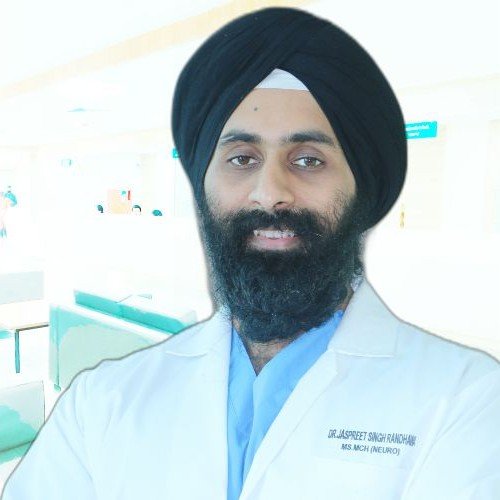
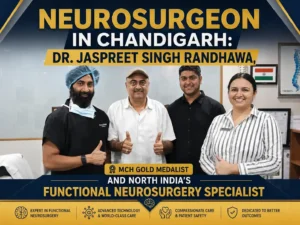
Dr. Jaspreet Singh Randhawa, MCh Neurosurgery (Gold Medalist), Medisyn Neuro Centre, Mohali
Types of Dystonia That Deep Brain Stimulation Can Treat
Deep brain stimulation treatment for dystonia does not work equally well across all types. Understanding the classification helps patients and families set realistic expectations.
Primary Dystonia (Best DBS Outcomes)
Primary dystonia, also called isolated dystonia, is the category that responds most reliably to DBS. In primary dystonia, the involuntary movements are the only neurological problem. There is no underlying brain damage or degenerative disease.
- Generalised dystonia: affects the whole body; often genetic in origin (DYT1 gene mutation); best DBS outcomes of all dystonia types
- Cervical dystonia (spasmodic torticollis): affects the neck; head pulls, twists, or tilts involuntarily; highly responsive to DBS when Botox fails
- Segmental dystonia: affects two or more adjacent body regions; good DBS response in most cases
- Meige syndrome: affects the face and jaw; involuntary blinking, grimacing, jaw clenching; DBS offers significant improvement
Tardive Dystonia (Good DBS Outcomes)
Tardive dystonia develops as a side effect of long-term use of antipsychotic or anti-nausea medications. Despite being a secondary cause, tardive dystonia responds surprisingly well to DBS, better than most other secondary dystonia types.
Secondary Dystonia (Variable Outcomes)
Secondary dystonia results from identifiable brain injury including stroke, cerebral palsy, head trauma, infection, or Wilson’s disease. Outcomes here are more variable. Patients with a structurally normal brain MRI tend to do better. Those with significant underlying brain damage may see limited benefit.
“One of the most important things I explain to families is that DBS for secondary dystonia is not the same as DBS for primary dystonia. The surgery is the same. But the brain we are working with is different, and that matters for outcomes.”
Dr. Jaspreet Singh Randhawa
How Deep Brain Stimulation Treatment for Dystonia Works
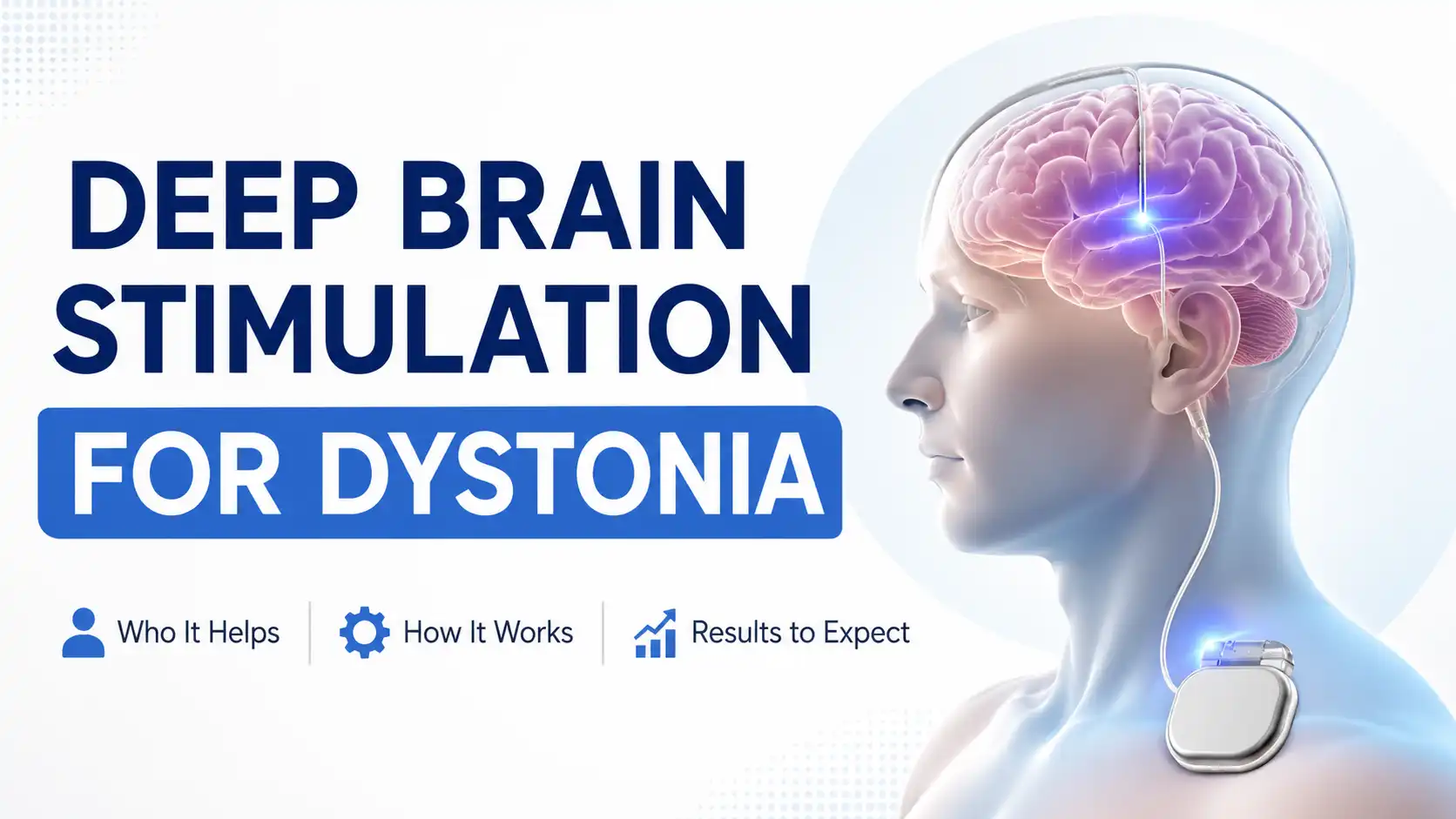
In dystonia, the globus pallidus internus (GPi) is overactive. It sends excessive inhibitory signals that disrupt normal movement. Deep brain stimulation treatment for dystonia targets this structure directly.
A thin electrode is placed into the GPi through a small hole in the skull. The electrode delivers continuous, adjustable electrical pulses that modulate the abnormal activity. Over weeks and months, the brain’s movement circuitry gradually recalibrates. Muscle contractions reduce. Posture normalises. Pain decreases.
The subthalamic nucleus (STN) is an alternative target used in some cases, particularly for cranial and cervical dystonia. Studies have shown comparable outcomes with both GPi and STN targets, with the GPi remaining the more established choice and STN showing strong results especially in cervical and craniofacial presentations.
The full system includes:
- Brain electrode (lead): implanted into the GPi or STN; delivers precise electrical pulses
- Extension wire: tunnelled under the skin from the skull to the chest
- Neurostimulator: a small battery-powered device implanted near the collarbone; controlled wirelessly by the surgeon and patient
One important distinction from DBS for Parkinson’s disease: in dystonia, improvement is slower. With Parkinson’s, patients often see tremor reduction within days of device activation. With dystonia, full benefit can take three to twelve months as the brain adapts to the new stimulation pattern. Families must understand this timeline before surgery.
What Success Rate Can Patients Expect from DBS for Dystonia?
This is the question every family asks first. The honest answer is: it depends on the type of dystonia.
On average, patients with primary or genetic dystonia experience around 50% reduction in symptoms. However, around 20% of implanted patients may have very little benefit, while some experience up to 80 to 90% reduction in symptoms and signs of dystonia.
Breaking it down by type:
- DYT1 generalised dystonia (genetic): 70 to 90% improvement in most published series; the best-responding dystonia type
- Non-DYT1 primary dystonia: 60 to 75% improvement on average; still highly meaningful for daily function
- Cervical dystonia (Botox-resistant): 50 to 70% improvement; comparable to long-term Botox in responders but sustained without repeated injections
- Tardive dystonia: 60 to 80% improvement; one of the better-responding secondary types
- Secondary dystonia (stroke, CP): 20 to 40% improvement; benefit is real but more modest
Research confirms that patients with dystonia who underwent DBS reported an easier, more satisfying life with greater confidence in the majority of cases. Functional outcomes including the ability to walk, eat independently, write, and maintain social relationships improved significantly in well-selected patients.
According to research published in PubMed reviewing GPi-DBS for dystonia, pallidal stimulation is now an established treatment for medically refractory dystonia, with meaningful long-term benefit across multiple patient populations. The Frontiers in Human Neuroscience systematic review on DBS targets for dystonia further confirms that GPi and STN targets show comparable efficacy in most dystonia subtypes.
DBS for Dystonia vs Botox Injections: Which Is Right for You?
Most dystonia patients who reach a DBS consultation have already been through Botox injections. The two treatments are not competitors. They serve different stages and severities of the condition.
| Factor | Botox Injections | Deep Brain Stimulation (DBS) |
|---|---|---|
| Best suited for | Focal dystonia; mild to moderate severity | Generalised; severe; Botox-resistant cases |
| Duration of benefit | 2 to 3 months per injection cycle | Long-term; device adjustable over years |
| Body coverage | One region per treatment session | Whole body simultaneously via one device |
| Adjustability | Fixed dose; cannot fine-tune once injected | Reprogrammable anytime by the surgeon |
| Procedure type | Clinic injection; no surgery required | Surgical; performed in hospital under anaesthesia |
| Response timeline | Days to weeks | Weeks to months; full benefit by 6 to 12 months |
| Suitable if generalised | Rarely; impractical for whole-body dystonia | Yes; one device treats the full body |
International guidelines from the European Federation of Neurological Societies recommend DBS for dystonia after failure of Botox and oral medications. Deep brain stimulation treatment for dystonia is not a replacement for Botox in early-stage focal cases. It is the next step when those treatments no longer provide adequate relief.
“I always tell patients that Botox and DBS are teammates, not rivals. Botox is the first line for focal dystonia and it works well for many years in most patients. DBS becomes relevant when the disease has spread, when Botox has stopped working, or when the disability has become too significant to manage with injections alone.”
Dr. Jaspreet Singh Randhawa
Who Is the Right Candidate for DBS Treatment for Dystonia?
Patient selection is the single most important factor in DBS outcomes for dystonia. A well-selected patient at a specialist centre consistently achieves far better results than a poorly selected patient at even the most prestigious hospital.
Good candidates for deep brain stimulation treatment for dystonia typically share these characteristics:
- Confirmed diagnosis of primary or tardive dystonia by a movement disorder neurologist
- Significant functional disability that limits daily activities, work, or quality of life
- Inadequate response to at least two oral medications tried at appropriate doses
- For focal and cervical dystonia: failed Botox therapy or developed resistance to it
- No significant cognitive impairment or uncontrolled psychiatric illness
- Structurally normal or near-normal brain MRI (especially important for secondary dystonia cases)
- Medically fit to undergo surgery under anaesthesia
Patients who are less likely to benefit include those with advanced secondary dystonia caused by extensive brain structural damage, severe dementia, or active uncontrolled psychosis. A thorough pre-surgical evaluation at a functional neurosurgery centre is the only way to confirm candidacy accurately.
What Patients Experience After DBS Surgery for Dystonia
Recovery from DBS surgery for dystonia follows a different timeline than Parkinson’s disease. The brain rewiring that produces the benefit takes time.
Weeks 1 to 4: Recovery from surgery. The device is activated two to four weeks after implantation. No major symptom change is expected yet. This is normal.
Months 2 to 4: Gradual improvement begins. Muscle contractions may start reducing. Posture begins to improve. Programming sessions fine-tune stimulation settings every few weeks.
Months 4 to 8: The period of most significant improvement for most patients. Functional gains accelerate. Many patients reduce or stop oral medications during this phase.
Beyond 12 months: Stable phase. The brain has adapted fully to stimulation. Most patients reach their maximum benefit by this point. Annual reviews maintain the device and adjust settings as needed.
Patients who have undergone deep brain stimulation treatment for dystonia at Medisyn consistently report:
- Meaningful reduction in involuntary muscle contractions and painful postures
- Improved ability to walk, eat, write, and speak in cases where these were affected
- Significant reduction in pain associated with sustained abnormal posture
- Reduced or eliminated dependence on Botox injections in cervical and segmental cases
- Return to social, professional, and family life that had been disrupted by the condition
“One patient came to me unable to feed herself. Generalised dystonia from childhood. She had never had a single meal without help. A year after DBS surgery, she called me to say she had cooked lunch for her family for the first time. That call is why I do this work.”
Dr. Jaspreet Singh Randhawa
Deep Brain Stimulation for Dystonia at Medisyn Neuro Centre, Mohali
Deep brain stimulation treatment for dystonia requires a surgeon with specific expertise in functional neurosurgery, not just general neurosurgery. The GPi target in dystonia surgery demands precision within two millimetres. Electrode placement accuracy is the single greatest predictor of outcome.
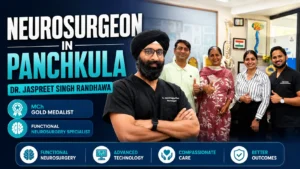
Dr. Jaspreet Singh Randhawa holds an MCh in Neurosurgery from Armed Forces Medical College, Pune, where he was awarded the Gold Medal. He has trained and worked at AIIMS New Delhi, Maulana Azad Medical College, and Fortis Hospital Delhi, and is a Lifetime Member of the Endoscopic Spine Foundation of India. His specialisation spans the full range of functional neurosurgery procedures including DBS surgery for Parkinson’s disease, essential tremor, dystonia, and drug-resistant epilepsy.
Patients travel to Medisyn from across Punjab, Haryana, Himachal Pradesh, Jammu and Kashmir, and internationally from Canada, the UK, the USA, Africa, and the Middle East specifically for neuromodulation procedures.
The cost of deep brain stimulation surgery at Medisyn ranges from Rs. 13 lakh to Rs. 27 lakh depending on device type; unilateral or bilateral implantation; and post-operative care requirements. This represents a fraction of the cost for the same procedure in the USA or Europe, with equivalent surgical expertise and device quality.
10 Questions Dystonia Patients Ask Before Choosing DBS
1. Is deep brain stimulation for dystonia safe?
DBS is an established, FDA-approved treatment for dystonia since 2003. Serious complications including brain bleeding or infection occur in fewer than 1 to 2% of cases at experienced centres. Temporary side effects during the programming phase are common but usually resolved by adjusting stimulation settings.
2. How long does it take to see results after DBS for dystonia?
Unlike Parkinson’s where improvement is often immediate, dystonia improvement is gradual. Most patients see meaningful change between three and six months. Full benefit typically appears by nine to twelve months post-surgery. Patience during the programming phase is essential.
3. Can children with dystonia have DBS surgery?
Yes. Children with severe primary genetic dystonia, particularly DYT1 generalised dystonia, are among the best DBS responders of any patient group. DBS has been performed safely in children as young as six to eight years old at specialist centres globally. Each case requires careful individual evaluation.
4. Will I still need Botox after DBS for dystonia?
Many patients with cervical or segmental dystonia are able to reduce or stop Botox injections after DBS surgery. Some continue occasional low-dose injections for residual symptoms in specific muscle groups. The goal of DBS is not necessarily to eliminate Botox entirely but to significantly improve overall function.
5. What is the difference between DBS for Parkinson’s and DBS for dystonia?
The surgery and device system are similar. The key differences are the brain target (GPi for dystonia vs STN for Parkinson’s in most cases); the timeline of benefit (gradual over months for dystonia vs rapid for Parkinson’s); and the underlying condition being treated. The programming approach also differs significantly.
6. Does secondary dystonia from stroke or cerebral palsy respond to DBS?
Results in secondary dystonia are more variable than in primary dystonia. Some patients with stroke-related dystonia or cerebral palsy see meaningful improvement, especially those with a structurally near-normal MRI. Others see limited benefit. A detailed pre-surgical evaluation is essential before committing to surgery in secondary dystonia cases.
7. Is the DBS device permanent? Can it be removed?
DBS is reversible in principle. The device can be switched off or removed. In practice, most patients choose to keep the device long-term as the benefits are sustained. Battery replacement is required every three to five years for non-rechargeable devices; rechargeable devices last up to nine years before battery exchange.
8. What happens if dystonia worsens after DBS?
The neurostimulator can be reprogrammed as the condition evolves. If symptoms change over time, stimulation parameters are adjusted at follow-up visits. This adaptability is one of the major advantages of DBS over other surgical options like pallidotomy, which is a permanent and non-adjustable procedure.
9. Is DBS for dystonia available in Mohali or Chandigarh?
Yes. Dr. Jaspreet Singh Randhawa at Medisyn Neuro Centre, Airport Road, Mohali, performs DBS surgery for all major dystonia types including generalised, cervical, segmental, tardive, and Meige syndrome. Patients from across North India and internationally are evaluated and treated here.
10. How do I know if I am a candidate for DBS treatment for dystonia?
The only way to know is through a specialist evaluation. A movement disorder neurologist and functional neurosurgeon together review your diagnosis, imaging, medication history, and functional status. This evaluation typically takes one to two outpatient visits. You can book a consultation at Medisyn to begin the assessment process with Dr. Randhawa’s team.