
A patient from Melbourne once told me, “I’m not looking for cheaper surgery. I’m looking for a clear path.”
She had waited months to see a movement disorder specialist. Her private quote had a gap she could not cover, and her tremor was getting worse.
That is the real reason most families look into DBS surgery in India from Australia. It is rarely about price alone. It is about access, timing, and knowing exactly what happens next.
I review records from Australian families every month. Sometimes the honest answer is that care at home is the better choice. Sometimes travel makes good sense. Either way, you deserve facts before you book a flight.
Key Takeaways
- Parkinson’s is common and growing in Australia. More than 150,000 Australians live with Parkinson’s, and about 50 people are diagnosed every day.
- DBS is costly in Australia. The Medical Services Advisory Committee (MSAC) estimated the public/private DBS cost per patient at about AUD 91,250 for essential tremor. Device and hospital costs have risen significantly since then.
- Medicare does not travel with you. Medicare benefits are only paid for services provided in Australia, so surgery in India is fully self-funded.
- Cost in India is predictable. Bilateral DBS at Medisyn costs Rs.13 to 27 lakh all-inclusive, roughly AUD 23,000 to 47,000 at recent exchange rates. Pre-surgical tests are extra (Medisyn published cost breakdown, 2026).
- Tremor responds best. In a study following Parkinson’s patients for up to 13 years, tremor showed the strongest and most lasting benefit, at about 72.5%.
- DBS treats symptoms, not the disease. It improves movement but does not stop Parkinson’s from progressing.
- Plan for 3 to 4 weeks in India, and confirm a programming clinic in Australia before you travel.
Why Australians Look at Deep Brain Stimulation Overseas
Australia has excellent DBS centres. So the question is not whether care is good at home. It is whether you can reach it in time and afford the gap.
These are the reasons I hear most often:
- The hidden wait. Public surgical waiting lists only start counting once you are booked. The wait to see a neurologist, then a DBS team, often comes first and can take months.
- The private gap. Private DBS is partly covered by Medicare and health funds, but patients without strong hospital cover can face large out-of-pocket costs.
- Distance. DBS programs sit mainly in capital cities, which is hard for regional families.
- Family links. Many Australians of Indian origin have relatives in Punjab who can support recovery.
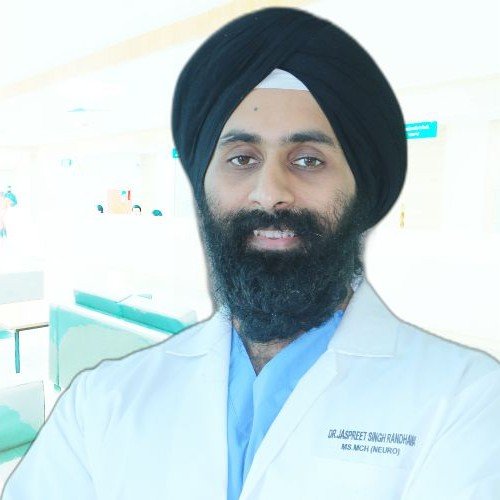
“If you have good private cover and a DBS team near you, staying in Australia is often the simplest choice. Travel makes sense when the path at home is blocked by time, cost or distance. My job is to help you see which situation you are in.” Dr Jaspreet Singh Randhawa
Is DBS Surgery in India from Australia Right for You?
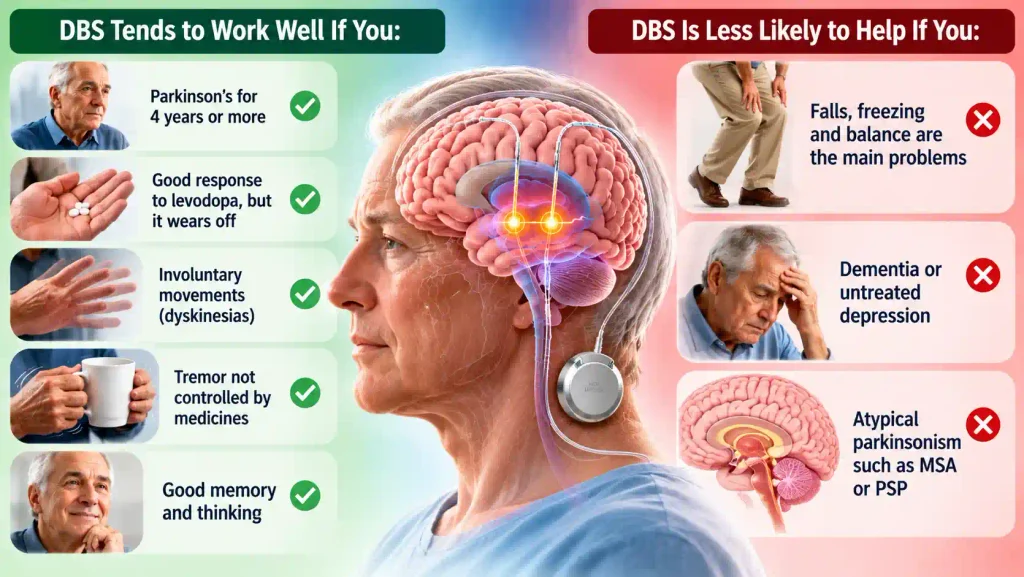
Before any travel plan, the medical question comes first. DBS helps some people a great deal and others very little.
1. DBS tends to work well if you:
- Have had Parkinson’s for about four years or more
- Still get a clear benefit from levodopa, but it wears off between doses
- Have involuntary movements (dyskinesias) from medication
- Have a tremor that medicines do not control
- Have good memory and thinking
2. DBS is less likely to help if:
- Falls, freezing and balance are your main problems, even when medicine is working
- You have dementia or untreated depression
- You have an atypical parkinsonism, such as MSA or PSP
Our page on Parkinson’s symptoms and DBS explains which symptoms usually improve and which do not.
Cost Comparison: Australia vs India
Cost is only one part of the decision. The table sets it beside timing, cover and follow-up.
| Factor | Australia (public) | Australia (private) | India (Medisyn, Mohali) |
|---|---|---|---|
| Cost to you | Usually no charge as a public patient | Gap varies widely with your fund and surgeon | Rs.13 to 27 lakh (about AUD 23,000 to 47,000) |
| Medicare and health fund | Covered | Partly covered | Not covered |
| Typical timing | Specialist and list waits can add up to months | Faster, depends on surgeon | 4 to 8 weeks after records are reviewed |
| Devices | Medtronic, Abbott, Boston Scientific | Same | Medtronic, Abbott |
| Extra costs | Travel to a capital city | Travel to a capital city | Flights, 3 to 4 weeks of stay, a companion |
| Programming | Local clinic | Local clinic | First sessions in India, then at home |
When families add up private DBS costs in Australia, they often forget battery replacements. A non-rechargeable battery may need replacing every 3 to 5 years, while a rechargeable one can last much longer. Our DBS cost breakdown explains each device option.
Medicare, Health Funds and Travel Insurance
This is where many Australian families get caught out. Check all three before you commit.
- Medicare: Benefits are only payable for services provided in Australia. Surgery in India is not reimbursed.
- Private health insurance: Australian hospital cover generally applies only to treatment in Australia. Ask your fund in writing.
- Travel insurance: Most policies exclude planned medical treatment overseas and its complications. Look for a policy that states clearly what it covers for a pre-planned procedure.
The good news: once you are home, follow-up visits with your Australian neurologist are covered by Medicare in the usual way.
How the Process Works, Step by Step
Medical travel from Australia to India works best when the hard decisions are made before you leave home.
Step 1: Remote Review
You send your reports. I review them, and we talk on a video call. If DBS looks right, you receive a written plan and estimate. If not, you hear that before spending money on flights.
Step 2: Travel and Evaluation (Week 1)
Direct flights run from Sydney and Melbourne to Delhi, with a short onward connection to Chandigarh, about 12 km from our centre. The first week covers:
- Consultation and full neurological exam
- Levodopa challenge test, off and on medication
- DBS-planning MRI
- Memory, mood and thinking assessment
- Heart and anaesthesia clearance
Step 3: Surgery (Week 2)
- Stage 1: Electrodes are placed using precise MRI and CT planning
- Stage 2: The battery is placed under the skin below the collarbone
- A short hospital stay follows each stage
Step 4: Activation and Recovery (Weeks 3 to 4)
- The device is switched on and first settings are tested
- Medicines are reduced as stimulation takes effect
- Wounds are checked and stitches removed
- You receive a device ID card and a full handover report for your Australian team
Our international patient desk helps with visa letters, airport pickup and accommodation.
Records to Send Before You Book
Good records can shorten the process by weeks. Please gather:
- Neurologist letters confirming your diagnosis and its duration
- Your current medication list with doses and timings
- Any recent brain MRI, with images and report
- A short phone video of your “on” and “off” states
- Recent blood tests, ECG and other medical conditions
- Details of blood thinners, which need a safe plan before surgery
Safety, Risks and Realistic Results
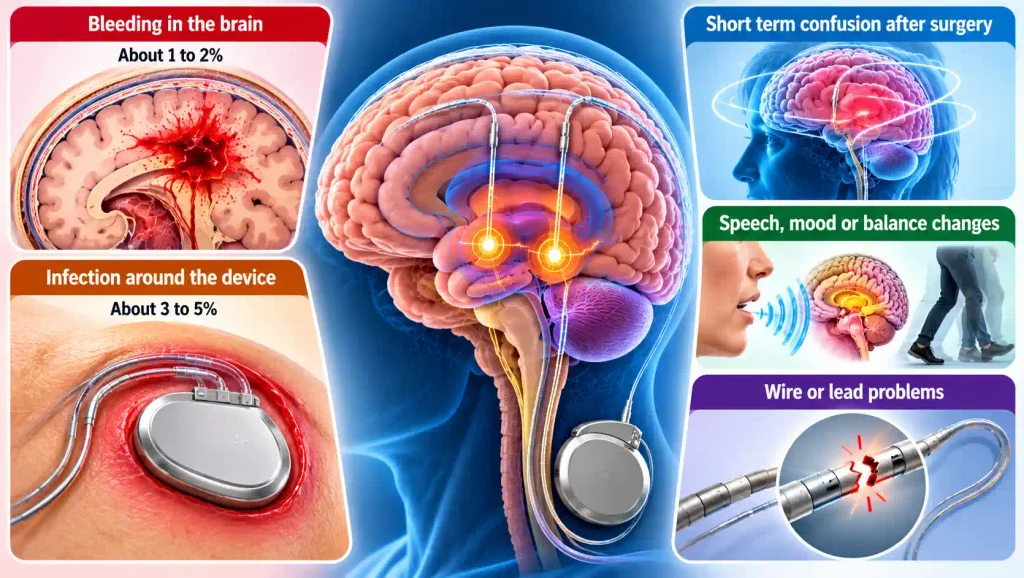
DBS is a well-established operation, but it is still brain surgery. You deserve clear numbers.
Possible complications include:
- Bleeding in the brain, in about 1 to 2% of patients in published series
- Infection around the device, in about 3 to 5%, sometimes needing removal
- Short-term confusion after surgery, more common in older patients
- Speech, mood or balance changes from stimulation, often improved by reprogramming
- Wire or lead problems that may need a minor repeat procedure
Cleveland Clinic describes a similar range of risks. For outcomes by condition, see our page on DBS success rates.
“A long-haul flight is not the time to find out a wound is unhappy. I check every incision myself before I clear a patient to fly. If something needs a few more days, we take those days.” Dr Jaspreet Singh Randhawa
Flying Home and Follow-Up in Australia
Most patients can fly about 7 to 14 days after the final stage. On a long flight, walk the aisle, drink water and wear compression socks if advised. Show your device ID card at security and ask for a hand search.
Programming is where long-term results are made. Settings are adjusted over 3 to 12 months, then checked once or twice a year.
Before you leave Australia, confirm:
- A neurologist or DBS clinic at home has agreed to manage your device
- That clinic supports your device brand and has its programmer
- You know the MRI safety rules for your system
- You know the warning signs that need urgent care: fever, wound redness or discharge, new weakness, severe headache or confusion
“The surgery takes a morning. The programming takes months. I will not book an international patient until we know who will adjust the device at home, because that is what decides how well you do over the years.” Dr Jaspreet Singh Randhawa
How to Choose the Right Surgeon for International Neurosurgery
Aggregator sites list hospitals and prices, but rarely tell you what to check. Use this list:
- DBS-specific experience, not only general neurosurgery
- A full team: neurology, neuropsychology and a dedicated programming specialist
- A written estimate covering the device, both stages and first programming
- Honest candidacy advice, including telling you when not to operate
- A clear handover plan for your Australian doctors
- Direct access to the surgeon before you travel, not only a sales coordinator
You can read more about Dr Randhawa’s background in DBS and functional neurosurgery.
Final Thoughts
Parkinson’s treatment abroad is a personal decision. It works best when three things line up: you are a strong candidate, the surgical team has real DBS experience, and your follow-up at home is secure.
If those pieces fit, DBS surgery in India from Australia can offer world-standard care within weeks. Send your reports for a no-obligation review, and you will get a straight answer about whether DBS is likely to help you.
Frequently Asked Questions
1. Can Australian patients travel to India for deep brain stimulation (DBS) surgery?
Yes. Australian patients can travel to India on a medical visa for DBS surgery. The first step is a remote review of your reports, so we can confirm you are a good candidate before you plan travel.
2. How much does DBS surgery cost in India for Australian patients compared with Australia?
At Medisyn, bilateral DBS costs Rs.13 to 27 lakh, roughly AUD 23,000 to 47,000, depending on the device. In Australia, public patients usually pay nothing, while private patients face gaps that depend on their fund and surgeon, so compare your real out-of-pocket figure, not the total bill.
3. Which hospitals in India offer DBS surgery for international patients, and how can Australians choose the right hospital?
DBS is offered at several centres, including AIIMS New Delhi, SCTIMST Trivandrum, Jaslok Mumbai, Medanta Gurugram and Medisyn Mohali. Choose based on the surgeon’s DBS experience, a full multidisciplinary team, a written all-inclusive estimate and a clear plan for follow-up in Australia.
4. Who is eligible for DBS surgery, and is it suitable for patients with advanced Parkinson’s disease?
The best candidates still respond to levodopa but have wearing-off or dyskinesias, with good memory and thinking. In advanced Parkinson’s, DBS can still help if levodopa works, but it does little for falls, freezing or dementia that do not respond to medicine.
5. How can Australian patients arrange DBS surgery in India, from the initial consultation to treatment?
Start by sending your reports to our international patient desk for a remote review and video consultation. If DBS is suitable, we send a written estimate, a visa invitation letter and confirmed dates, then help arrange airport pickup and accommodation.
6. How long must Australian patients stay in India for DBS surgery, recovery, and initial device programming?
Plan for 3 to 4 weeks in total. This covers evaluation, both surgical stages, device activation, wound checks and early programming.
7. Is DBS surgery in India safe for Australian patients, and what should they check before choosing a neurosurgeon?
At experienced centres, DBS in India uses the same devices and protocols as Australia. Check the surgeon’s DBS case volume, the team’s programming support, infection control and how the centre hands over care to your doctors at home.
8. What is the success rate of DBS surgery, and how much improvement can patients realistically expect?
In well-selected Parkinson’s patients, motor scores often improve by 40 to 60%, and medicine doses frequently fall. Tremor responds best, while balance, speech and memory improve much less.
9. When can patients safely fly back to Australia after DBS surgery in India?
Most patients can fly 7 to 14 days after the final stage, once the surgeon has checked the wounds. On the long flight, keep moving, stay hydrated and carry your device ID card.
10. Can Australian neurologists adjust DBS settings after a patient has surgery in India?
Yes, as long as the clinic supports your device brand and has its programmer. We send a full report with your settings, and we agree on the device brand with you before surgery so follow-up at home is smooth.
11. What medical reports, brain scans, and medication records are required before travelling to India for DBS surgery?
Send neurologist letters, your medication list with timings, any recent brain MRI and recent blood tests. A short video of your “on” and “off” states helps us judge suitability before you travel.
12. Does Australian Medicare or private health insurance cover DBS surgery performed in India?
No. Medicare pays only for services provided in Australia, and Australian hospital cover generally does not apply overseas. Follow-up care with your neurologist after you return is covered in the usual way.
13. What are the possible complications of DBS surgery, and how are they managed after patients return to Australia?
The main risks are brain bleeding in about 1 to 2% and device infection in about 3 to 5%. If a problem appears at home, go to your local emergency department with your device card and our report, and we will share imaging and settings with your doctors.
14. Can DBS surgery reduce tremors, stiffness, involuntary movements, and the need for Parkinson’s medication?
Yes, these are the symptoms DBS helps most. Many patients see less tremor, stiffness and dyskinesia, and many can lower their medication dose.
15. What should Australian patients compare before choosing DBS surgery in India instead of treatment in Australia?
Compare your real out-of-pocket cost, the true wait including specialist appointments, and the surgeon’s DBS experience. Also confirm who will programme your device at home, because that matters as much as the surgery itself.
Planning Your Travel from Melbourne, Sydney, Brisbane or Perth: Review our surgical service overview for Deep Brain Stimulation surgery at Medisyn Mohali, compare itemised DBS surgery costs in India vs Canada and Australia, check Australian passport e-Medical visa requirements for DBS surgery in India, and read how post-operative DBS programming is handed over to your neurologist back in Australia. You can also reach our International Desk directly on WhatsApp at +91 98765 40305.