
Most families dealing with Parkinson’s disease in India spend years managing the condition with medications before they ever hear that a surgical option exists. By the time they walk into a neurosurgeon’s clinic in Mohali or Chandigarh, the disease has often progressed further than it needed to. The gap is not in available treatment. It is in awareness. Parkinson’s disease treatment in Mohali today includes one of the most effective neurological interventions in modern medicine, deep brain stimulation, but few patients and families know when or why to consider it.
This article covers what Parkinson’s disease actually looks like in its earliest stages, how it progresses, what the warning signs are that families commonly dismiss, how treatment evolves as the disease advances, and at what point a conversation about Deep Brain Stimulation surgery becomes the right clinical decision. If you or someone close to you is living with Parkinson’s in the Mohali, Kharar, or Chandigarh area, this is the information that matters most.
What Is Happening Inside the Brain When Parkinson’s Begins
Parkinson’s disease is a progressive neurological disorder that develops when the brain’s dopamine-producing cells, located in a region called the substantia nigra, begin to die off gradually. Dopamine is the chemical messenger that allows the brain to send precise movement instructions to the rest of the body. As these cells are lost, movement becomes increasingly difficult to initiate, control, and sustain.
This process does not happen overnight. Research shows that a person can lose up to 60 to 80 percent of these dopamine-producing cells before the classic motor symptoms become obvious enough to prompt a medical visit. This is why the prodromal phase, the period before a formal diagnosis, can last anywhere from five to over ten years. During this window, non-motor symptoms quietly appear and are almost always attributed to something else entirely.
According to a study published in PubMed, nearly 98.8 percent of Parkinson’s patients reported experiencing prodromal symptoms for an average of over 10 years before their diagnosis. These were real, noticeable changes that did not get connected to Parkinson’s until it was formally identified later.
The Early Signs of Parkinson’s Disease That Patients in Punjab Often Miss
In clinical practice, the gap between when Parkinson’s symptoms first appear and when a patient finally sees a movement disorder specialist or neurosurgeon is often several years. Part of this is because early Parkinson’s rarely announces itself with a dramatic tremor. The symptoms in the early phase are subtle, intermittent, and easy to explain away as aging, stress, or an unrelated health issue.
These are the signals that deserve attention:
- Resting tremor in one hand or finger: A fine, rhythmic tremor that appears when the hand is at rest and reduces or disappears when the person reaches out to pick something up. Many families notice this but attribute it to tiredness or anxiety for months before seeking evaluation.
- Micrographia (shrinking handwriting): Handwriting that gradually becomes smaller, more cramped, and trails off toward the end of a sentence. This is one of the most specific early motor signs and reflects the brain’s increasing difficulty automating fine motor control.
- Loss of smell without a sinus cause: A sudden or gradual reduction in the ability to detect smells is well documented as an early non-motor sign of Parkinson’s, sometimes appearing a decade or more before movement symptoms. In Indian households, where food aroma is embedded in daily life, this change is often noticed by family members before the patient acknowledges it.
- Sleep disturbances, particularly REM sleep behaviour disorder: Acting out vivid dreams, shouting, or physically moving during sleep is a recognised pre-motor symptom of Parkinson’s. Many patients and families think this is simply age-related sleep disruption.
- Reduced arm swing on one side while walking: One arm no longer swings naturally when the person walks. This asymmetry in gait is clinically significant and often precedes a formal tremor by months to years.
- Facial masking: The face gradually loses its natural expressiveness. Reduced blinking, a fixed or blank expression, and a quieter voice are changes that family members may interpret as depression or withdrawal.
- Constipation without a clear dietary cause: Disruption to the autonomic nervous system is common in early Parkinson’s. Persistent constipation that appears alongside other non-motor symptoms deserves neurological evaluation, not just dietary advice.
- Stiffness in the shoulder or hip: Pain and rigidity in a shoulder or hip that does not resolve with physiotherapy or orthopaedic treatment should prompt a neurological review, particularly if it is asymmetric.
A research study from India published in NCBI found that non-motor symptoms were present in nearly all Parkinson’s patients studied, and were frequently underdiagnosed in the Indian clinical setting. Addressing this awareness gap is one of the most important things a neurologist or neurosurgeon can do for patients in the Mohali and Chandigarh region.
How Parkinson’s Disease Progresses: Understanding the Five Stages
Parkinson’s disease is most commonly described using the Hoehn and Yahr scale, which maps disease progression across five stages. Understanding this staging helps patients and families know what to expect and when to escalate treatment discussions.
| Stage | Key Features | Typical Impact on Daily Life | Treatment Focus |
|---|---|---|---|
| Stage 1 | Mild symptoms on one side of body only | Minimal. Often dismissed as normal aging | Medication initiated, lifestyle adjustment |
| Stage 2 | Symptoms on both sides, balance mostly intact | Slowness and stiffness affect daily tasks | Medication optimisation |
| Stage 3 | Balance affected, falls possible | Independent but with increasing limitations | Medication adjustments, DBS evaluation begins |
| Stage 4 | Significant disability, assistance required | Cannot live independently | DBS surgery often strongly indicated |
| Stage 5 | Wheelchair or bed-bound | Full-time care needed | Palliative care, supportive management |
The important clinical insight here is that Stage 3 is often the window of opportunity for deep brain stimulation to deliver the most meaningful quality-of-life improvement. Waiting until Stage 4 or 5, which is unfortunately the pattern in many Indian families who view brain surgery as a last resort, significantly limits what the surgery can achieve.
How Parkinson’s Disease Is Treated: From Medication to Advanced Interventions
Parkinson’s disease treatment in Mohali, as everywhere, follows a structured progression based on how the disease responds to intervention over time.
Medication: The Starting Point for Every Patient
The cornerstone of early to mid-stage Parkinson’s treatment is levodopa, usually combined with carbidopa to make it more effective and reduce side effects. Levodopa works by being converted into dopamine in the brain, temporarily replacing what the substantia nigra can no longer produce. In the early years, this medication can provide excellent symptom control and allow patients to live near-normal daily lives.
Alongside levodopa, neurologists may prescribe dopamine agonists, MAO-B inhibitors, and COMT inhibitors depending on the patient’s age, symptom profile, and how the disease is evolving. The goal of medication management is to maintain adequate dopamine levels throughout the day without causing excessive peaks that trigger involuntary movements called dyskinesias.
The problem is that levodopa’s effectiveness changes over time. As more dopamine cells are lost, the brain loses its capacity to store dopamine between doses. Patients begin to experience what is called the wearing-off effect, where symptoms return before the next dose is due. Eventually, motor fluctuations become unpredictable, and the patient cycles between periods of good mobility (on time) and sudden freezing or tremor (off time). This is the clinical signal that medication alone is approaching its ceiling.
When Medication Starts to Fail: Recognising the Right Moment
This is where the conversation about Parkinson’s disease treatment in Mohali needs to expand beyond pills. A patient or family should bring up the following signs with their neurologist or neurosurgeon immediately:
- Medication works, but the effect lasts only two to three hours instead of four to five.
- Involuntary writhing movements (dyskinesias) appear during peak medication times.
- Morning off periods, when symptoms are worst before the first dose kicks in, are becoming longer or more severe.
- The patient is taking multiple doses throughout the day with unpredictable results.
- Quality of life is declining despite medication compliance and regular dose adjustments.
These are not signs of treatment failure. They are signs that the treatment strategy needs to evolve. This is exactly the clinical moment where DBS surgery delivers its most transformative outcomes.
Deep Brain Stimulation for Parkinson’s Disease: What It Is and How It Works
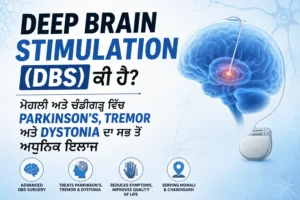
Deep Brain Stimulation is a surgical procedure in which thin electrodes are precisely placed into specific regions of the brain that control movement. The most common target in Parkinson’s is the subthalamic nucleus (STN). These electrodes are connected by a fine wire to a small pulse generator, similar to a pacemaker, which is implanted just below the collarbone under the skin.
The device delivers continuous, controlled electrical pulses that regulate the abnormal brain signals responsible for tremor, rigidity, and slowness of movement. Unlike older surgical approaches that destroyed brain tissue permanently, DBS is fully adjustable. A neurologist can modify the stimulation settings non-invasively to optimise symptom control as the patient’s condition evolves over time.
DBS does not cure Parkinson’s disease and does not stop its progression. What it does is provide consistent symptom control that medication alone can no longer deliver. According to the Parkinson’s Foundation, DBS can significantly improve tremor, stiffness, and slowness, while also reducing the motor fluctuations and dyskinesias that make daily life unpredictable for patients in the mid to advanced stages of the disease.
For many patients, the result is a substantial reduction in medication dosage, more stable on time throughout the day, and a return to daily activities that motor fluctuations had taken away, including writing, eating without assistance, walking without fear of freezing, and sleeping more comfortably.
Who Is a Good Candidate for DBS Surgery in Mohali
Patient selection is perhaps the most important factor in DBS outcomes. Proper selection significantly raises the chance of a meaningful, lasting benefit from the procedure. A thorough evaluation at a qualified neurosurgical centre is the only way to determine candidacy accurately.
In general, good candidates for DBS surgery include patients who:
- Have been diagnosed with idiopathic Parkinson’s disease for at least four years.
- Previously responded well to levodopa, even if that response is now inconsistent or short-lived.
- Experience significant motor fluctuations, wearing-off episodes, or disabling dyskinesias that cannot be adequately controlled by adjusting medications.
- Have tremor that significantly interferes with daily activities, even if it does not fully respond to levodopa.
- Are in reasonable general health and do not have significant dementia or active psychiatric illness.
- Have a stable support system at home, as post-operative programming and follow-up require regular attendance over several months.
Patients who may not be suitable include those with atypical Parkinsonism (conditions that mimic Parkinson’s but have a different underlying cause), significant cognitive decline or dementia, severe depression or anxiety that is not being treated, or symptoms that are primarily related to balance and freezing of gait, which respond less predictably to DBS.
“DBS should not be thought of as a last resort. The concept of a window of opportunity is important: the surgery delivers far more when the patient is still able to functionally benefit from restored movement control. Waiting too long closes that window.” — International consensus position, published in npj Parkinson’s Disease, 2026.
This is one of the most important points for families in Punjab and across northern India to internalise. Cultural hesitation around brain surgery leads many families to delay evaluation until the patient is in advanced disease. By that stage, the neurological substrate the surgery relies on is often too compromised for optimal results.
DBS Surgery vs Medication Alone: A Direct Comparison
| Factor | Medication Alone (Long-Term) | Deep Brain Stimulation |
|---|---|---|
| Symptom consistency | Fluctuates with each dose cycle | Continuous, stable control |
| Motor fluctuations | Increases over time | Significantly reduced |
| Dyskinesias | Worsens as doses increase | Often improved after surgery |
| Medication load | Escalates over years | Often reduced post-surgery |
| Adjustability | Limited by side effect ceiling | Fully adjustable via programming |
| Tremor control | Often inadequate in advanced stages | Highly effective in most patients |
| Quality of life impact | Declines progressively | Significantly improved in good candidates |
| Non-motor symptoms | Not well controlled by medication | Not a primary target of DBS |
Why Timing of DBS Surgery Matters More Than Most Families Realise
One of the most consequential misunderstandings around Parkinson’s disease treatment is the belief that DBS should only be considered after all medication options have been completely exhausted. This is clinically incorrect and it costs patients years of quality life they could have had.
A major clinical trial called EARLYSTIM compared patients who received DBS surgery approximately 7.5 years after diagnosis with those continuing on best medical therapy. The group that had DBS showed significantly better quality of life at 24 months and maintained greater independence than the medication-only group. The benefit appeared as early as five months after surgery.
The reason timing matters is biomechanical. DBS works by regulating dysfunctional brain circuits. If the patient waits until the circuit degradation is severe enough that medications provide no benefit at all, DBS loses its functional substrate. The Parkinson’s Foundation is clear that DBS does not work well in patients who no longer get any benefit from levodopa.
Families in Mohali, Kharar, and across Punjab who observe their loved one’s medication working well for shorter periods, taking more doses than before, experiencing morning stiffness that takes long to resolve, or having involuntary movements during medication peak times, these are the families who should be having a DBS conversation with a neurosurgeon now, not later.
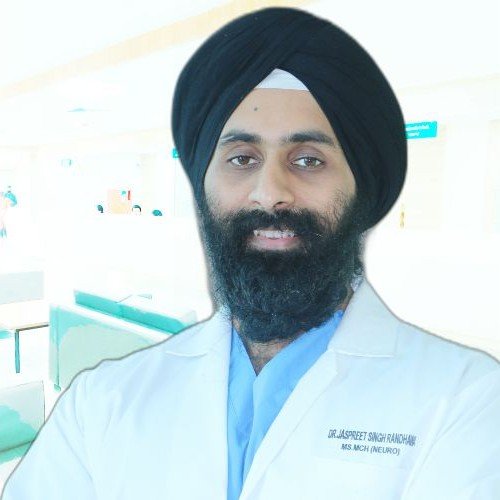
Dr. Jaspreet Singh Randhawa: Parkinson’s Disease and DBS Surgery at Medisyn Neuro Centre, Mohali
Patients and families in Mohali and Chandigarh seeking expert guidance on Parkinson’s disease treatment are consulting Dr. Jaspreet Singh Randhawa, one of the region’s most experienced neurosurgeons at Medisyn Neuro Centre.
Dr. Randhawa’s practice covers the full spectrum of neurological and neurosurgical conditions, from early-stage Parkinson’s evaluation and medication coordination to complex functional neurosurgery including Deep Brain Stimulation. His approach to Parkinson’s care is rooted in the understanding that the right intervention at the right stage of the disease is what produces the best long-term outcomes for patients and their families.
For families who have noticed early warning signs in a loved one, or who are finding that the current medication regimen is becoming less predictable, a neurological evaluation with Dr. Randhawa provides a clear assessment of where the disease stands and what treatment options are most appropriate at that stage.
You can learn more about the DBS surgery for Parkinson’s disease at Medisyn Neuro Centre, Mohali and what the procedure involves from evaluation through to post-operative programming and follow-up.
The clinic’s location in Kharar makes it accessible to patients from across Mohali, Chandigarh, Panchkula, Ropar, and the wider Punjab and Haryana region who need specialist neurological care close to home. Detailed contact information, directions, and appointment booking are available at the Medisyn Neuro Centre contact page.
What to Expect From the DBS Evaluation and Surgery Process
The decision to pursue DBS surgery is never made in a single appointment. It follows a structured, multi-disciplinary evaluation that typically includes:
- Neurological assessment: A detailed review of symptom history, disease duration, medication response, and current functional status. The evaluation includes on and off medication testing to understand the degree of levodopa responsiveness.
- Neuropsychological testing: To assess memory, attention, and executive function, as significant cognitive impairment reduces DBS candidacy.
- Brain imaging: MRI scans are used to visualise the target brain structures and plan surgical electrode placement with precision.
- Neurosurgical consultation: A detailed discussion of the procedure, expected outcomes specific to the patient’s symptom profile, and surgical risks.
- Speech and swallow evaluation: In some patients, particularly those with voice or swallowing changes, this is an important pre-operative step.
The surgery itself typically involves two stages. In the first, electrodes are placed into the brain target with the patient awake, so the surgical team can confirm correct placement through patient responses. In the second stage, usually within a week, the pulse generator is implanted under the chest skin and connected to the electrodes. Programming of the device begins approximately a month after surgery and continues over several months of fine-tuning.
Life After DBS Surgery: What Parkinson’s Patients in Mohali Can Realistically Expect
Managing expectations is a critical part of any honest conversation about DBS. The surgery has a strong track record in appropriate candidates, but it works within defined limits.
What DBS typically improves in Parkinson’s patients:
- Tremor at rest, often dramatically in good candidates
- Rigidity and muscle stiffness
- Bradykinesia, the overall slowness of movement
- Motor fluctuations and unpredictable on and off cycles
- Dyskinesias, often by allowing a reduction in medication dose
- Some sleep-related symptoms
What DBS does not reliably improve:
- Freezing of gait and balance problems (these are poorly responsive to DBS)
- Speech and swallowing difficulties
- Non-motor symptoms such as memory, mood, constipation, or urinary issues
- Cognitive decline or dementia
Most patients who are well selected and well programmed experience a meaningful improvement in functional independence, a reduction in medication burden, and a better overall quality of life compared to where they were in the months before surgery. For many families in northern India who have watched a parent or spouse lose the ability to eat, dress, or walk without assistance, this return of function is profoundly significant.
10 Most-Asked Questions About Parkinson’s Disease and DBS Surgery in India
1. Is Parkinson’s disease common in India? How serious is it?
Parkinson’s disease is the second most common neurodegenerative disorder in the world after Alzheimer’s disease, affecting approximately 1 percent of people above 60 years of age. India has a substantial patient population, and studies suggest that non-motor symptoms are underdiagnosed in the Indian context compared to western countries. The disease is serious and progressive, but with the right treatment at the right stage, quality of life can be maintained meaningfully for many years.
2. My parent’s hand shakes only when resting, not when they reach for something. Is that Parkinson’s?
A resting tremor that reduces when the hand is in use is one of the most characteristic early signs of Parkinson’s disease. This pattern, unlike action tremors associated with essential tremor, strongly suggests a dopaminergic problem. It does not confirm Parkinson’s on its own, but it warrants a neurological evaluation without delay. Do not wait for the symptom to worsen.
3. How is Parkinson’s disease diagnosed? Is there a blood test?
There is no blood test, brain scan, or single investigation that confirms Parkinson’s disease. Diagnosis is clinical, meaning a neurologist examines the patient’s symptoms, their progression, their response to levodopa, and rules out other conditions that can look similar, such as essential tremor, drug-induced Parkinsonism, or atypical Parkinsonian syndromes. An MRI may be ordered to rule out other structural causes, but the diagnosis itself is based on the clinical picture.
4. At what age can Parkinson’s start? Can it affect people in their 40s or 50s?
While Parkinson’s is most common in people above 60, early-onset Parkinson’s disease does occur and can begin as early as the 30s or 40s. Early-onset patients tend to experience more prominent dystonia and more complex medication side effects over time. They are also often better surgical candidates for DBS when the time comes, as younger patients with intact cognition tend to respond more robustly.
5. My father’s Parkinson’s medication worked well for three years but now it barely lasts two hours. What does that mean?
This is the wearing-off effect, one of the most significant clinical milestones in Parkinson’s management. It signals that the brain has lost enough dopaminergic capacity that it can no longer store the medication between doses. This is the period when medication adjustments become increasingly complex and when a referral for DBS evaluation is strongly warranted. Acting on this signal early gives the surgery its best chance of producing a sustained improvement.
6. Is DBS brain surgery dangerous? Are there serious risks?
Like all surgical procedures involving the brain, DBS carries risks. These include a small risk of infection, bleeding inside the brain (haemorrhage), stroke, and hardware-related complications such as lead displacement or battery issues requiring replacement. The overall risk of serious adverse events in experienced centres is low, and for patients whose Parkinson’s symptoms are significantly affecting quality of life, the benefit-risk balance is generally favourable. An honest, detailed discussion with the neurosurgeon before proceeding is essential.
7. Does DBS work for all Parkinson’s patients?
No. DBS works best for patients with idiopathic Parkinson’s disease who still respond, even partially, to levodopa. Patients who get no benefit from levodopa are unlikely to benefit from DBS. It is also less effective for symptoms like balance problems, freezing, and cognitive decline. Careful pre-operative evaluation exists specifically to identify patients for whom DBS is most likely to produce meaningful benefit.
8. What is the difference between Parkinson’s disease and essential tremor?
Essential tremor is an action tremor, meaning it appears when the person is using their hand, such as when holding a cup or writing. It typically affects both hands, the head, and sometimes the voice. Parkinson’s tremor is primarily a resting tremor that reduces when the hand is in active use, and is usually accompanied by other Parkinson’s features such as stiffness, slowness, and reduced arm swing. A neurologist can distinguish the two through clinical examination.
9. Can a person with Parkinson’s live a normal life?
In the early to mid stages, yes. With appropriate Parkinson’s disease treatment, including the right medication regime and eventual consideration of advanced options like DBS, many patients continue to work, socialise, travel, and manage daily activities independently for years. The goal of treatment is to preserve functional independence and quality of life for as long as possible, not just to suppress symptoms in isolation.
10. Where can I consult a specialist for Parkinson’s disease treatment in Mohali?
Patients in Mohali, Kharar, Chandigarh, and the surrounding Punjab region can consult Dr. Jaspreet Singh Randhawa at Medisyn Neuro Centre for a comprehensive neurological evaluation. For patients in whom DBS surgery is being considered, the centre offers detailed pre-operative assessment and surgical consultation. You can learn more about the DBS surgery service at Medisyn Neuro Centre Mohali or get in touch to book an appointment.