

A two inch incision doing the job that once needed an eight inch cut down the back is not a marketing claim, it is how spine surgery has actually changed over the last two decades. This shift is exactly what patients are asking about when they research minimally invasive spine surgery in Mohali before their first consultation. Smaller access points, specialized tubes, and cameras that let a surgeon see deep into the spine without opening it wide have shifted recovery timelines from months to weeks for a number of common procedures. Minimally invasive spine surgery in Mohali now covers a real, established set of techniques, not an experimental add on, and knowing what it can and cannot do helps set the right expectations before a consultation.
Key Takeaways
- Minimally invasive spine surgery uses smaller incisions and specialized tools to treat the spine while preserving more surrounding muscle and ligament
- It generally offers less blood loss, a shorter hospital stay, and a faster return to normal activity compared with open surgery, without compromising typical outcomes
- Candidacy depends on the specific diagnosis, spinal stability, prior surgery history, and overall anatomy, not simply personal preference
- Certain situations, including spondylolisthesis, pars fractures, and previous failed surgery, need direct imaging review before deciding on an approach
- Book a consultation with a spine specialist in Mohali to find out whether a minimally invasive approach fits your specific condition
What Minimally Invasive Spine Surgery Actually Involves
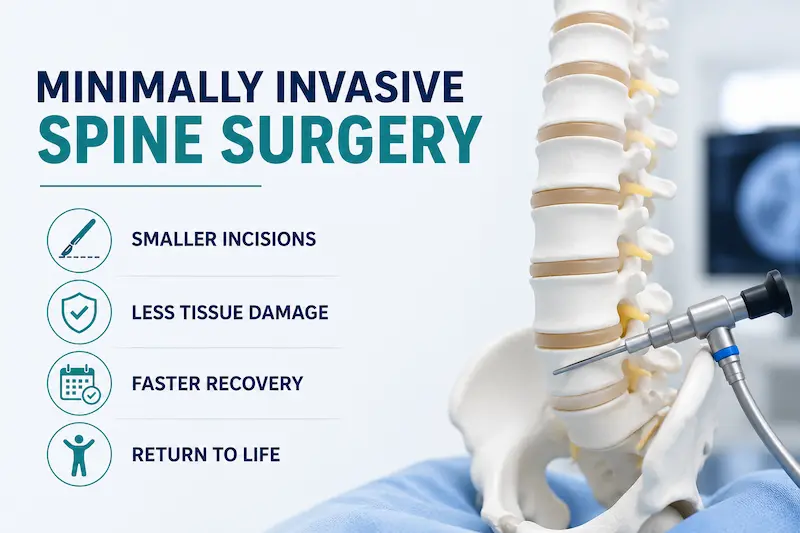
Minimally invasive spine surgery, often shortened to MISS, uses small incisions, specialized tubular retractors, and magnified visualization to treat spinal conditions while preserving as much surrounding muscle and ligament as possible. Rather than pulling back large sections of tissue to expose the spine directly, the surgeon works through a narrow corridor, guided by a microscope, endoscope, or fluoroscopic imaging.
This is sometimes called keyhole spine surgery or MISS spine surgery, and the comparison to traditional surgery is where the difference becomes clear.
| Factor | Open Spine Surgery | Minimally Invasive Spine Surgery |
|---|---|---|
| Incision size | Five to eight inches | Often under two inches |
| Muscle disruption | Significant retraction and stripping | Preserved through tubular access |
| Typical hospital stay | Several days | Often 24 to 48 hours |
| Return to normal activity | Several months | Often within a few weeks |
Neither approach is universally better. The right choice depends entirely on the specific diagnosis, the surgeon’s training, and what the imaging shows about your spine.
Conditions Treated With Minimally Invasive Spine Surgery in Mohali
A smaller incision changes very little about what condition it is treating underneath. Minimally invasive techniques are applied to a specific range of spinal problems, rather than any back complaint that walks through the door.
- A herniated or slipped disc pressing on a nerve root, treated through minimally invasive microdiscectomy
- Lumbar spinal stenosis, addressed through a tubular decompression or laminectomy
- Mild degenerative spondylolisthesis, sometimes managed with decompression surgery alone in carefully selected cases
- Spinal instability requiring fusion, now often performed through smaller, staged incisions rather than one long exposure
- Select cases of scoliosis correction, where minimally invasive instrumentation reduces the surgical footprint
Sciatica caused by a slipped disc is one of the most frequent reasons a minimally invasive approach gets discussed, since microdiscectomy through a tubular retractor is now considered a standard option for straightforward disc herniations. Correction of scoliosis in select cases also increasingly uses minimally invasive instrumentation, though the decision depends heavily on the degree and pattern of the spinal curve.
Minimally Invasive Spine Surgery in Mohali: Is It Actually Safer?
The evidence generally points that way, with some conditions attached. Cleveland Clinic notes that minimally invasive and robotic spine surgery techniques can reduce disruption to normal tissue, leave smaller scars, shorten hospital stays, reduce postoperative pain, and lower blood loss during surgery compared with open approaches. These benefits show up specifically because less muscle and ligament tissue is disturbed to reach the spine.
Lower general risk does not mean risk free. Even minimally invasive procedures carry a possibility of complications depending on the complexity of the case, the spinal level involved, and individual patient factors, which is why routine safety precautions, including having blood available if needed, remain standard practice rather than a signal that a particular surgery is unusually dangerous.
Fusion success rates and long term outcomes with minimally invasive techniques are generally comparable to open surgery for appropriately selected patients, according to Mayo Clinic. The advantage lies mainly in the recovery experience rather than a fundamentally different surgical outcome.
Who Is a Good Candidate for a Minimally Invasive Approach
Candidacy is decided case by case, based on a combination of factors rather than a single rule.
- The specific diagnosis and which spinal structures are involved
- The degree of spinal instability present, if any
- Whether there has been prior surgery at the same spinal level
- Overall spinal anatomy and any anatomical variations that affect surgical access
- General health factors that influence how well a patient tolerates anesthesia and surgery
A minimally invasive approach is not automatically the right choice simply because it sounds less invasive. Complex instability, significant deformity, or extensive prior surgery at the same level can sometimes make an open approach the more appropriate option, and this decision genuinely requires a surgeon reviewing your imaging directly.
Special Situations Worth Discussing Directly With a Surgeon
Certain scenarios come up often enough in consultations that they deserve specific mention rather than a general answer.
Elderly patients and those with other health conditions. Minimally invasive and endoscopic techniques have been used successfully in older patients who might otherwise be considered higher risk for a traditional open procedure, largely because these approaches involve less anesthetic burden, shorter operating time, and lower physical trauma.
Spondylolisthesis without fusion. A mild, grade one slip can sometimes be treated with decompression alone in carefully selected cases, without needing a fusion. This decision depends on spinal stability specific to that patient, and destabilizing an already slipped vertebra is a real surgical risk that has to be weighed carefully against the benefits of a less extensive procedure.
A pars fracture, or spondylolysis. This changes the stability calculation for the spine. Whether a minimally invasive approach alone is appropriate, or whether it needs to be combined with a fusion, depends on the degree of associated instability, and this requires direct evaluation of the imaging by a spine surgeon rather than a general answer.
Previous failed surgery at the same level. Additional surgery after a prior operation is more complex because of scar tissue and altered anatomy. Outcomes vary considerably, and a thorough re evaluation with fresh imaging is needed to determine whether further surgery, minimally invasive or otherwise, is realistic for that specific case.
What Recovery From Minimally Invasive Spine Surgery Looks Like
Recovery is one of the areas where minimally invasive spine surgery in Mohali shows the clearest practical difference from open surgery. With minimally invasive spine surgery, patients often go home within 24 to 48 hours and resume normal daily activities within a few weeks, compared with a recovery stretching several months and a longer hospital stay after traditional open surgery.
Preparing properly ahead of time makes a genuine difference to how smoothly recovery goes.
- Stop smoking well before the scheduled surgery date, since it affects wound and bone healing
- Stay physically active and continue core strengthening exercises where your doctor advises it
- Review all current medications, particularly blood thinners, with the surgical team in advance
- Arrange home support for at least the first week after the procedure
- Confirm the specific postoperative instructions for your particular procedure with your surgeon directly
One symptom deserves direct mention here. New or different sided pain after spine surgery, for example pain appearing in the opposite leg from before the operation, should always be reported to the operating surgeon promptly. It can reflect postsurgical swelling, a new area of compression, or an unrelated issue, and it is not something to self diagnose or simply wait out.
Minimally Invasive Spine Surgery in Mohali: What to Ask Before You Commit
Choosing between a minimally invasive and an open approach for minimally invasive spine surgery in Mohali works best as a direct conversation with a spine surgeon who has reviewed your specific imaging, not a general preference for the smaller incision. A consultation with Dr. Jaspreet Singh Randhawa, a neurosurgeon based in Mohali, typically covers your diagnosis, imaging, and which surgical approach genuinely fits your anatomy, rather than presenting one technique as a default answer regardless of the case.
Patients considering surgery for a related trauma, such as a spinal cord injury, should know that minimally invasive techniques are not suitable for all situations. Trauma cases often need broader access and a different surgical plan entirely, which is exactly why an individual assessment matters more than a general preference for smaller incisions.
Patients travelling in from Chandigarh and nearby areas for a neurosurgeon in Chandigarh consultation often ask the same core questions asked in Mohali: whether their specific condition suits a minimally invasive approach, what recovery will realistically involve, and how experienced the surgical team is with the specific technique being proposed. These are reasonable questions to bring to any spine consultation, regardless of which clinic you visit.
Cost and insurance coverage for minimally invasive spine surgery in Mohali vary by procedure complexity and individual case factors, so a personalized estimate through direct consultation is more useful than relying on a general figure found online.
Frequently Asked Questions
1. What is minimally invasive spine surgery, and how is it different from traditional open surgery?
Traditional open spine surgery typically requires a larger incision, often five to eight inches, along with more retraction and disruption of the surrounding muscle to give the surgeon a full direct view of the spine. Minimally invasive spine surgery instead uses smaller incisions, often under two inches, along with specialized tubes or an endoscope, to reach the same structures while preserving more of the surrounding muscle and ligament tissue. The underlying surgical goal, whether removing disc material or relieving nerve pressure, is generally the same. What changes is the pathway used to get there and the amount of collateral tissue disruption involved along the way.
2. Is minimally invasive spine surgery actually less risky than open surgery?
Minimally invasive techniques are generally associated with lower blood loss during surgery, reduced pain afterward, shorter hospital stays, and a lower rate of certain complications compared with open surgery, without compromising outcomes like fusion success in appropriately selected patients. This does not mean the approach is risk free, since any spinal procedure carries some possibility of complications depending on the complexity of the case and individual patient factors. The comparative advantage shows up mainly in recovery experience and tissue preservation rather than in a fundamentally different surgical result for the underlying condition being treated.
3. Can minimally invasive decompression be done for spondylolisthesis without needing a fusion?
It depends on the specific case. A mild, grade one slip can sometimes be decompressed alone in carefully selected patients without adding a fusion, but this decision rests on the degree of spinal stability present in that particular spine. Destabilizing an already slipped vertebra through decompression alone is a real surgical risk that has to be weighed against the benefit of avoiding a more extensive fusion procedure. This is exactly the kind of question that needs an in person assessment with imaging rather than a general yes or no answer, since the stability calculation is specific to each patient’s anatomy.
4. Can minimally invasive surgery be done if I have a pars fracture, or spondylolysis?
A pars fracture changes the stability calculation for the spine, and whether a minimally invasive approach alone is appropriate, or whether it needs to be combined with a fusion, depends on the degree of associated instability present. Some cases with a stable pars defect and no significant slip can be managed with a more limited procedure, while others with progressive instability need a more comprehensive approach. This requires a surgeon’s direct evaluation of your specific imaging rather than a blanket answer, since spondylolysis presents differently from one patient to the next depending on chronicity and any associated slip.
5. How much shorter is recovery with minimally invasive spine surgery compared to open surgery?
Recovery from minimally invasive spine surgery is typically measured in weeks rather than months, with patients often resuming normal daily activities within a few weeks and frequently going home within 24 to 48 hours of the procedure. Traditional open surgery, by comparison, generally involves a longer hospital stay and a recovery period stretching several months before a full return to normal activity. Individual recovery still depends on the specific procedure performed, overall health, and how closely postoperative instructions are followed, so these timelines are general patterns rather than a guarantee for any particular case.
6. What should I do to prepare for minimally invasive spine surgery to get the best outcome?
Commonly recommended preparation includes stopping smoking well ahead of the surgery date, since smoking affects wound and bone healing, and staying physically active with core strengthening exercises where your doctor advises it. Reviewing all current medications with the surgical team is essential, particularly blood thinners, since some need to be paused before surgery under medical supervision. Arranging home support for at least the first week after the procedure also makes a real difference to how smoothly early recovery goes. Your surgical team will give you specific instructions tailored to your exact procedure, which should always take priority over general guidance.
7. Is it normal to feel new pain in the opposite leg after spine surgery?
New or different sided pain after spine surgery is not something to self diagnose or simply wait out, and it should always be reported to the operating surgeon promptly. It can reflect postsurgical swelling around the nerve, a new area of compression that was not present before, or an issue unrelated to the original surgery entirely. Reporting it quickly allows the surgical team to assess what is actually happening, whether through a physical exam or repeat imaging, rather than assuming it will settle on its own. Prompt communication with your surgeon is the appropriate response any time symptoms change in an unexpected way after surgery.
8. Is minimally invasive surgery a good option for elderly patients or those with other health conditions?
Yes, in a number of cases. Minimally invasive and endoscopic approaches have been used successfully in older patients who might otherwise be considered higher risk for a traditional open procedure, specifically because these techniques involve less anesthetic burden, shorter procedure time, and lower physical trauma than open surgery. This does not mean age alone makes a patient an automatic candidate, since overall health, bone quality, and the specific spinal condition still need direct evaluation. For patients with other health conditions where a long, complex open surgery carries added risk, a minimally invasive option is often worth raising directly during the consultation.
9. Does minimally invasive spine surgery work for cervical neck problems as well as the lower back?
Yes, minimally invasive approaches are used across different regions of the spine, including cervical procedures affecting the neck, not just the lumbar spine in the lower back. The specific technique used and whether it suits a given case depends on the exact condition being treated and which spinal level is involved, since cervical anatomy differs meaningfully from the lumbar spine. A surgeon experienced in minimally invasive cervical procedures can advise whether your specific neck condition, such as a herniated cervical disc or nerve compression, is suitable for this type of approach.
10. What determines whether someone is a good candidate for minimally invasive surgery versus open surgery?
Candidacy depends on a combination of factors, including the specific diagnosis, the degree of spinal instability present, whether there has been prior surgery at the same spinal level, and the patient’s overall anatomy. Minimally invasive techniques require specialized surgeon training and careful patient selection, so the approach carrying lower general risk on its own does not make it suitable in all cases. A surgeon weighs these factors together against your imaging and symptom history to recommend the approach most likely to address your specific condition safely and effectively.