
A shooting pain down one leg that gets worse when you sit is often the first clue that something in the lower spine is pressing on a nerve, not the leg itself. Patients researching sciatica surgery in Mohali usually arrive at this stage already, after weeks of pain that has not settled on its own. That single detail, pain travelling from the back into the leg rather than staying in one place, is what separates sciatica from ordinary muscle strain, and it changes how the problem gets treated from the very first appointment. Sciatica surgery in Mohali only becomes part of the conversation once conservative treatment has had a fair trial, and knowing where that line sits can save weeks of uncertainty.
Key Takeaways
- Sciatica is nerve pain travelling from the lower back into the leg, most often caused by a herniated disc pressing on a nerve root
- A genuine trial of physiotherapy, medication, and injections comes before surgery in the large majority of cases
- Surgery is considered when pain is severe and unresponsive to treatment, or when there is progressive weakness, foot drop, or bladder and bowel changes
- Microdiscectomy is the most common procedure for sciatica caused by a herniated disc, while laminectomy and fusion suit different underlying causes
- Sciatica surgery in Mohali is generally recommended only after conservative treatment has had a genuine trial and specific warning signs appear
- Book a consultation with a spine specialist in Mohali if pain, weakness, or numbness is not settling with conservative treatment
What Sciatica Is and Why It Travels Down the Leg
Sciatica is nerve pain that runs along the sciatic nerve, from the lower back through the buttock and down one leg, usually caused by pressure on a nerve root where it exits the spine. The sciatic nerve is the longest and widest nerve in the body, so irritation near its root at the base of the spine can be felt far away, sometimes right down to the foot.
The pain itself is a symptom, not the diagnosis. What causes that pressure is the actual problem a doctor needs to identify, and it usually falls into one of a small number of categories.
- A slipped or herniated disc pressing directly on a nerve root, the single most common cause
- Bone spurs narrowing the space where the nerve exits the spine
- Lumbar spinal stenosis, where the canal around the nerve roots becomes tight
- Muscle spasm or inflammation around the nerve, without any structural compression
- Rarely, a spinal tumour or infection affecting the nerve root
Sciatic nerve pain caused by a slipped disc behaves differently from sciatica caused by tight muscles, which is why an accurate diagnosis, not just a symptom description, is what actually decides the treatment path.
Sciatica Treatment That Comes Before Sciatica Surgery in Mohali Is Discussed
Sciatic pain, even when it is intense, tends to settle with time and the right conservative care. A large share of sciatica cases improve within a few weeks to a few months without any operation, according to Mayo Clinic. This is exactly why a genuine trial of nonsurgical treatment, done properly rather than half heartedly, is the standard first step.
| Treatment | What It Involves | Best Suited For |
|---|---|---|
| Physiotherapy | Targeted stretches, core strengthening, posture correction | Mild to moderate pain without progressive weakness |
| Medication | Anti inflammatory drugs, short term muscle relaxants, nerve pain medication | Managing pain during the early weeks |
| Epidural steroid injection | Targeted anti inflammatory injection near the affected nerve root | Persistent leg pain not settling with medication alone |
| Activity modification | Staying active, avoiding prolonged sitting or bed rest | Supporting recovery alongside physiotherapy |
Prolonged bed rest slows recovery rather than speeding it up. Staying reasonably active, within what the pain allows, keeps the surrounding muscles from stiffening further and generally supports a better outcome than complete rest.
When Sciatica Surgery Becomes the Right Option
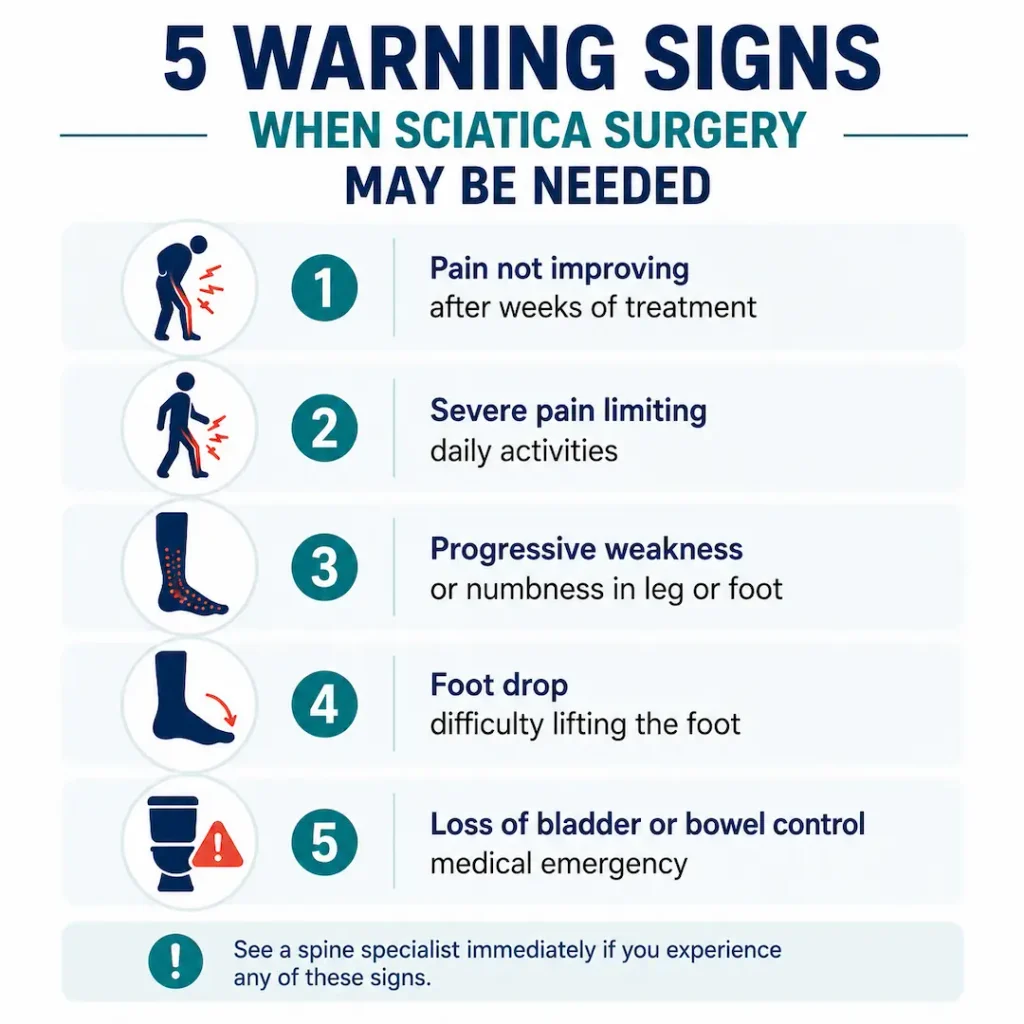
Surgery enters the conversation once a specific set of conditions is met, not simply because pain has lasted a while. A spine surgeon typically looks at three things together: how long conservative treatment has been tried, how severe the pain is, and whether there is any sign of active nerve damage beyond pain alone.
- Sciatic pain that has not responded to a genuine course of physiotherapy, medication, and injections over several weeks
- Pain severe enough to significantly limit daily function despite treatment
- Progressive weakness or numbness in the leg or foot that is getting worse rather than staying stable
- Foot drop, where lifting the front of the foot becomes difficult while walking
- Loss of bladder or bowel control, which is treated as a same day emergency rather than a routine referral
Pain alone, without one of these additional findings, is rarely treated with surgery first. It is the combination of severity, duration, and neurological signs together that shifts the recommendation toward an operation.
According to the NHS, decompression surgery becomes an option specifically when pain is severe and other treatments have not helped, which lines up closely with how spine surgeons in Mohali approach the decision. It is worth saying directly: physiotherapy that makes pain noticeably worse rather than better is not something to push through silently. That change is worth reporting to the treating doctor right away, since it can signal that the case needs a fresh look rather than a repeat of the same exercises.
Types of Sciatica Surgery Available in Mohali
Not all sciatica surgery is the same procedure. The right option depends on what is causing the nerve compression and how much of the surrounding spine is affected.
| Procedure | What It Does | Typically Used For |
|---|---|---|
| Microdiscectomy | Removes the herniated portion of a disc pressing on the nerve, through a small incision using magnification | Sciatica caused by a herniated disc, the most common surgery for this condition |
| Discectomy | Removes part of a herniated disc through a standard incision | Cases where a minimally invasive approach is not suitable |
| Laminectomy | Removes part of the vertebra to relieve pressure from spinal stenosis | Sciatica linked to a narrowed spinal canal rather than a disc alone |
| Spinal fusion | Joins two or more vertebrae together permanently | Cases involving spinal instability alongside the nerve compression |
A microdiscectomy is a minimally invasive procedure specifically designed to remove the piece of disc pressing on the nerve, without disturbing the rest of the spine. It falls under the broader category of lumbar spine surgery used to relieve nerve compression in the lower back. A large share of sciatica cases trace back to a herniated disc in the lower spine, which is why this particular procedure comes up so often in sciatica surgery discussions.
What to Expect Around the Procedure and Afterward
Any recommendation for sciatica surgery in Mohali should come with a clear conversation about the risks and possible complications involved, not just the expected benefit. A responsible spine surgeon walks through this as a normal part of informed consent, even when they believe surgery is genuinely the right choice for that particular case.
Foot drop deserves specific mention here. When it develops from nerve compression, outcomes after surgery tend to depend heavily on how long the weakness was present beforehand. Earlier surgical intervention is generally associated with a better chance of the foot and ankle strength returning, while weakness that has been present for a long stretch of time carries a less predictable recovery. This is exactly why worsening foot drop is treated with more urgency than pain alone, rather than being left for a later review.
Surgery does carry real risk, including the possibility of continued symptoms afterward or the need for a further procedure down the line. This is precisely why a clear, honest discussion of expected outcomes before committing to a surgeon and a procedure matters as much as the technical skill involved.
Sciatica Surgery in Mohali: A Second Opinion Done Right
Considering sciatica surgery in Mohali starts with an accurate diagnosis. If sciatic pain has lasted several weeks, physiotherapy has not helped, or leg weakness is becoming noticeable, a proper evaluation with a spine specialist in Mohali is the practical next step rather than repeating the same treatment indefinitely. Imaging, a detailed clinical exam, and a straightforward conversation about whether surgery fits your specific case can usually happen within a single visit.
Sciatica linked to a slipped disc is treated differently from sciatica caused by broader spinal degeneration, and a scan alone rarely tells the whole story without a proper clinical correlation. Patients travelling in from Kharar, Zirakpur, and Panchkula for a neurosurgeon in Mohali consultation typically get this clarity in one sitting, which matters when repeated injections or years of on and off flare ups have not settled the underlying problem.
A second opinion on the same imaging is standard, sensible practice rather than a sign of distrust in the first surgeon. Discectomy, microdiscectomy, laminectomy, and fusion are genuinely different procedures with different risk profiles, and getting clarity on which one actually fits your case is worth the extra conversation before committing to a date on the calendar.
Making the call on sciatica surgery in Mohali works best as a two part process: rule out whether conservative treatment still has room to work, and if it does not, get a clear, specific recommendation on which surgical approach matches your actual imaging and symptoms rather than a generic one.
Frequently Asked Questions
1. How do I know if my sciatica actually needs surgery?
Surgery is generally considered when sciatic pain has not responded to a genuine trial of physiotherapy, medication, or injections, when the pain is severe enough to significantly limit daily activity, or when there is progressive numbness or weakness in the leg. Pain alone, without one of these additional findings, is rarely treated with surgery as a first step. The combination matters more than any single symptom on its own. If you are unsure where your case falls, a spine surgeon can review your imaging alongside your symptom history and give you a clear answer rather than a general impression based on pain severity alone.
2. Will sciatica go away on its own without surgery?
A large share of sciatica cases improve without surgery within a matter of weeks to a few months, which is why doctors typically recommend a genuine trial of conservative treatment before discussing surgical options. This includes physiotherapy, appropriate medication, and staying reasonably active rather than resting completely. Recovery timelines vary from person to person depending on the underlying cause and severity of nerve compression. If pain is not settling after a reasonable period of proper conservative care, or if it is getting worse rather than better, that is the point to ask directly about further evaluation rather than continuing the same approach indefinitely.
3. I have a slipped disc and mild spinal narrowing, and my job requires standing or walking through the day. Do I need surgery?
This combination, structural compression alongside a job that depends on mobility, is exactly the kind of case that benefits from a direct conversation with a spine surgeon rather than a general answer. Functional limitation, meaning an inability to manage normal daily activity because of pain or weakness, is treated as a stronger indicator for surgical evaluation than imaging findings or pain alone. If your symptoms are affecting your ability to work and conservative treatment has not resolved them, a specific assessment of your imaging against your daily function is the right next step, since the answer genuinely depends on the details of your case rather than a general rule.
4. I have had sciatica for years with repeated flare ups. Does that change whether I need surgery?
A long history of recurring episodes does not automatically mean surgery is the answer, since a number of patients manage sciatica for years through physiotherapy and activity adjustments between flare ups. That said, if a current flare is not responding to another round of the same physiotherapy that has been tried before, repeating it again with no change is not usually the most useful next step. At that point, asking directly for a surgical opinion, or at minimum fresh imaging to see if anything has changed, gives you more clarity than continuing an approach that has already been tried without lasting success.
5. Physiotherapy is making my pain worse, not better. Is that normal?
This is not something to work through quietly, and it is worth reporting back to your treating doctor as soon as it happens rather than continuing the same exercises. Pain that increases with a prescribed physiotherapy programme can mean the specific exercises do not suit your particular disc pathology, or it can mean the underlying case needs to be reassessed for a different or more urgent treatment path. It does not automatically mean physiotherapy has failed as a whole, since a modified programme under closer supervision sometimes resolves the issue. What it does mean is that the current plan should not simply continue unchanged without your doctor reviewing what is happening.
6. Why does my doctor talk about surgical risks when I ask if I need surgery?
This is standard, responsible medical practice rather than a way of discouraging you. A surgeon recommending an operation is expected to walk through the possible risks and complications as part of informed consent, even in cases where they believe surgery is genuinely the right choice. Sciatica surgery, like any operation, carries some risk, including the possibility of continued symptoms afterward or a need for further treatment later. Hearing about these risks upfront is a sign the surgeon is giving you a complete picture rather than only the benefits, and it puts you in a better position to make an informed decision about your own care.
7. What is a microdiscectomy, and is it the same as spine surgery in general?
A microdiscectomy is a minimally invasive procedure that removes the herniated portion of a disc pressing on a nerve, using a microscope and a small incision to limit disruption to the surrounding tissue. It is not the same as spine surgery in general, since spine surgery covers a broad range of procedures, including laminectomy and spinal fusion, used for different underlying problems. Microdiscectomy specifically targets disc related nerve compression and is the most frequently performed surgery for sciatica caused by a herniated disc, since a herniated disc is the underlying cause in the large majority of sciatica cases.
8. Can foot drop from sciatica be reversed after surgery?
Outcomes vary and depend heavily on how long the foot drop has been present before surgery takes place. Earlier surgical intervention is generally associated with a better chance of recovering foot and ankle strength, since the nerve has had less time under sustained pressure. Foot drop that has been present for an extended period before treatment carries a less predictable recovery, and some weakness can remain even after the compression is relieved. This is exactly why worsening or new foot drop is treated as a signal to seek prompt evaluation rather than waiting to see if it resolves on its own.
9. What is the difference between a discectomy, microdiscectomy, and spinal fusion for sciatica?
A discectomy removes part of the herniated disc that is compressing the nerve, typically through a standard incision. A microdiscectomy achieves the same goal through a smaller incision, using a microscope for magnification, and is generally associated with less tissue disruption and a shorter recovery. Spinal fusion is a different type of procedure entirely, joining two or more vertebrae together permanently, and is generally reserved for cases involving spinal instability rather than a straightforward disc herniation. The right choice between these depends on what your imaging shows and whether instability is part of the picture, which is something your spine surgeon will assess directly.
10. How do you pick the right surgeon for sciatica surgery?
A properly qualified spine surgeon with clear communication about the procedure, realistic expected outcomes, and a willingness to discuss possible complications upfront is generally a stronger indicator of quality care than reputation alone. Look for a surgeon who reviews your specific imaging and symptoms in detail rather than recommending surgery from a brief description of your pain, and who explains why a particular procedure fits your case rather than presenting surgery as the only option. If something about a recommendation does not add up, or if the surgeon is not willing to walk through alternatives and risks, seeking a second opinion before committing to a date is a reasonable and common step to take.