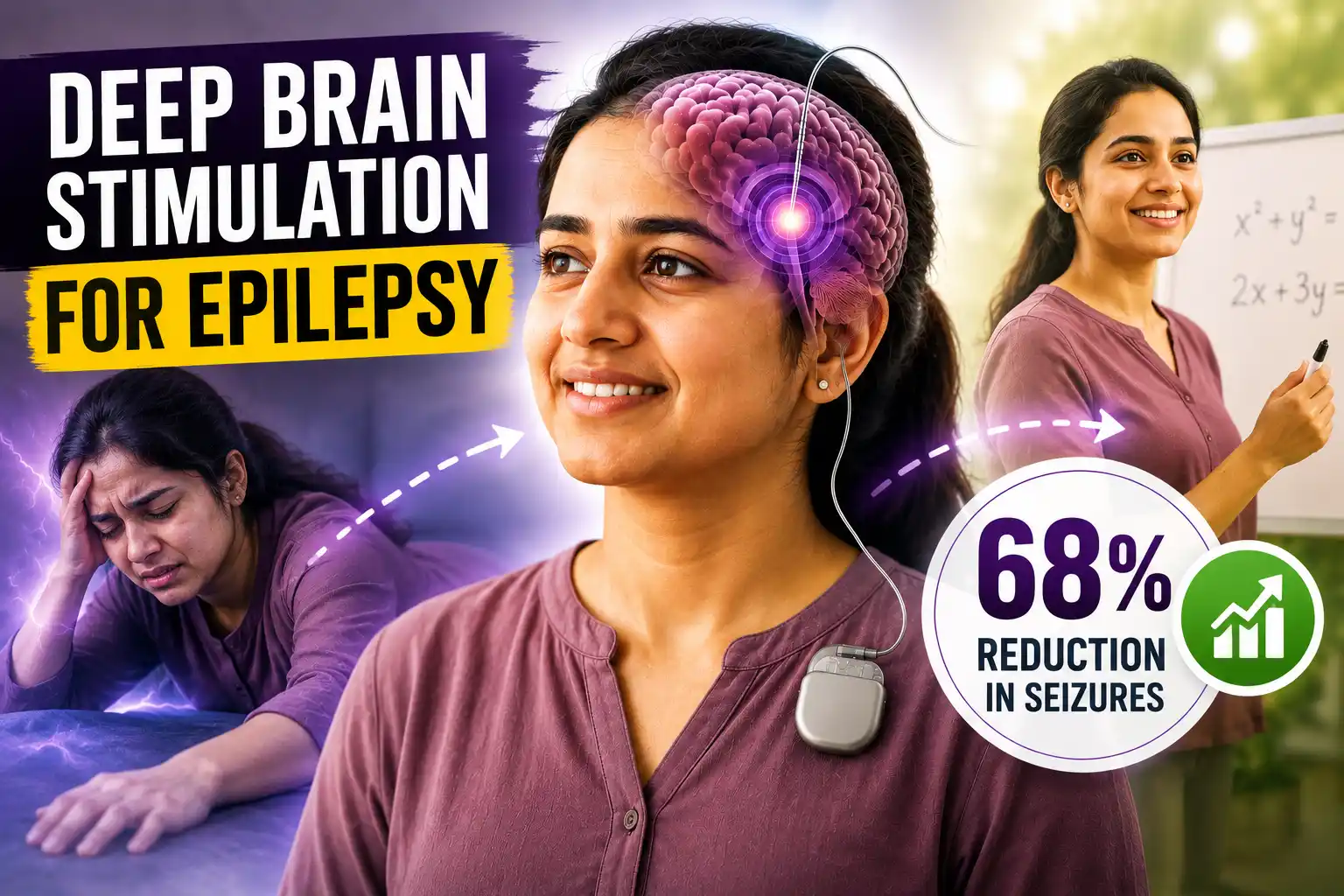
A 27-year-old teacher from Patiala had her first seizure at age 19.
Eight years later, she had tried six different anti-seizure medications. Three in combination.
A ketogenic diet for fourteen months. Her seizures still came four to five times a month. She had given up driving. She had stopped travelling alone. Her school had placed her on administrative duty because they could not predict when she would collapse in a classroom.
Nobody had told her that deep brain stimulation treatment for epilepsy existed.
She came to Medisyn for a consultation. Fourteen months after surgery, her seizure frequency had dropped by 68%. She is teaching again.
If you or someone in your family has epilepsy that medications cannot control, this article is written specifically for you.
Why Epilepsy Stops Responding to Medication for 1 in 3 Patients
Epilepsy affects roughly 50 million people worldwide. For the majority, one or two anti-seizure medications bring the condition under reliable control.
But for approximately 30 to 40% of epilepsy patients, seizures continue despite optimised drug therapy. This is called drug-resistant epilepsy (DRE), and the definition is specific: a patient who has failed two appropriately chosen anti-seizure medications, taken at adequate doses, is considered to have drug-resistant epilepsy.
Drug-resistant epilepsy is not just inconvenient. It is dangerous.
Patients with uncontrolled seizures face a significantly elevated risk of falls, injuries, cognitive decline over time, and sudden unexpected death in epilepsy (SUDEP). The longer seizures go uncontrolled, the more the quality of life erodes, professionally, socially, and personally.
For these patients, the question is not whether to look beyond medication. It is which surgical or neuromodulatory option to consider, and when.
“The tragedy in epilepsy care is not that treatment options don’t exist. It is that patients spend years on failing medication combinations when they should have been evaluated for surgery or neuromodulation long before. Drug resistance in epilepsy becomes clear early. We should act on it early.”
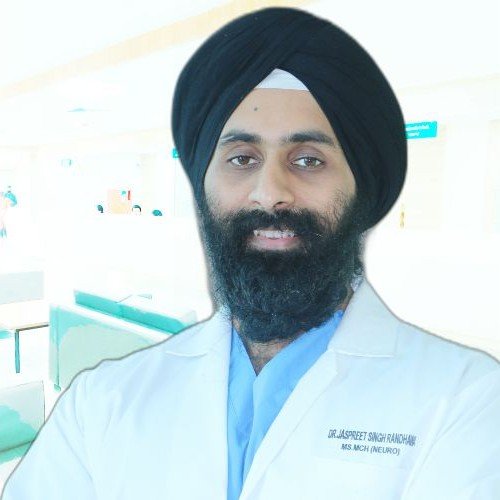
Dr. Jaspreet Singh Randhawa, MCh Neurosurgery (Gold Medalist), Medisyn Neuro Centre, Mohali
What Is Deep Brain Stimulation Treatment for Epilepsy?
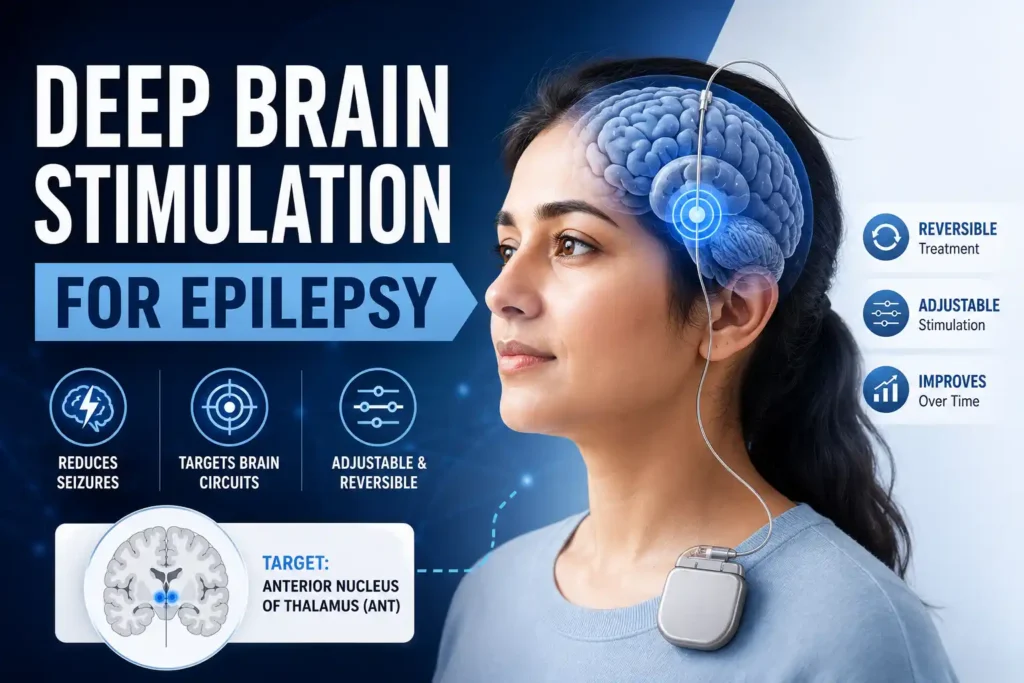
Deep brain stimulation treatment for epilepsy is a surgical procedure in which a small electrode is implanted into a specific nucleus inside the brain. This electrode delivers precisely calibrated electrical pulses that interfere with the brain’s seizure-generating circuits, reducing the frequency and severity of seizures over time.
Unlike resective brain surgery, which physically removes the part of the brain causing seizures, DBS does not remove any brain tissue. It is reversible. It is adjustable. And it continues to improve in effectiveness the longer it is in place.
The primary target for deep brain stimulation treatment for epilepsy is the anterior nucleus of the thalamus (ANT). The thalamus functions as a relay and gating station for electrical signals across the brain. By modulating the ANT, DBS disrupts the Papez circuit, the network through which seizure activity spreads from the temporal lobe to wider brain regions.
Other targets being used and studied include:
- Centromedian nucleus of the thalamus (CM): used for generalised epilepsy and Lennox-Gastaut syndrome
- Hippocampus: used for temporal lobe epilepsy with hippocampal involvement
- Pulvinar: an emerging target for posterior cortex epilepsy; still investigational
- Subthalamic nucleus (STN): explored in specific seizure types with promising results
ANT-DBS is the most studied and the only target with data from a large-scale randomised controlled trial, making it the current standard of care for DBS in epilepsy.
The SANTE Trial: What the Evidence Actually Shows
Every conversation about deep brain stimulation treatment for epilepsy comes back to the SANTE trial, the Stimulation of the Anterior Nucleus of the Thalamus for Epilepsy study. It is the most important evidence base for this treatment and the reason ANT-DBS received regulatory approval.
Here is what the data shows, year by year:
| Timepoint | Median Seizure Reduction | Responder Rate (greater than 50% reduction) |
|---|---|---|
| Year 1 | 41% | 43% of patients |
| Year 2 | 56% | 54% of patients |
| Year 5 | 69% | 68% of patients |
| Year 7 | 75% | 74% of patients |
The most important finding from SANTE is not the one-year number. It is the trend. DBS for epilepsy gets more effective over time. Patients who respond modestly at year one often become strong responders by year three to five as the brain adapts to the stimulation pattern. This is fundamentally different from medication tolerance, where drugs often become less effective over time.
The trial also found that the most severe seizure type, focal to bilateral tonic-clonic seizures, was reduced by 71% at seven years. This is clinically significant because these are the seizures most associated with injury, SUDEP risk, and social disability.
“When I show families the SANTE data, I always focus on year seven, not year one. At year one, only 43 out of 100 patients see major improvement. By year seven, 74 out of 100 do. That is not a drug that stops working. It is a treatment that keeps working harder the longer you use it.”
Dr. Jaspreet Singh Randhawa
Who Qualifies for Deep Brain Stimulation Treatment for Epilepsy?
Not every epilepsy patient needs or benefits from DBS. The evaluation process is thorough, and the right candidacy assessment makes all the difference to outcomes.
Patients who are typically good candidates for deep brain stimulation treatment for epilepsy:
- Have failed two or more appropriately chosen anti-seizure medications at adequate doses
- Are not suitable candidates for resective brain surgery, either because the seizure focus cannot be precisely localised, or because it lies in or near an eloquent brain area that cannot safely be removed
- Have focal epilepsy, focal to bilateral seizures, or generalised epilepsy depending on the DBS target chosen
- Have no progressive brain disease or rapidly deteriorating neurological condition
- Are medically fit for a surgical procedure under anaesthesia
- Understand that DBS reduces seizures but does not guarantee complete seizure freedom
Patients who may not be good candidates at this stage:
- Those who have not genuinely tried and failed two well-chosen anti-seizure medications
- Patients who are candidates for resective surgery and have a clearly localised seizure focus; resection typically offers better seizure freedom rates than DBS
- Those with rapidly progressive neurodegenerative conditions
- Patients with active psychosis or significant uncontrolled psychiatric illness
Dr. Jaspreet Singh Randhawa performs epilepsy surgery at Medisyn, including DBS for drug-resistant epilepsy. His approach involves a multidisciplinary evaluation before any surgical decision, ensuring that each patient receives the most appropriate treatment for their specific seizure type and brain anatomy. You can review his full credentials and experience at his neurosurgeon profile page.
DBS vs VNS vs Resective Surgery: Understanding Your Options
Families dealing with drug-resistant epilepsy often encounter several treatment options. Understanding where DBS fits relative to other choices is essential for making an informed decision.
| Treatment | How It Works | Best For | Seizure Freedom Rate | Reversible |
|---|---|---|---|---|
| Resective Surgery | Removes the seizure-generating brain tissue | Focal epilepsy with clear, operable seizure focus | 50 to 70% seizure freedom | No |
| VNS (Vagus Nerve Stimulation) | Stimulates the vagus nerve in the neck | Generalised epilepsy; not surgical candidates | 20 to 50% seizure reduction | Yes |
| DBS (Deep Brain Stimulation) | Stimulates the ANT or other thalamic targets | Focal; multifocal; temporal lobe; not resection candidates | 50 to 75% seizure reduction; improves over years | Yes |
| RNS (Responsive Neurostimulation) | Detects and responds to seizure onset in real time | Well-localised focal epilepsy; hippocampal targets | Similar to DBS; limited availability in India | Yes |
The key principle: if resective surgery is safe and feasible, it typically offers the highest chance of seizure freedom and should be considered first. When resection is not possible, DBS and VNS are the leading neuromodulatory options, with DBS showing stronger seizure reduction in the first years post-implantation compared to VNS, based on comparative studies.
How Deep Brain Stimulation Surgery for Epilepsy Is Performed
The procedure follows the same two-stage approach as DBS for other conditions, but the brain target and programming protocol are specific to epilepsy.
Pre-Surgical Evaluation
Before surgery, the patient undergoes comprehensive evaluation including brain MRI, video EEG monitoring to characterise seizure types, neuropsychological testing, and a detailed neurological examination. This evaluation identifies the seizure type, confirms drug resistance, and rules out surgical resection as a better option.
Stage 1: Electrode Implantation
Under general anaesthesia, a stereotactic head frame is placed for precision targeting. The ANT is identified on MRI. Two small holes are made in the skull and bilateral electrodes are placed, one in each hemisphere. Microelectrode recording confirms correct placement. The procedure takes approximately four to six hours.
Unlike DBS for Parkinson’s disease where the patient must remain awake, epilepsy DBS is typically performed under general anaesthesia throughout. No awake cooperation is required.
Stage 2: Neurostimulator Implantation
One week later, the battery-powered neurostimulator is placed under the skin near the collarbone and connected to the brain electrodes via extension wires tunnelled under the skin. Most patients are discharged within two to three days of Stage 2.
Device Activation and Programming
The device is activated two to four weeks post-surgery. Initial settings follow the established SANTE protocol; these are then individualised based on the patient’s response over subsequent visits. Programming continues every one to three months in the first year as the optimal settings are found.
What Patients Experience After DBS for Epilepsy
Setting realistic expectations is the most important part of preparing a family for this procedure. The timeline for epilepsy DBS is gradual.
Month 1 to 3: Device activated. Seizure diaries begin. Some patients notice early reduction. Others see little change yet. Both are normal at this stage. Anti-seizure medications are continued alongside DBS initially.
Month 3 to 6: Progressive seizure reduction begins for most responders. Programming sessions every four to six weeks refine stimulation parameters. Some patients begin reducing one medication during this phase under neurologist supervision.
Month 6 to 12: The most active response period. Seizure frequency continues declining. Injuries from falls reduce. Many patients regain independence in daily activities: driving in some cases, independent travel, return to work or school.
Year 2 and beyond: Improvement typically continues. SANTE data shows the responder rate rising from 43% at year one to 74% at year seven. Patients who showed only partial response in year one often become strong responders by years three to five.
Patients consistently report improvements beyond seizure numbers. Reduced anxiety about when the next seizure will happen. Better sleep. Reduced cognitive fog from lower medication doses. Return to a degree of independence and confidence that medication alone had taken away.
“A young man came to me who had not been on a bus alone in four years. His family was with him every moment because no one could predict when he would seize. After eighteen months of DBS, he took the train to Delhi on his own to visit a friend. His mother sent me a voice note. I did not know what to say.”
Dr. Jaspreet Singh Randhawa
Deep Brain Stimulation for Epilepsy at Medisyn Neuro Centre, Mohali
Deep brain stimulation treatment for epilepsy requires a functional neurosurgeon who performs this procedure regularly, supported by a neurologist experienced in epilepsy management and a dedicated programming team. The combination of surgical precision, correct target selection, and thoughtful post-operative programming determines most of the outcome.
At Medisyn Neuro Centre, Airport Road, Mohali, Dr. Jaspreet Singh Randhawa brings MCh Gold Medal credentials, experience across the full range of functional neurosurgery procedures, and a patient base that includes drug-resistant epilepsy cases from Punjab, Haryana, Himachal Pradesh, Jammu and Kashmir, and internationally.
The cost of deep brain stimulation surgery at Medisyn ranges from Rs. 13 lakh to Rs. 27 lakh, depending on device type and whether unilateral or bilateral implantation is required. This is a fraction of the cost of the same procedure in the USA or UK, with equivalent surgical expertise and the same globally approved neurostimulator devices from Medtronic and Abbott.
According to a comprehensive review published on PubMed covering DBS therapy for drug-resistant epilepsy, ANT-DBS and other thalamic targets have emerged as viable, reversible treatment options for patients who are not candidates for resective surgery. The SANTE trial long-term data published in Neurology confirms that seizure reduction improves progressively over years of continuous stimulation.
10 Questions Epilepsy Patients Ask Before Choosing DBS
1. Will DBS cure my epilepsy completely?
DBS reduces seizures significantly but does not guarantee complete seizure freedom. The SANTE trial showed 74% of patients had more than 50% seizure reduction at seven years. Some patients do achieve seizure freedom; most experience meaningful reduction that transforms daily life even if seizures are not eliminated entirely.
2. How is epilepsy DBS different from brain surgery to remove the seizure focus?
Resective surgery removes brain tissue to eliminate the seizure source. DBS does not remove tissue. It modulates the brain’s electrical activity through stimulation. Resection offers higher seizure freedom rates when feasible, but DBS is appropriate when the seizure focus cannot be safely removed or is not clearly localised.
3. Does the patient need to be awake during epilepsy DBS surgery?
No. Unlike Parkinson’s DBS where awake surgery helps confirm electrode placement through patient feedback, epilepsy DBS is performed under general anaesthesia throughout. The patient remains completely asleep for both stages.
4. Can children with drug-resistant epilepsy have DBS?
Yes. DBS has been used in adolescents and children with drug-resistant epilepsy, particularly for generalised seizures and specific syndromes like Lennox-Gastaut. The CADET pilot trial is currently evaluating adaptive DBS specifically for paediatric epilepsy. Each case requires individual specialist evaluation.
5. Is DBS better than VNS for drug-resistant epilepsy?
In the first one to two years post-implantation, DBS shows stronger seizure reduction than VNS in most comparative studies. The advantage narrows over longer follow-up. The choice depends on seizure type, brain anatomy, and individual factors. A specialist evaluation is needed to determine which option is more appropriate for each patient.
6. What are the risks of DBS surgery for epilepsy?
Surgical risks include infection, bleeding, or hardware complications, occurring in fewer than 2 to 3% of cases at experienced centres. Stimulation-related side effects include mood changes, memory effects, and tingling in some patients. These are typically managed through programming adjustments. Serious adverse events are rare in well-selected patients at skilled centres.
7. Can I continue my epilepsy medications after DBS surgery?
Yes. DBS is used alongside anti-seizure medications, not as a replacement. Over time, as seizure control improves, many patients are able to reduce their medication load under neurologist supervision. Most patients continue at least one anti-seizure medication long term.
8. How long does the DBS device last for epilepsy patients?
Non-rechargeable neurostimulators typically last three to five years before battery replacement is needed. Rechargeable devices last up to nine years per battery cycle. Battery replacement is a minor surgical procedure under local anaesthesia. The brain electrode itself rarely requires replacement.
9. Is the improvement from DBS for epilepsy permanent?
The device needs to remain active for sustained benefit. If switched off, seizures return to pre-surgery levels. However, with the device running, benefits are long-lasting and typically improve over years. Long-term follow-up from SANTE shows continued benefit at ten years with no evidence of the effect wearing off.
10. How do I find out if I qualify for DBS treatment for epilepsy in Mohali?
The first step is a specialist consultation with a functional neurosurgeon and epilepsy neurologist together. Bring your full seizure history, all medications tried, and your most recent MRI and EEG reports. Dr. Randhawa’s team at Medisyn can evaluate whether you are a suitable candidate for deep brain stimulation treatment for epilepsy. Book your consultation online to begin the assessment.