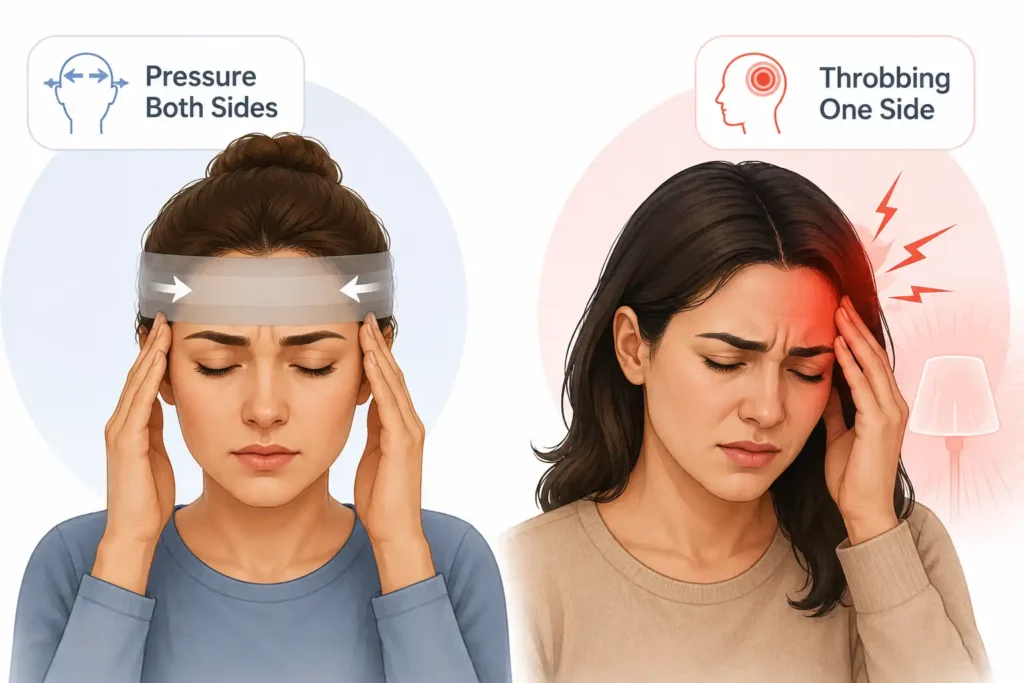
It feels like someone has placed a clamp around your skull.
Not stabbing. Not throbbing. Just constant pressure, across the forehead, around the temples, sometimes at the back of the head, sitting there for hours.
Tension headache is the most common headache type in the world. A 2024 North India study found a prevalence of 34.1%, exceeding global averages. Up to 78% of adults will experience it at some point in their lives. And 3% develop chronic tension headache: the kind that is there most days of the week, week after week.
If you are in that 3%, you know the difference between “getting headaches” and living with one.
Tension headache everyday is not a personality trait. It is a clinical pattern with identifiable causes and specific solutions.
What causes tension headaches every day is not simply stress. Stress is one of five specific triggers. And in chronic tension headache, there is a neurological process happening beyond the obvious triggers that explains why the headache persists even when the stress has passed, the sleep has improved, and the water intake is fine.
Dr. Jaspreet Singh Randhawa, neurosurgeon at Medisyn Neuro Centre in Mohali, explains what is actually behind a daily tension headache, how to identify which trigger is driving yours, and what treatment works beyond taking a paracetamol every morning.
First: How to Know It Is Actually a Tension Headache
The clinical features of tension headache are specific enough to distinguish it from migraine without a test.
Feature
Tension Headache
Migraine
Location
Both sides of the head
Usually one side
Pain character
Pressure, tightening, band-like
Throbbing, pulsating
Nausea
Absent or very mild
Common, sometimes severe
Light or sound sensitivity
Mild, if present at all
Significant, often disabling
Effect of physical activity
Not worsened by walking or exercise
Significantly worsened
Duration
30 minutes to 7 days
4 to 72 hours
Does your daily headache feel like pressure on both sides of your head, without nausea, and without getting dramatically worse when you walk around?
If yes, tension headache is the likely diagnosis. If throbbing, one-sided, and accompanied by nausea or severe light sensitivity, you are looking at migraine, covered in the article on migraine vs headache.
The One Thing Every Tension Headache Patient Needs to Understand
Tension headache is not pain caused by tension in the way most people think.
The traditional explanation was that stress causes muscles in the head and neck to tighten, and that tightening causes the headache. That is partly true for episodic tension headaches.
But in chronic tension headache, something more significant happens.
The brain’s pain-processing system itself becomes sensitised. Researchers call this central sensitisation. What it means clinically is that the pain threshold has dropped so low that stimuli which would normally not produce pain, including ordinary muscle activity, mild stress, or even just being awake, now register as painful.
This is why people with chronic daily tension headache feel that their headache appears “for no reason.” There is a reason. The reason is that the central nervous system has been recalibrated toward pain. Addressing only the peripheral triggers, posture, sleep, stress, without addressing this central sensitisation is why most people who try to manage chronic tension headache on their own get only partial and temporary improvement.
“Central sensitisation is the concept that changes how I approach every chronic tension headache patient. Once a person has had daily tension headache for several months, the nervous system itself has become part of the problem. The muscles are a trigger. But the amplifier is in the brain. You have to treat both.”
Dr. Jaspreet Singh Randhawa, Medisyn Neuro Centre, Mohali
5 Causes of Tension Headaches Every Day
Cause 1: Forward Head Posture, The Silent Daily Trigger Most People Don’t Feel
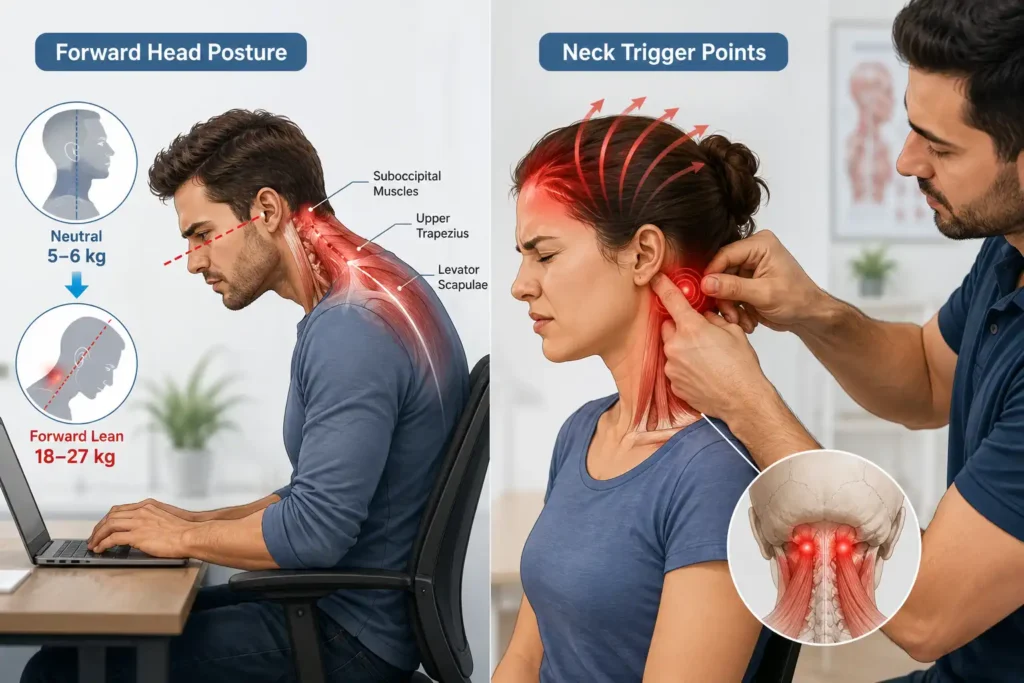
For every centimetre your head moves forward from its neutral position over your spine, the effective load on your cervical muscles approximately doubles.
At a neutral position, the head weighs around 5 to 6 kilograms. At the typical forward-lean position most people adopt while looking at a laptop or phone screen, that effective load on the neck muscles increases to 18 to 27 kilograms.
These muscles do not switch off when you stand up.
After hours of sustained overload, the suboccipital muscles at the base of the skull, the upper trapezius, and the levator scapulae develop active trigger points: tight, tender knots that refer pain upward to the head. This is the mechanism behind the tight band.
How many hours a day are you looking at a screen, and what does your posture look like when you do?
If your chin is protruding forward and your shoulders are rounded, the trigger points producing your daily tension headache are almost certainly located in your posterior neck and suboccipital muscles. Pressing firmly at the base of your skull with your thumbs will likely reproduce or worsen the headache immediately. That is a positive suboccipital pressure test, and it is clinically significant.
“I see patients who have tried every headache medication and nothing works long-term. When I examine them, the diagnosis is in the neck within 2 minutes. The tender points are so obvious that pressing them produces the exact headache they describe. It is not a brain problem. It is a posture problem that has been treated as a brain problem for years.”
Dr. Jaspreet Singh Randhawa
Targeted physiotherapy addressing these trigger points, combined with ergonomic correction, produces lasting improvement in this specific cause. It does not respond well to paracetamol because the source is mechanical, not neurochemical.
Cause 2: Jaw Clenching During Sleep, The Trigger That Happens While You Are Unconscious
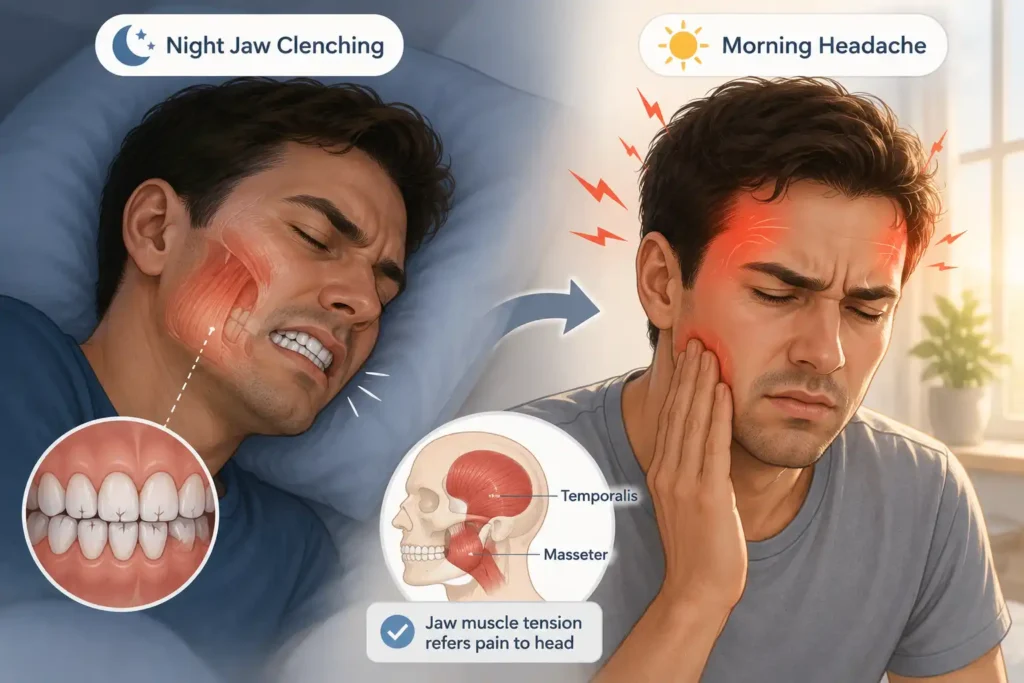
Bruxism is the involuntary clenching or grinding of teeth, most commonly during sleep.
Most people who do it have no idea they do it.
The jaw muscles, particularly the masseters and temporalis, are among the most powerful muscles in the body relative to their size. When they sustain contraction overnight, the referred pain radiates to the temples, forehead, and base of the skull. You wake up with a tension headache that was created entirely while you were asleep.
Signs that bruxism is causing or contributing to your daily tension headache:
Headache is consistently worst within 30 minutes of waking
Jaw feels sore, stiff, or tight when you first open your mouth in the morning
Your dentist has mentioned tooth wear, flattened cusps, or enamel erosion
Your partner has heard grinding sounds from you during sleep
Pressing on the temple or just in front of the ear reproduces the headache
A custom occlusal splint fitted by a dentist can eliminate the jaw component of a morning tension headache entirely. It is one of the most underutilised solutions for daily tension headaches, simply because headache doctors rarely ask about jaw symptoms and dentists rarely ask about headaches.
Cause 3: Chronic Stress Without Physical Release, How Emotion Becomes a Daily Physical Headache
Chronic stress does not produce tension headache by thinking too hard.
It produces it through a specific physiological pathway: sustained emotional tension activates the sympathetic nervous system, which maintains the paraspinal and pericranial muscles in a state of low-grade contraction. The muscles never fully relax, because the nervous system is never fully at rest.
This is different from acute stress producing an occasional headache. This is the pattern where the nervous system has been running in a chronic low-level threat response for weeks or months, and the pericranial muscles have essentially forgotten how to fully relax. Every scan of a difficult email, every commute, every family tension adds a small increment to a muscle system that is already close to its tipping point.
Does your headache get reliably worse when you are under pressure, and reliably better on holidays or days completely away from work responsibilities?
That pattern confirms stress as a primary driver. But the fix is not simply “reduce stress.” The physical component, the muscle tension itself, needs direct treatment alongside any stress management approach, because the muscles do not automatically relax when the stressor is removed after months of chronic loading.
Cause 4: Poor Sleep Timing, Not Just How Much, But When
Sleep deprivation is a well-established tension headache trigger.
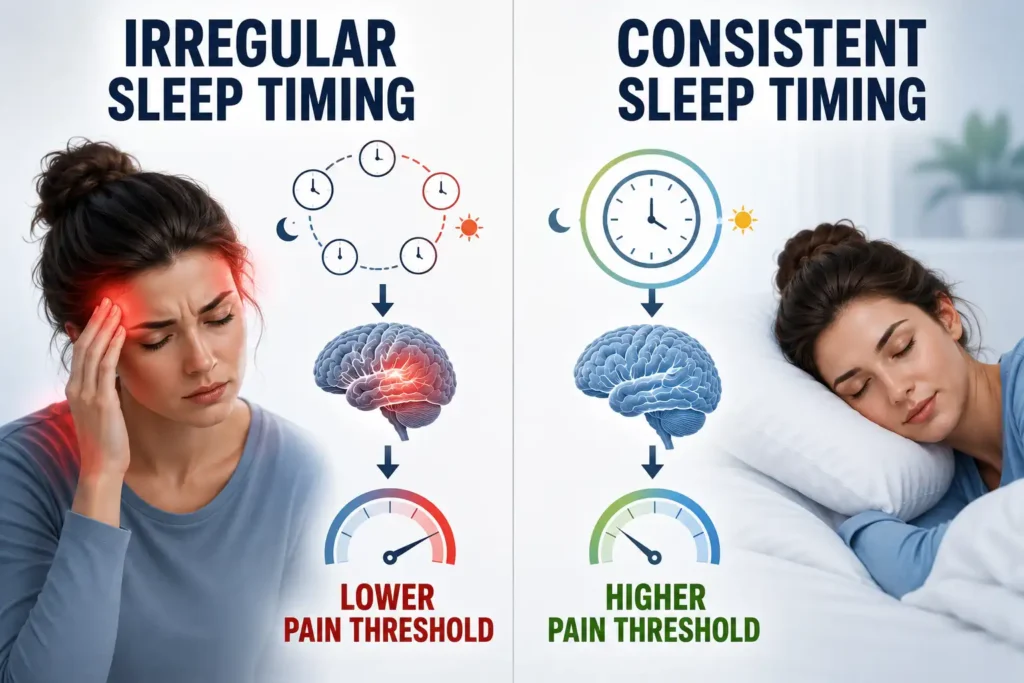
What is less well understood is that irregular sleep timing, going to sleep and waking at different times each day, disrupts the brain’s circadian pain regulation even when total sleep duration is adequate.
The brain modulates its pain sensitivity in sync with the circadian clock. When that clock is irregular, the pain threshold does not follow a predictable daily pattern. The result is a headache that appears without a clear trigger because the trigger is the absence of a consistent biological rhythm rather than any external event.
Research from NIH consistently shows that people who maintain rigid sleep and wake times, including weekends, have measurably lower headache frequency than those who vary their schedule by even 60 to 90 minutes. In tension headache specifically, where central sensitisation is already lowering the pain threshold, this circadian regulation becomes particularly important.
“Sleep regularisation is the intervention I push hardest and that patients resist most. They tell me they cannot sleep at the same time every day because of their schedule or their family. I tell them that the headache is the price of that irregularity. Once they commit to consistent sleep and wake times for 6 weeks, the change in headache frequency is often the most dramatic result of anything else we do.”
Dr. Jaspreet Singh Randhawa
Cause 5: Pericranial Muscle Tenderness Becoming Self-Sustaining
This is the cause that explains why tension headaches become daily even after the original trigger has been addressed.
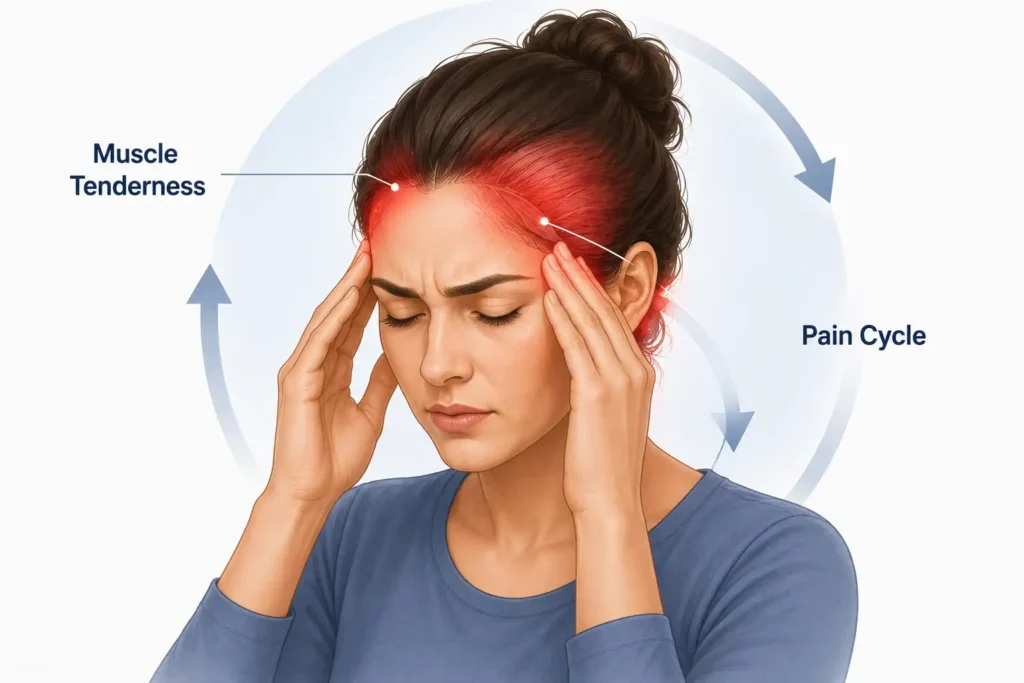
Pericranial muscles are the muscles of the scalp, temples, and around the skull. In people with chronic daily tension headache, these muscles develop sustained tenderness even without active contraction. Pressing gently on the muscles of the scalp, temples, or base of the skull reproduces pain that radiates into a full headache.
This tenderness develops through a cycle:
A trigger (posture, stress, jaw clenching) activates pericranial muscle tension
Sustained tension causes local inflammation and tissue sensitisation in the muscle
Central sensitisation in the brain amplifies the signals from these sensitised muscles
The muscles become tender at rest, without any active trigger
Normal daily activities now maintain the headache because the muscles are in a chronic low-level inflammatory state
At this stage, treating only the original trigger is insufficient. The pericranial muscle tenderness has become a self-sustaining pain source. Breaking this cycle requires either physiotherapy targeting these specific muscles, low-dose preventive medications that reduce central sensitisation, or both.
This is the mechanism most standard advice about tension headache completely ignores. And it is why people who address stress, sleep, and posture conscientiously still sometimes continue to have daily tension headaches.
According to Mayo Clinic, chronic tension headache occurring 15 or more days per month may require preventive medications and is rarely adequately managed with over-the-counter pain relief alone. Professional evaluation is recommended when headaches are frequent, disabling, or not responding to self-care measures.
Dr. Randhawa’s Clinical View: The Patient Pattern That Repeats
There is a patient Dr. Jaspreet Singh Randhawa sees regularly at Medisyn.
Software professional. Works 9 to 10 hours daily at a desk. Sleeps irregularly. Drinks 5 cups of tea. Takes Dolo when the headache gets bad, which is most days. Has been told by previous doctors to “reduce stress.” Has tried to reduce stress. The headache has not reduced.
“This person has four things happening simultaneously: forward head posture creating pericranial trigger points, caffeine dependence adding a daily withdrawal layer, medication overuse building a rebound component, and irregular sleep lowering the pain threshold chronically. Telling them to reduce stress is not wrong. It is just addressing 20% of the problem and calling it a full solution.”
Dr. Jaspreet Singh Randhawa, Medisyn Neuro Centre, Mohali
The structured approach at Medisyn addresses all contributing causes simultaneously, in the correct sequence. Medication overuse must be cleared first. Sleep regularisation runs in parallel. Physiotherapy for pericranial and cervical trigger points begins once medication overuse is resolved. Preventive medication is added where central sensitisation has become self-sustaining.
For people whose tension headache pattern also involves features of migraine on some days, the detailed article on daily headache causes explains how the two types interact and how that mixed presentation changes the treatment approach.
Women experiencing tension headaches that worsen in the premenstrual phase should review the article on female daily headache causes for the hormonal component that frequently layers on top of a tension headache pattern.
According to 2024 Delhi NCR study, TTH prevalence in North India stands at 34.1%, substantially above global means, with a significant proportion experiencing it chronically. The study also found that fewer than 25% of headache sufferers in India had consulted a healthcare provider about their symptoms in the past year, meaning the majority are managing a treatable chronic condition without a diagnosis.
What Actually Stops a Daily Tension Headache
In order of clinical priority:
Clear medication overuse first. If you are taking analgesics more than 10 to 15 days per month, this must be resolved before any other intervention works properly. Under neurological guidance at Medisyn Mohali.
Fix sleep timing. Same sleep and wake time daily for 6 weeks minimum. Duration of at least 7 hours. No weekend variation of more than 30 minutes.
Physiotherapy for pericranial and cervical trigger points. Not massage. Targeted trigger point release and cervical joint mobilisation by a trained physiotherapist. Typically 6 to 10 sessions to see sustained improvement.
Ergonomic correction. Screen at eye level. Chair height allowing feet flat on floor. Phone held up rather than head bent down.
Jaw assessment. If morning headaches are a consistent feature, a dental assessment for bruxism and an occlusal splint trial is warranted.
Preventive medication where central sensitisation is established. Low-dose amitriptyline or nortriptyline is the most evidence-backed option for chronic tension headache, taken at night, reducing headache frequency by 30 to 50% within 6 to 8 weeks in most patients.
10 Questions People Ask About Daily Tension Headaches
1. What causes tension headaches every day when I am not particularly stressed?
Stress is only one of five causes. Forward head posture from screen use, jaw clenching during sleep, poor sleep timing, and pericranial muscle sensitisation all produce daily tension headaches independently of emotional stress. A tension headache that persists on non-stressful days is almost certainly being driven by one of the physical causes above.
2. Why does my tension headache feel like a tight band around my head?
The band sensation is produced by sustained contraction and tenderness in the pericranial muscles: the frontalis across the forehead, the temporalis at the temples, and the suboccipital muscles at the base of the skull. When these muscles are chronically tense or tender, any sustained wakefulness maintains the sensation of pressure and tightening that people describe as a band around the skull.
3. Can tension headaches become permanent?
Chronic tension headache with central sensitisation can feel permanent because the pain exists even in the absence of obvious triggers. It is not actually permanent, but it does require more than lifestyle changes to resolve once central sensitisation is established. Preventive medication combined with physiotherapy and sleep regularisation produces sustained improvement in the majority of cases within 3 to 4 months of consistent treatment.
4. Why do I get a headache every day after work?
End-of-day tension headaches reflect accumulated muscle load and stress decompression. The pericranial and cervical muscles have been under sustained tension all day. Stress hormones that were suppressing pain awareness during the working day begin to drop. The headache that arrives at 5 or 6pm is the accumulated physical tension of the day finally becoming perceptible when the focus of work no longer masks it.
5. Why am I getting headaches everyday since I started working from home?
Home work setups are almost universally worse ergonomically than office setups. Dining tables are too low, chairs do not support lumbar posture, and the absence of commute means people sit for longer unbroken stretches. The result is greater forward head posture load over more hours per day. Most people who develop new daily tension headaches after switching to home working are experiencing a posture problem, not a stress problem.
6. Is tension headache dangerous?
Episodic and chronic tension headache are not dangerous. They do not cause permanent neurological damage. However, the significant reduction in quality of life, the loss of productive hours, and the risk of developing medication overuse headache as a secondary layer make chronic tension headache a condition that genuinely warrants treatment rather than indefinite management with daily analgesics.
7. How do I know if my daily headache is tension or migraine?
The table at the top of this article covers the six clinical distinctions. The most practically useful: if your daily headache is on both sides, feels like pressure rather than throbbing, and does not make you feel sick or force you to lie in a dark room, it is tension headache. If it is one-sided, throbbing, and accompanied by nausea or severe light sensitivity, it is migraine. Many people with chronic daily headache have elements of both on different days, which is a mixed picture that requires neurological assessment to manage properly.
8. Can poor posture really cause a headache every single day?
Yes. It is one of the most reliable and most overlooked causes of daily tension headache. Forward head posture maintained for 6 to 8 hours daily creates cumulative mechanical load on the posterior cervical muscles that produces active trigger points referring pain to the head. The process is gradual enough that people do not connect posture and headache. The connection becomes obvious when targeted physiotherapy resolves the headache in people who have been taking analgesics daily for months.
9. What is the difference between tension headache and cervicogenic headache?
Tension headache is bilateral (both sides), pressure-like, and driven by pericranial muscle sensitisation and central nervous system factors. Cervicogenic headache is strictly unilateral (one side), starts at the neck and radiates forward, and is reproduced by specific neck movements or pressure. Both involve the cervical muscles, but cervicogenic headache has a clear, demonstrable mechanical origin in the neck joint or nerve, while tension headache’s origin is more diffuse. Both respond to physiotherapy, but the specific techniques differ.
10. When should I see Dr. Jaspreet Singh Randhawa for a daily tension headache?
See Dr. Randhawa at Medisyn Neuro Centre if your tension headache occurs on most days of the week, if you are taking painkillers more than 10 days per month, if the headache is interfering with your work or daily activities, or if self-management approaches including sleep regularisation, ergonomic correction, and reduced caffeine have not produced improvement after 4 to 6 weeks. Daily tension headache at the chronic stage requires a structured, multi-component treatment plan, not a repeat prescription for analgesics.
Dr. JS Randhawa is an award-winning Senior Neurosurgeon and Functional Neurosurgery expert with over 14 years of experience. A Gold Medalist from the prestigious AFMC, Pune, he specializes in advanced procedures like DBS, Spinal Cord Stimulation, and complex brain tumor surgeries.
Trustindex verifies that the original source of the review is Google.
5-Star Review for Dr. Balvin Kaur – Exceptional GynecologistI recently visited Dr. Balvin Kaur,From the moment I walked into her clinic, her warm and welcoming demeanor put me at ease. She took the time to listen to all my concerns without rushing, explained everything in simple terms, and made me feel truly cared for.Dr. Kaur's expertise shines through in her precise diagnosis and personalized treatment plan. She addressed my issues effectively, and I felt confident in her recommendations. The follow-up care was equally impressive – prompt and thorough. All the staff of the clinic is very knowledgeable and helpful.If you're looking for a compassionate, skilled gynecologist who prioritizes patient comfort and health, Dr. Balvin Kaur is the best choice!
Thank you, Doctor, for your outstanding service
Posted on Google
Ajay Kumar
Trustindex verifies that the original source of the review is Google.
A big thank you to Medisyn Clinic for giving us such a memorable experience during the birth of our baby boy. From the pre-delivery consultations to the delivery and post-delivery care, everything was smooth, well-managed, and reassuring.
We received excellent care and support throughout the process. Dr. Balveen explained everything clearly at every step, the nurses took great care of my wife and baby, and the entire staff was always available whenever we needed help.
The environment was clean, positive, and very well maintained. We are very satisfied with all the services and had an overall wonderful experience. We highly recommend Medisyn Clinic for maternity and delivery services.
Posted on Google
Gunjan Garg
Trustindex verifies that the original source of the review is Google.
I met Dr. Balvin and she is very knowledgable. I liked the overall service. I would definitely recommend.
Posted on Google
Jaya Thakur
Trustindex verifies that the original source of the review is Google.
I am extremely grateful to my gynaecologist Dr. Balvin Kaur Ghai for the excellent care and support throughout my pregnancy. Dr. Balvin is very patient, knowledgeable and always took the time to explain everything clearly, which made me feel comfortable and confident. Overall it was a very positive experience and I highly recommend Dr. Balvin Kaur Mam to anyone seeking quality women's health care.
Posted on Google
avtar rose
Trustindex verifies that the original source of the review is Google.
It was overall a good experience. Doctors and staff were so co operative. Overall satisfied.
Posted on Google
Anjali Mouraya
Trustindex verifies that the original source of the review is Google.
My experience with Clags clinic has been really great, and their treatment is excellent. The staff here is very cooperative and kind. The patient is taken care of very well, from admission to discharge.
Posted on Google
Gurmeet Shergill
Trustindex verifies that the original source of the review is Google.
Exceptional care and guidance we received from Dr. Balvin.
She and her care team was readily available throughout our journey!!
Highly recommended.