

A woman told she has an ovarian cyst sometimes hears a very different word a year later: endometrioma. The confusion is understandable, since an endometrioma is technically a type of ovarian cyst, yet it behaves nothing like the simple, self resolving cysts most women experience during a normal menstrual cycle. Knowing which category your specific result falls into changes everything about what happens next.
Key Takeaways
- A simple ovarian cyst is a normal, temporary structure related to ovulation, while endometriosis is a chronic condition involving tissue growing outside the uterus
- An endometrioma is a specific type of ovarian cyst caused by endometriosis, not a separate, unrelated condition
- Symptom timing differs: endometriosis pain tends to follow the menstrual cycle and persist over months, while simple cyst symptoms are often sudden and temporary
- Ultrasound can usually distinguish a simple cyst from an endometrioma based on appearance, though further evaluation is sometimes needed for a complete picture
- If your symptoms or scan results are unclear, reviewing our Ovarian Cyst Diagnosis guide alongside a consultation with an endometriosis specialist in Mohali is a reasonable next step, since picking a qualified endometriosis specialist Mohali offers matters as much as the diagnosis itself
Ovarian Cyst vs Endometriosis: The Core Distinction
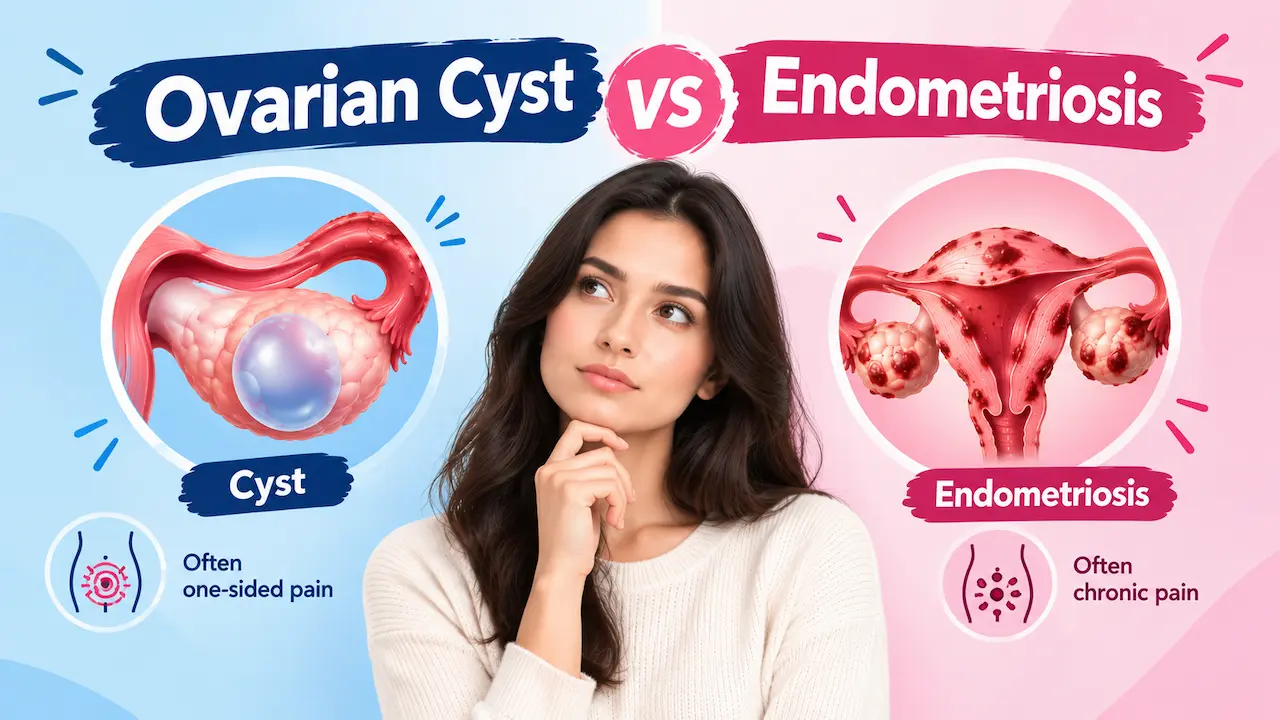
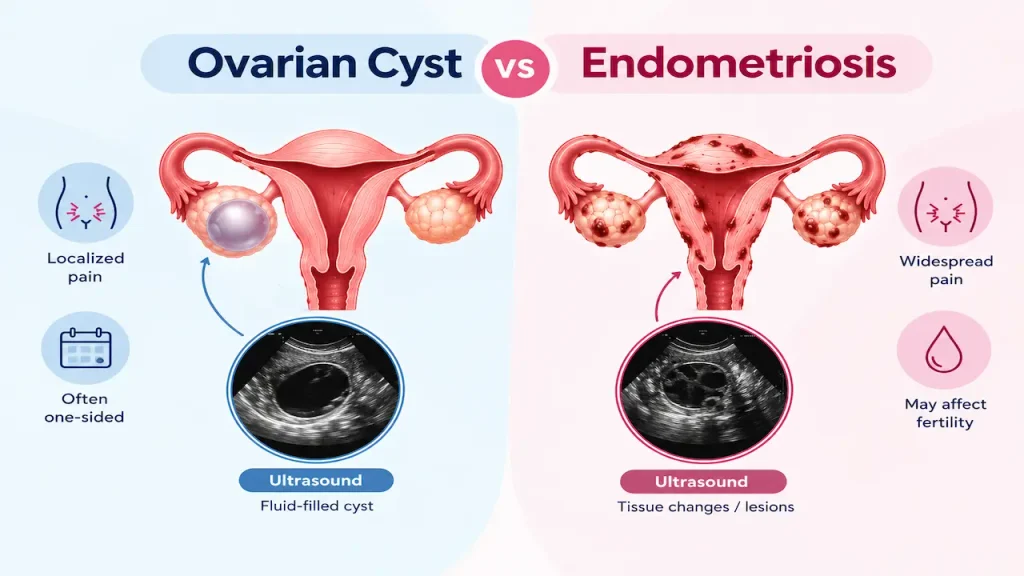
Ovarian cyst vs endometriosis comes down to this: an ovarian cyst is a fluid filled sac that can form for several different reasons, most commonly as a normal part of ovulation, while endometriosis is a chronic condition where tissue similar to the uterine lining grows outside the uterus, sometimes forming a specific type of cyst on the ovary called an endometrioma. A cyst is a structure. Endometriosis is a disease process. One type of cyst happens to be caused by the other condition, which is exactly where the confusion tends to start.
According to Mayo Clinic, diagnosis of endometriosis generally involves a pelvic exam, ultrasound imaging, and in some cases laparoscopy, since ultrasound alone cannot always detect all forms of the disease. This is a meaningfully different diagnostic path from a routine simple cyst, which ultrasound alone can usually characterize with confidence.
Endometriosis vs Ovarian Cyst: 8 Key Differences
Beyond the core distinction, several specific factors separate these two commonly confused findings.
| Factor | Simple Ovarian Cyst | Endometriosis |
|---|---|---|
| Nature | A temporary structure, often related to ovulation | A chronic condition affecting tissue outside the uterus |
| Typical duration | Resolves within a few menstrual cycles | Persists and can worsen over months or years without treatment |
| Symptom pattern | Often sudden, may come and go as the cyst changes | Tends to follow the menstrual cycle and recur consistently |
| Ultrasound appearance | Simple, fluid filled, thin walled | Endometrioma appears as a distinct dark, complex mass if present |
| Pain during sex | Less commonly a defining symptom | A commonly reported, specific symptom |
| Fertility impact | Generally minimal for functional cysts | Can meaningfully affect ovarian reserve and conception |
| Definitive diagnosis | Ultrasound is usually sufficient | May require laparoscopy for full confirmation |
| Treatment approach | Often monitored, sometimes surgically removed | Managed with medication, hormonal therapy, or surgery depending on severity |
An endometrioma sits at the overlap of both categories. It is structurally a cyst, but it behaves like endometriosis, since it does not resolve on its own and reflects ongoing disease activity rather than a temporary ovulation related event.
Ovarian Cyst vs Endometriosis: Symptom Timing Patients Often Overlook
Symptom pattern, more than symptom type, is often what separates these two possibilities in practice.
- Endometriosis pain tends to follow the menstrual cycle closely and persist over time, often worsening gradually across successive cycles
- Simple cyst symptoms are frequently sudden in onset and may resolve as the cyst itself changes or disappears
- Both conditions can cause pelvic pain, bloating, and irregular bleeding, which is exactly why relying on symptoms alone rarely gives a confident answer
- Pain during intercourse, painful bowel movements during periods, and infertility appear more consistently in endometriosis than in a typical simple cyst
Tracking when your symptoms occur relative to your cycle, and whether they are getting worse or staying the same, gives your doctor considerably more useful information than describing pain severity alone. A pattern that repeats consistently around your period points more toward endometriosis, while an isolated, sudden episode is more typical of a simple cyst event such as rupture or torsion.
Ovarian Cyst vs Endometriosis: How Ultrasound Tells the Two Apart
Imaging is the first step in distinguishing between a simple cyst and an endometrioma, though it does not always give a complete answer on its own.
- A transvaginal ultrasound is generally the first test used for either possibility
- A simple cyst appears as a clear, fluid filled circle with thin, smooth walls
- An endometrioma typically appears as a distinct mass with a characteristic ground glass appearance, reflecting the old blood it contains
- MRI may be recommended when ultrasound findings are unclear, particularly for deeper or more complex endometriosis
- Laparoscopy remains the definitive method for confirming endometriosis when imaging alone does not provide a clear answer
According to Cleveland Clinic, most ovarian cysts are diagnosed through a routine pelvic exam or ultrasound, and the majority are harmless and resolve without treatment. Endometriomas, while technically a type of ovarian cyst, are managed differently because they reflect an underlying disease process rather than a self limiting event.
Can You Have Both an Ovarian Cyst and Endometriosis at the Same Time
When comparing endometriosis vs ovarian cyst cases side by side, coexistence is where the diagnostic picture gets genuinely more complex. Yes, both can occur together, and this is exactly where confusion tends to start. A woman can have both a simple functional cyst, unrelated to endometriosis, and separately have confirmed or suspected endometriosis affecting other areas of the pelvis.
Having one confirmed result does not rule out the other, particularly when symptoms do not fully match what the initial diagnosis would typically explain. A woman diagnosed with a simple cyst who continues to experience pain during sex, painful bowel movements tied to her cycle, or persistent symptoms after the cyst has resolved on repeat ultrasound has a reasonable basis for asking whether endometriosis, separate from the original cyst result, might also be present.
Fertility: Where the Distinction Actually Matters Most
The practical stakes of this comparison become clearest when fertility enters the conversation.
A functional ovarian cyst generally has little to no lasting impact on fertility, since it resolves on its own without damaging surrounding ovarian tissue. An endometrioma is different. It forms through a process that is inherently inflammatory and can gradually damage healthy ovarian tissue nearby, meaningfully affecting ovarian reserve, the number of remaining healthy eggs, particularly when large or when surgical removal becomes necessary. This is one reason fertility specialists treat a confirmed endometrioma with more clinical weight than an incidental simple cyst, even though both technically fall under the same general term.
Ovarian Cyst vs Endometriosis: Getting an Accurate Diagnosis in Mohali
Reaching clarity between these two possibilities depends on combining your specific symptom pattern with proper imaging, not assuming either diagnosis based on the word cyst alone.
Women researching ovarian cyst symptoms Mohali patients commonly describe, or comparing an ovarian cyst doctor Chandigarh consultation against a Mohali based clinic, generally benefit from a combined evaluation that considers both possibilities together rather than treating them as entirely separate diagnostic paths. A gynecologist Punjab wide with specific experience distinguishing between the two can review your imaging directly and explain exactly what features led to your specific diagnosis, rather than applying a generic label based on incomplete information.
If your ultrasound findings and symptoms do not clearly point in one direction, reviewing our broader endometriosis treatment guide alongside a direct consultation with an ovarian cyst specialist in Mohali gives a more complete picture than relying on either label in isolation. Reaching an accurate answer in the comparison of ovarian cyst vs endometriosis ultimately depends on this same principle: a specific, individualized evaluation, not a general reassurance based on terminology alone.
Dr. Balvin Kaur Ghai, gynecologist at Medisyn, says the confusion between these two often comes from the word cyst itself. In her experience, patients hear “cyst” and assume it is something temporary, even when the report is describing an endometrioma. She recommends asking directly whether the finding is a simple cyst or an endometrioma, since that one word changes the entire treatment conversation.
Frequently Asked Questions
1. What is the actual difference between an ovarian cyst and endometriosis?
An ovarian cyst is a fluid filled sac that can form for several reasons, most commonly as a normal, temporary part of ovulation. Endometriosis is a chronic condition where tissue similar to the uterine lining grows outside the uterus, causing inflammation and pain over time. The two terms are not interchangeable, though they overlap in one specific way, since endometriosis can cause a particular type of ovarian cyst called an endometrioma. A simple cyst is generally a passing event related to your menstrual cycle, while endometriosis is an ongoing condition that requires a different, longer term approach to management once confirmed.
2. Is an endometrioma the same thing as an ovarian cyst?
An endometrioma is technically classified as a type of ovarian cyst, but it behaves very differently from a simple functional cyst. It forms when endometriosis related tissue grows on or inside the ovary, bleeds repeatedly over time, and becomes trapped, creating a cyst filled with old, dark blood, sometimes called a chocolate cyst. Unlike a simple cyst, an endometrioma does not resolve on its own and reflects active, ongoing endometriosis rather than a temporary ovulation related event. This distinction matters clinically, since an endometrioma is managed as part of endometriosis treatment rather than through simple observation alone.
3. Can an ultrasound tell the difference between a simple cyst and an endometrioma?
Generally yes, in a large share of cases. A simple cyst typically appears on ultrasound as a clear, fluid filled circle with thin, smooth walls, while an endometrioma has a distinct appearance, often described as having a ground glass or speckled quality, reflecting the old blood it contains. This difference is usually clear enough for an experienced sonographer or gynecologist to distinguish between the two. In some cases, particularly with smaller or less typical findings, additional imaging such as MRI may be recommended to confirm the diagnosis with more confidence before deciding on a specific treatment plan.
4. Do ovarian cysts go away on their own, but endometriosis does not?
Generally, yes, this distinction holds true. Simple functional cysts, related to normal ovulation, typically resolve on their own within a few menstrual cycles without any treatment needed. Endometriosis, including an endometrioma specifically, does not resolve on its own, since it reflects an ongoing disease process rather than a temporary structure. This is one of the clearest practical differences between the two, and it is exactly why a cyst that persists, grows, or returns on repeat ultrasound after the expected resolution window raises the question of whether it might actually be an endometrioma rather than a simple functional cyst.
5. Can I have both an ovarian cyst and endometriosis at the same time?
Yes, and this is genuinely common rather than unusual. A woman can have a simple functional cyst, entirely unrelated to endometriosis, while also having confirmed or suspected endometriosis affecting other pelvic structures separately. Having one diagnosis does not automatically rule out the other, particularly if your symptoms do not fully match what the confirmed result would typically explain on its own. If you have been told you have a simple cyst but continue to experience symptoms such as painful sex, painful bowel movements during your period, or persistent pain after the cyst has resolved, raising this specifically with your gynecologist is a reasonable step.
6. Does an ovarian cyst hurt more than endometriosis, or is it the other way around?
Pain severity varies considerably from woman to woman with either condition, so neither is consistently worse than the other. A simple cyst is often asymptomatic or causes mild, temporary discomfort, though complications such as rupture or torsion can cause sudden, severe pain. Endometriosis pain tends to be more persistent, following the menstrual cycle and sometimes worsening gradually over successive cycles rather than appearing as a single sudden event. The pattern of pain, sudden versus persistent and cyclical, is generally more informative than pain intensity alone when trying to distinguish between the two possibilities.
7. Can an ovarian cyst turn into endometriosis, or vice versa?
Not quite, since these are fundamentally different types of processes rather than one condition progressing into the other. A simple functional cyst does not transform into endometriosis, since it is a temporary structure unrelated to the disease process that drives endometriosis. What can happen is that endometriosis, if present, produces its own specific type of cyst, an endometrioma, over time as the underlying tissue growth and bleeding continue. This is better understood as endometriosis creating a cyst as one of its effects, rather than a simple cyst evolving or changing into a completely different condition.
8. Which condition is more likely to affect fertility, an ovarian cyst or endometriosis?
Endometriosis, particularly when it involves an endometrioma, carries more direct relevance for fertility than a simple functional cyst. A functional cyst generally resolves without lasting effect on ovarian tissue or egg quality. An endometrioma forms through an inflammatory process that can gradually damage nearby healthy ovarian tissue, meaningfully affecting ovarian reserve over time, particularly if it grows large or requires surgical removal. This is why fertility specialists evaluate a confirmed endometrioma with more clinical weight than an incidental simple cyst result, even though both are technically described using the word cyst.
9. If I had an ovarian cyst removed, could it come back as an endometrioma?
If the original cyst was a simple functional cyst unrelated to endometriosis, its removal or resolution does not create any specific risk of a future endometrioma, since the two are unrelated processes. If underlying endometriosis is present, however, a new endometrioma can develop even after a prior cyst, whether simple or an earlier endometrioma, has been treated, since removing one cyst does not eliminate the underlying disease driving its formation. This is why ongoing monitoring is generally recommended for women with confirmed endometriosis, even after successful treatment of a specific cyst, rather than assuming one procedure resolves the condition permanently.
10. How do doctors decide between monitoring and surgery for a cyst versus endometriosis?
The decision depends on the specific diagnosis, cyst characteristics, symptom severity, and fertility goals rather than a single universal rule. A simple, small cyst without concerning features is often monitored with a repeat ultrasound to confirm resolution. A confirmed or suspected endometrioma, particularly if large, growing, or causing significant symptoms, is more likely to be discussed for surgical removal, especially when fertility is a priority and the cyst may be affecting ovarian reserve. Medical management with hormonal therapy is also considered for endometriosis broadly, separate from any specific decision about a cyst. Your gynecologist weighs these factors together based on your individual imaging and symptoms.