





A scan report calling something a cyst is only the first sentence of the story, not the whole answer. Two patients can walk out of the same clinic with the same word on their report and completely different next steps, because ovarian cyst diagnosis depends on a sequence of checks, not a single scan. Knowing what that sequence looks like removes most of the anxiety around waiting for results.
Key takeaways
- Diagnosis usually starts with history and a pelvic exam before any imaging is ordered.
- Transvaginal ultrasound remains the single most useful test for most cysts.
- Blood tests, MRI and Doppler studies get added only when the picture is unclear or complex.
- A follow up scan is often part of the diagnosis itself, not a delay in treatment.
- Once a type is confirmed, the plan shifts toward the approach covered on our ovarian cyst treatment in Mohali page.
What Counts as a Confirmed Ovarian Cyst Diagnosis
An ovarian cyst diagnosis is confirmed when imaging, most often a transvaginal ultrasound, identifies a fluid filled sac on or in the ovary and characterizes its size, wall pattern and contents. Additional tests such as a CA125 blood test, MRI or Doppler study may follow when the scan appearance is complex or symptoms suggest a specific cause.
That definition matters because a scan alone rarely closes the file. It opens one, and what happens next depends on what the images and the patient’s history show together.
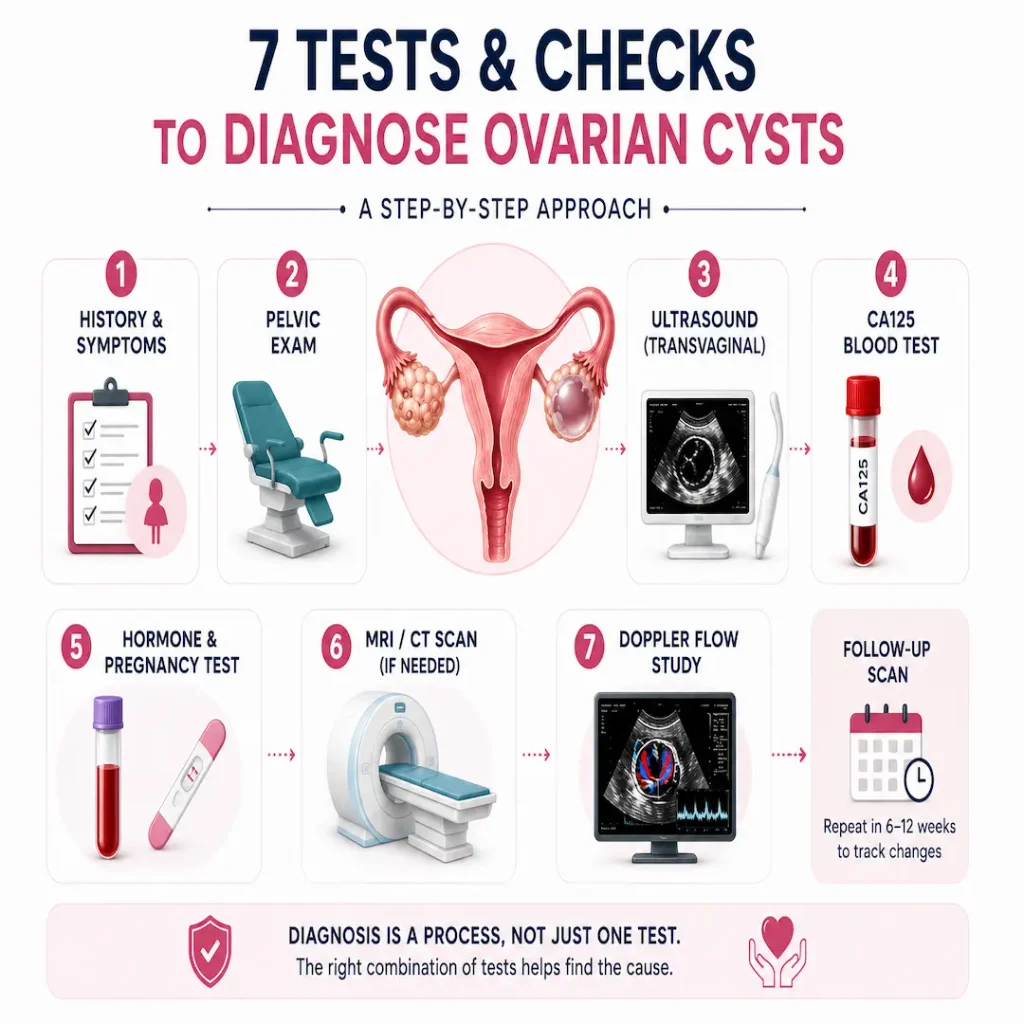
The 7 Tests and Checks Used in Ovarian Cyst Diagnosis
Doctors rarely jump straight to imaging. The sequence below is what most gynecology visits actually follow.
1. Symptom and Medical History Review
Pain pattern, cycle timing, family history of ovarian or breast cancer, and pregnancy status all shape which tests get ordered next. A cyst found in a 22 year old with regular cycles is approached very differently from one found in a postmenopausal woman.
2. Pelvic Examination
A manual exam checks for tenderness, size and whether a mass can be felt at all. It cannot confirm what a cyst is, but it flags whether imaging needs to happen urgently or can be scheduled routinely.
3. Transvaginal or Pelvic Ultrasound
This is the test that actually confirms a cyst exists and describes it. An ovarian cyst ultrasound reads fluid pattern, wall thickness, septations and blood flow, and remains the first choice among the standard tests for ovarian cysts in most clinics.
4. CA125 Blood Test
This blood test measures a protein that can rise with certain ovarian conditions, including some cancers, though plenty of noncancerous conditions raise it too. According to Mayo Clinic’s CA 125 test overview, it works best alongside imaging rather than as a standalone screening tool, and is not routinely ordered for a simple, small cyst.
5. Hormone and Pregnancy Blood Panel
A pregnancy test rules out an ectopic pregnancy or corpus luteum cyst of pregnancy. Hormone levels can also help explain cysts linked to PCOD or unusual ovulation patterns.
6. MRI or CT Scan
When ultrasound leaves a cyst’s nature unclear, an MRI adds detail on tissue composition, which is particularly useful for telling a dermoid cyst apart from a cystadenoma. CT is used less often, mainly when checking for spread beyond the ovary is the concern.
7. Doppler Flow Study
Doppler ultrasound checks whether a cyst has its own blood supply. Unusual blood flow patterns can point toward a structural cyst rather than a functional one, and help assess the risk of torsion in a cyst causing sudden pain.
What These Tests Can and Cannot Tell You
Imaging is very good at describing size, shape and fluid pattern. It is far less certain at ruling cancer in or out with total confidence, especially in cysts with mixed features. A Cleveland Clinic Journal of Medicine review of incidental ovarian cysts notes that most cysts found unexpectedly on scans done for other reasons are benign, yet a meaningful share still warrant a second look before anyone is reassured completely. That gap between a reassuring scan and total certainty is exactly why doctors lean on a second test, or time itself, before closing the case.
Why a Follow Up Scan Gets Recommended So Often
A repeat scan 6 to 12 weeks after the first one is not doctors being cautious for no reason. It answers a question a single image cannot: is this cyst shrinking, staying the same, or growing? That trend line often tells more than the first scan alone.
- Simple cysts under 5 centimeters typically get one follow up scan to confirm resolution
- Cysts that shrink or disappear need no further testing
- Cysts that persist or grow move toward CA125 testing, MRI or a surgical opinion
- Postmenopausal patients with any new cyst usually get closer monitoring regardless of size
Ovarian Cyst Diagnosis in Mohali, Chandigarh and Punjab
Ovarian cyst diagnosis Mohali clinics offer follows the same sequence used across the region, and a patient booking an ovarian cyst scan Chandigarh facility performs will go through an identical order of history, exam and ultrasound before anything else gets added. Any ovarian cyst doctor Punjab patients consult should be willing to explain exactly which scan feature is driving each next step, rather than moving straight to a recommendation without walking through the reasoning.
Our ovarian cyst specialist team follows this same stepwise process for each new patient, since skipping ahead to a treatment recommendation without a proper diagnosis tends to create more anxiety than it resolves. Once a scan report is in hand, matching it against the types of ovarian cysts article helps make sense of the terminology before your appointment even starts.
A precise ovarian cyst diagnosis is what makes each decision after it easier, from a simple repeat scan to a surgical referral. Bring your actual scan images or report to any consultation rather than a verbal summary, since the details doctors look for rarely survive translation into a phone call.
Frequently Asked Questions
1. How do doctors diagnose an ovarian cyst?
Diagnosis typically starts with a symptom history and pelvic exam, followed by a transvaginal or pelvic ultrasound, which confirms the cyst and describes its size and appearance. If the scan looks complex, is large, or symptoms suggest a specific cause, doctors add a CA125 blood test, hormone panel, MRI or Doppler study. Most simple cysts need nothing beyond the ultrasound and a repeat scan weeks later to confirm they have resolved. The exact combination of tests depends on age, symptoms and what the first scan shows, not a fixed checklist applied uniformly.
2. Does an ultrasound always show an ovarian cyst?
Ultrasound picks up the large majority of ovarian cysts, since it directly visualizes fluid filled structures well. It can occasionally miss very small cysts, or struggle with cysts obscured by bowel gas or a retroverted uterus. Timing also matters, since a functional cyst can appear on one scan and be gone by a repeat scan weeks later simply because the cycle moved on. When a scan is inconclusive, a repeat ultrasound at a different point in the cycle, or an MRI, usually resolves the uncertainty.
3. What blood test shows an ovarian cyst?
No blood test detects a cyst directly, since cysts are physical structures seen on imaging, not substances measured in blood. The CA125 test measures a protein that can rise with certain ovarian conditions, and gets used alongside ultrasound rather than in place of it, mainly to help judge whether a complex looking cyst needs closer evaluation. A pregnancy test and hormone panel are sometimes added too, less to find the cyst itself and more to understand what might be causing it.
4. Can an ovarian cyst be missed on ultrasound?
It happens, though not often. Very small cysts, ones located awkwardly behind bowel loops, or cysts present only briefly during a specific cycle phase can be missed on a single scan. This is part of why doctors sometimes recommend a repeat ultrasound rather than treating one scan as the final word, particularly if symptoms persist despite a clear looking initial report. A transvaginal approach, done by an experienced sonographer, catches far more than an abdominal scan alone.
5. Why did my doctor recommend a follow up scan instead of treatment?
Because most cysts resolve on their own, and a follow up scan is often the fastest way to confirm that without exposing anyone to unnecessary medication or surgery. A repeat scan 6 to 12 weeks later shows whether the cyst has shrunk, stayed the same or grown, and that trend guides the next step far better than a single snapshot. Watching is an active diagnostic decision, not a delay, and it is the standard recommendation for simple cysts under 5 centimeters in reproductive aged women.
6. Is a CA125 test necessary for all ovarian cysts?
No. CA125 is not routinely ordered for a simple, small cyst in a young patient, since the test is not accurate enough to serve as a general screening tool and can be raised by common, harmless conditions such as fibroids or menstruation itself. It becomes more relevant when a cyst has complex or solid features on ultrasound, when the patient is postmenopausal, or when a strong family history of ovarian or breast cancer exists. Your gynecologist will explain the specific reason if it is recommended in your case.
7. How accurate is ultrasound for diagnosing ovarian cysts?
Ultrasound is highly accurate at identifying that a cyst exists and describing its basic features, such as size and fluid pattern. It is somewhat less precise at predicting with certainty whether a cyst is functional, structural or, rarely, cancerous, particularly for cysts with mixed solid and fluid components. That is the main reason a second opinion, a repeat scan or additional tests like MRI sometimes follow an ultrasound that already looks fairly clear, rather than the ultrasound being treated as the final answer on its own.
8. Can an MRI confirm if an ovarian cyst is cancerous?
An MRI improves confidence significantly but does not offer absolute certainty on its own. It is particularly useful for distinguishing tissue types, such as telling a dermoid cyst apart from a solid tumor, and for characterizing cysts that looked ambiguous on ultrasound. In cases where imaging still cannot settle the question, a surgical biopsy remains the only way to confirm a diagnosis with complete certainty, which is why MRI is used to guide the next decision rather than replace it.
9. Do I need to fast before an ovarian cyst ultrasound?
Usually not for a transvaginal ultrasound, though a full bladder is sometimes requested for an abdominal pelvic scan since it helps push the bowel out of the imaging path. Fasting requirements, if any, are typically about associated blood tests rather than the scan itself. Ask the clinic directly when booking, since preparation can vary slightly depending on which specific ultrasound approach they plan to use for your appointment.
10. How long does it take to get an ovarian cyst diagnosis?
An initial diagnosis, meaning confirmation that a cyst exists and a first read on its type, usually happens the same day as your ultrasound. A fuller picture, including whether it is resolving on its own, generally takes the full follow up window of 6 to 12 weeks, since that is what the trend on a repeat scan is meant to show. Cases needing MRI, blood work or a specialist opinion can take a few additional days to weeks, depending on how quickly those results come back.