A patient who can walk a full kilometre on a treadmill but cannot cross a flat parking lot without stopping is not imagining things. That specific pattern, pain that eases when you lean forward or sit down, is one of the clearest clinical clues of spinal stenosis, and it is why the condition often gets missed for months before anyone connects the dots. If your legs feel heavy, tingly, or unreliable after short walks, understanding spinal stenosis treatment in Mohali starts with recognizing this pattern early, not after it has already changed how you move through your day.
Key Takeaways
- Spinal stenosis is a narrowing of the spinal canal that puts pressure on nerves, most often in the lower back
- Leg pain that eases with forward bending and worsens on standing is a classic symptom pattern, not a coincidence
- Most patients manage well with physiotherapy, medication, and activity changes before surgery is ever discussed
- Progressive weakness, foot drop, or loss of bladder or bowel control need urgent specialist evaluation
- Book a consultation with a spine specialist in Mohali for an accurate diagnosis before assuming surgery is the only option.
What Spinal Stenosis Actually Means for Your Spine
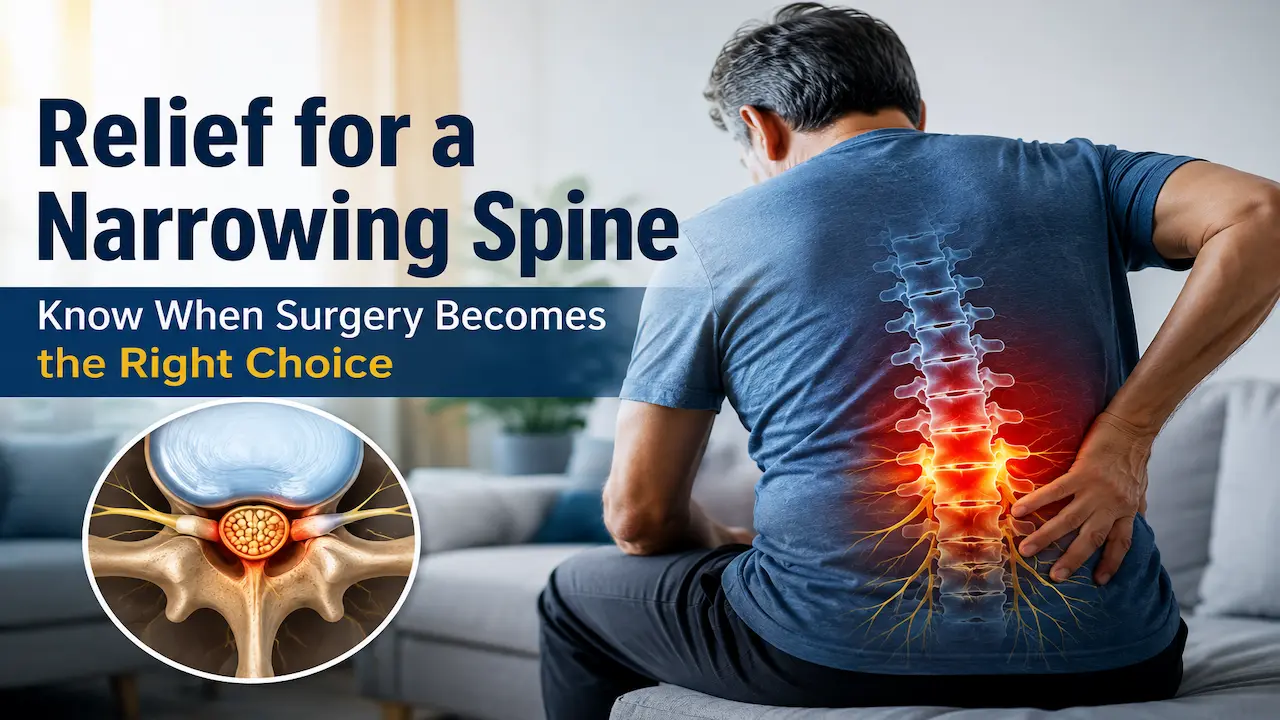
Spinal stenosis is the narrowing of the open spaces within the spine, which puts pressure on the spinal cord and the nerve roots that branch out from it. This narrowing most often develops in the lower back, where it is called lumbar stenosis, though it can also occur in the neck. Getting this distinction right early is the foundation of effective spinal stenosis treatment in Mohali, since where the narrowing sits changes which symptoms show up first. The pressure builds gradually, which is why symptoms tend to creep in rather than arrive all at once.
The canal that houses your spinal cord is meant to have room to spare. When bone, disc material, or thickened ligament tissue eats into that space, the nerves inside have nowhere to go. Some people with narrowing on an MRI feel almost nothing. Others, with what looks like a similar degree of narrowing, develop pain that limits every walk to the market. The degree of visible narrowing and the intensity of symptoms do not always match, which is one reason a specialist examination matters as much as the scan itself.
Early Spinal Stenosis Symptoms Patients Often Dismiss
Most people do not associate leg pain with their spine. They assume it is a knee problem, poor circulation, or simply age catching up. The symptoms below are the ones that should prompt a proper evaluation rather than a wait and watch approach.
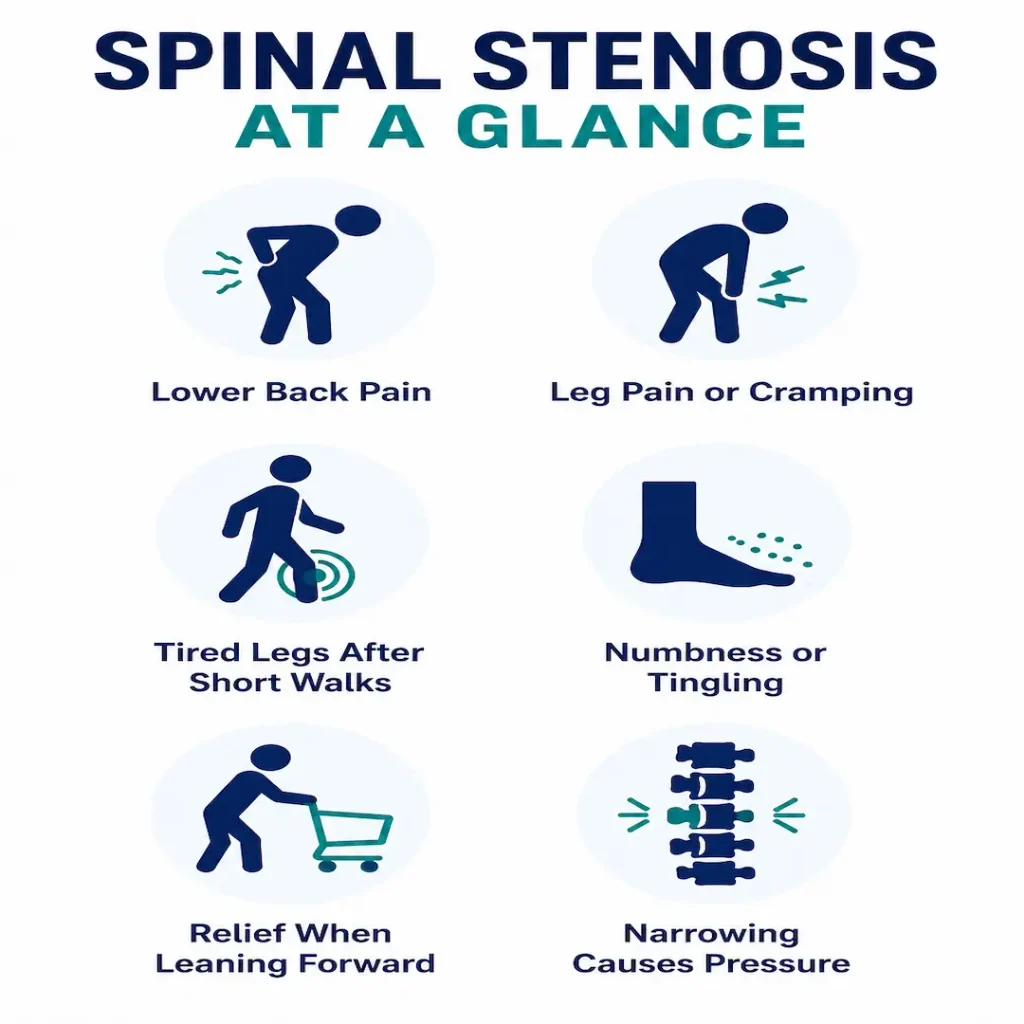
- Low back pain that comes and goes, often worse after standing for long periods
- Pain, cramping, or a burning sensation that starts in the buttocks and travels down one or both legs
- A heavy or tired feeling in the legs that sets in after walking a short distance
- Tingling or numbness in the feet, sometimes described as walking on cotton
- Relief when bending forward, sitting, or leaning on a shopping cart, and worsening when standing upright
This last point is what doctors call neurogenic claudication, and it is one of the most reliable signs that separates spinal stenosis from ordinary muscular back pain. Walking difficulty that improves with forward bending is rarely a coincidence.
What Causes Lumbar Stenosis to Develop
Spinal stenosis is rarely the result of one single event. It usually builds up over years through a combination of changes in the spine.
- Age related wear, where the discs between vertebrae lose height and the joints thicken as part of natural degeneration
- Bone spurs, small bony growths that form as the body reacts to worn cartilage and gradually intrude into the canal
- Thickened ligaments, particularly the ligamentum flavum, which can stiffen and bulge inward with age
- A herniated or slipped disc that pushes disc material backward into the spinal canal
- A congenital narrow canal, present from birth, which gives someone less spare room before symptoms start
- Past spinal injury or previous spine surgery that alters the shape of the canal
According to Mayo Clinic, degenerative changes linked to osteoarthritis are the most common underlying cause, which is why spinal stenosis is seen far more often in adults over 50. That said, a congenital narrow canal or an old injury can bring on symptoms much earlier, and specialists in Mohali regularly see patients in their twenties and thirties for exactly this reason.
How Nerve Compression in the Spine Is Diagnosed
A clinical exam alone can point strongly toward spinal stenosis, but confirming it and planning treatment properly requires imaging. A neurosurgeon typically works through the following steps.
- A detailed history of when the pain started, what worsens it, and what relieves it
- A physical exam checking walking pattern, reflexes, muscle strength, and areas of numbness
- An MRI scan, which remains the most detailed way to see nerve compression, disc material, and ligament thickening
- X rays to check alignment, bone spurs, and any instability between vertebrae
- In select cases, a CT scan or nerve conduction study to rule out other causes of leg pain
An MRI report describing narrowing does not automatically mean surgery is the next step. The report is one part of the picture; how it lines up with your actual symptoms is what guides the treatment plan.
Non Surgical Options That Come Before Spinal Stenosis Surgery
Most people diagnosed with spinal stenosis do not need an operation right away, and many manage the condition for years through conservative care. In fact, the first stage of spinal stenosis treatment in Mohali almost always starts here, well before surgery is ever discussed. The goal of early treatment is to reduce nerve irritation and keep you moving, since prolonged inactivity tends to make stiffness and weakness worse rather than better.
| Treatment | What It Involves | Best Suited For |
|---|---|---|
| Physiotherapy | Core strengthening, flexion based stretching, posture correction | Mild to moderate symptoms without neurological deficit |
| Medication | Anti inflammatory drugs, short courses of muscle relaxants, nerve pain medication | Flare ups and acute pain episodes |
| Epidural steroid injections | Targeted anti inflammatory injection near the compressed nerve root | Localized leg pain not responding to medication alone |
| Activity modification | Inclined treadmill walking, cycling, avoiding prolonged standing | Patients wanting to stay active without triggering symptoms |
Leaning forward while walking, on an inclined treadmill for instance, opens up the spinal canal slightly and can noticeably ease pressure on the nerves. Many patients find this single adjustment more useful than they expect. Weight management and avoiding activities that involve repeated arching of the lower back also help reduce strain on an already narrowed canal.
When Spinal Stenosis Surgery Becomes Necessary
Surgery is not the default path for spinal stenosis. It becomes the recommended option when conservative care has been genuinely tried and symptoms are not improving, or when specific warning signs point to active nerve damage rather than simple discomfort.
The following signs generally call for prompt specialist assessment rather than continued observation:
- Progressive weakness in the legs or a feeling that the leg is giving way while walking
- Numbness or weakness severe enough to interfere with daily walking
- Foot drop, where lifting the front of the foot becomes difficult
- Loss of bladder or bowel control, which is treated as an emergency and needs same day evaluation
- Symptoms that keep worsening despite months of physiotherapy and medication
Per the NHS, sudden loss of bladder or bowel control alongside numbness around the saddle area is a red flag symptom that needs urgent medical attention, since it can signal significant compression that will not resolve on its own. Progressive muscle weakness is treated with similar urgency, because delayed intervention raises the risk of nerve damage that does not fully reverse even after surgery.
Types of Spinal Stenosis Surgery Explained Simply
When surgery is recommended, the specific procedure depends on how much of the canal is narrowed, whether there is any spinal instability, and which level of the spine is affected.
| Procedure | What It Does | Typically Used When |
|---|---|---|
| Laminectomy | Removes the back portion of the vertebra (the lamina) to directly relieve pressure on the nerves | Stenosis without significant spinal instability |
| Microdiscectomy | Removes the portion of a herniated disc pressing on a nerve root | Disc material is the main cause of compression |
| Spinal fusion | Joins two or more vertebrae together so they no longer move against each other | Instability is present alongside the narrowing |
| Minimally invasive decompression | Relieves pressure through smaller incisions with less muscle disruption | Candidates suitable for a less invasive approach |
According to the Cleveland Clinic, a laminectomy on its own is often sufficient for straightforward stenosis, while fusion is generally reserved for cases where instability or spondylolisthesis accompanies the narrowing. Choosing between these approaches is a decision best made jointly between the patient and a neurosurgeon after reviewing the imaging in detail, not something to settle from a single opinion when the picture is unclear.
What Recovery After Spine Surgery Generally Involves
Recovery timelines vary from one patient to the next depending on age, overall health, and which procedure was performed. Most patients are encouraged to start gentle walking within a day or two of surgery, since movement supports healing rather than working against it. Physiotherapy usually follows once the surgical site has settled, focusing on gradually rebuilding core strength and walking tolerance. Your surgeon will set realistic expectations specific to your case, since no two spines respond in exactly the same way.
Finding the Right Spinal Stenosis Treatment in Mohali
Getting an accurate diagnosis matters as much as the treatment itself. A spine specialist in Mohali can review your MRI alongside a full clinical exam to work out whether physiotherapy and medication are enough, or whether your symptoms have crossed into territory that needs surgical evaluation. This is particularly useful when two different opinions do not agree, or when a report mentions narrowing but your doctor has not explained what it means for your specific symptoms.
Patients from Kharar, Zirakpur, and Panchkula travel into Mohali for this kind of assessment regularly, since access to an experienced neurosurgeon in Mohali means imaging, diagnosis, and a treatment plan can often be sorted out in a single visit rather than several weeks of back and forth. If your symptoms include leg weakness, walking difficulty, or numbness that is not improving, it is worth booking a consultation rather than waiting for the next flare up to decide.
A slip disc or broader spinal degeneration can produce symptoms that overlap with spinal stenosis. A proper clinical evaluation is what separates a condition that needs watching from one that needs a plan.
Spinal stenosis treatment in Mohali comes down to an accurate diagnosis, a treatment plan matched to how severe your symptoms actually are, and timely surgical evaluation when specific warning signs appear. Most people never need an operation. For those who do, catching the right window matters more than the procedure itself.
Frequently Asked Questions
1. What are the early warning signs of spinal stenosis?
The earliest signs are usually low back pain that comes and goes, along with pain that starts in the buttocks and travels down one leg. Many patients also describe a heavy or tired feeling in the legs after walking even a short distance, sometimes progressing into cramping. These symptoms often develop slowly over months, which is why they get mistaken for general fatigue or ageing rather than a spine problem. If pain consistently improves when you sit down or lean forward, and returns when you stand upright again, that pattern is worth mentioning specifically to a doctor, since it points toward nerve compression rather than a muscular issue.
2. Can spinal stenosis be treated without surgery?
Yes, in most cases. A large proportion of people diagnosed with spinal stenosis manage their symptoms through physiotherapy, anti inflammatory medication, activity changes, and occasionally epidural injections, without ever needing an operation. Moderate exercise that involves leaning forward, such as walking on an inclined treadmill or cycling, tends to ease pressure on the compressed nerves and is often recommended early on. Surgery becomes part of the conversation only when these measures stop working or when specific neurological symptoms appear. Your specialist will usually suggest a trial period of conservative treatment before recommending anything more involved.
3. What symptoms mean spinal stenosis needs surgery right away?
Surgery is generally recommended without delay when there is numbness or weakness severe enough to interfere with walking, when bladder or bowel function is affected, or when other neurological symptoms appear alongside the usual back and leg pain. These signs suggest that a nerve is under significant pressure rather than simply irritated, and they are treated differently from pain that stays at a manageable, stable level. If you notice any of these changes, particularly a sudden loss of bladder or bowel control, that situation calls for same day medical evaluation rather than scheduling a routine appointment.
4. Is walking difficulty or legs giving out a serious sign?
Yes, this is treated as a meaningful symptom rather than something to brush off. A leg that feels like it is buckling, shaky, or unreliable while walking, especially if you find yourself leaning on a shopping cart or railing for support, points toward active nerve compression rather than ordinary muscle fatigue. Progressive weakness like this is different from pain alone, since it suggests the nerve supplying that muscle is struggling to do its job properly. It is one of the clearer indicators that a specialist should assess your spine rather than waiting to see if it settles on its own.
5. Does spinal stenosis always require surgery eventually?
No, and this varies considerably from person to person. Many patients manage their symptoms for years through physiotherapy, core strengthening, and adjustments to daily activity, without their condition ever progressing to the point of needing surgery. Others notice a faster decline, particularly if neurological symptoms like weakness or numbness develop, and may need surgical evaluation within months of diagnosis rather than years. The deciding factor is how your specific symptoms behave over time, not simply having narrowing visible on a scan. Regular follow up with your specialist helps track whether your case is staying stable or progressing.
6. What happens if spinal stenosis surgery is delayed too long?
Leaving significant nerve compression untreated for an extended period carries a real risk of lasting nerve damage, particularly once weakness or numbness has already set in. This does not mean every case needs urgent surgery, since many people live with mild to moderate stenosis for years without complications. However, once clear warning signs appear, such as progressive weakness, foot drop, or bladder and bowel changes, delaying evaluation increases the chance that some nerve related symptoms will not fully resolve even after treatment. This is why these particular symptoms are treated with more urgency than pain alone.
7. Can spinal stenosis affect the knees, hips, or other joints?
It can produce symptoms that feel like they belong to the knees, hips, or thighs, even though the underlying problem sits in the lower spine. This happens because compressed nerve roots in the lumbar spine travel down into the leg, so irritation at the spine level can be felt as cramping, aching, or a buckling sensation much lower down. Patients sometimes see an orthopaedic specialist for knee or hip pain first, only to find the actual source is spinal nerve compression once imaging is done. If joint pain is accompanied by back pain or symptoms that shift with posture, mentioning both to your doctor helps get to the right diagnosis faster.
8. Is spinal stenosis linked to aging, or can younger people get it too?
Age is the single biggest risk factor, since degenerative changes in the spine become increasingly common after 50 and are present to some degree in the large majority of people by that age. That said, spinal stenosis is not exclusively a condition of older adults. A congenital narrow spinal canal, present from birth, can bring on symptoms much earlier in life, and a past spinal injury can also accelerate the process. Specialists in Mohali do see patients in their teens, twenties, and thirties with confirmed stenosis, usually linked to one of these two factors rather than typical age related wear.
9. What is foot drop, and can it improve without surgery?
Foot drop describes difficulty lifting the front of the foot while walking, which often causes a dragging or slapping motion of the foot with each step. It usually signals meaningful pressure on the nerve controlling that muscle group. Some mild, early cases do improve with focused physiotherapy if the underlying compression is addressed quickly, but foot drop that persists or worsens is generally viewed as a stronger indicator for surgical evaluation. The longer significant weakness continues uncorrected, the higher the chance that some of it becomes permanent, which is why this particular symptom tends to move a case toward earlier specialist review.
10. What is the difference between a laminectomy and spinal fusion for stenosis?
A laminectomy removes the back portion of the affected vertebra, called the lamina, to create more room and relieve direct pressure on the compressed nerves. Spinal fusion goes a step further by joining two or more vertebrae together so they no longer move independently, which is generally used when there is instability alongside the narrowing rather than narrowing on its own. Fusion is a more involved procedure with a longer recovery, so it is not the default choice for straightforward stenosis. Your surgeon will recommend one, the other, or a combination based on your imaging and whether any instability is present.