

India has one of the highest headache burdens in the world. A 2024 study published in the Journal of Headache and Pain found that 34.1% of adults in North India suffer from tension-type headache and 26.3% from migraine.
More striking: 3% of the adult population experiences headache on 15 or more days every month, which by medical definition qualifies as chronic daily headache. That is tens of millions of people waking up every day with head pain they cannot explain and cannot consistently stop.
If you are searching for what causes headaches everyday, you already know this is not a one-off problem. The head pain keeps coming back. Paracetamol helps for a few hours, then the headache returns. You are tired of managing it and want to understand what is actually behind it.
Dr. Jaspreet Singh Randhawa, neurosurgeon at Medisyn Neuro and Gynae Centre, has evaluated hundreds of patients struggling with daily or near-daily headaches. In his experience, when patients ask “What Causes Headaches Every Day?”, the answer is often not random stress or weakness, but an underlying neurological, lifestyle, cervical, sinus, sleep-related, or vascular issue that needs proper evaluation. The real problem is that many patients keep taking painkillers for temporary relief without ever finding the actual cause behind their recurring headaches.
First: What Medically Qualifies as a “Daily” Headache?
A headache occurring on 15 or more days per month for at least 3 consecutive months is classified as Chronic Daily Headache (CDH) by the International Classification of Headache Disorders (ICHD-3).
and
If your head hurts most days of the week, you are in this category regardless of whether each episode feels exactly the same.
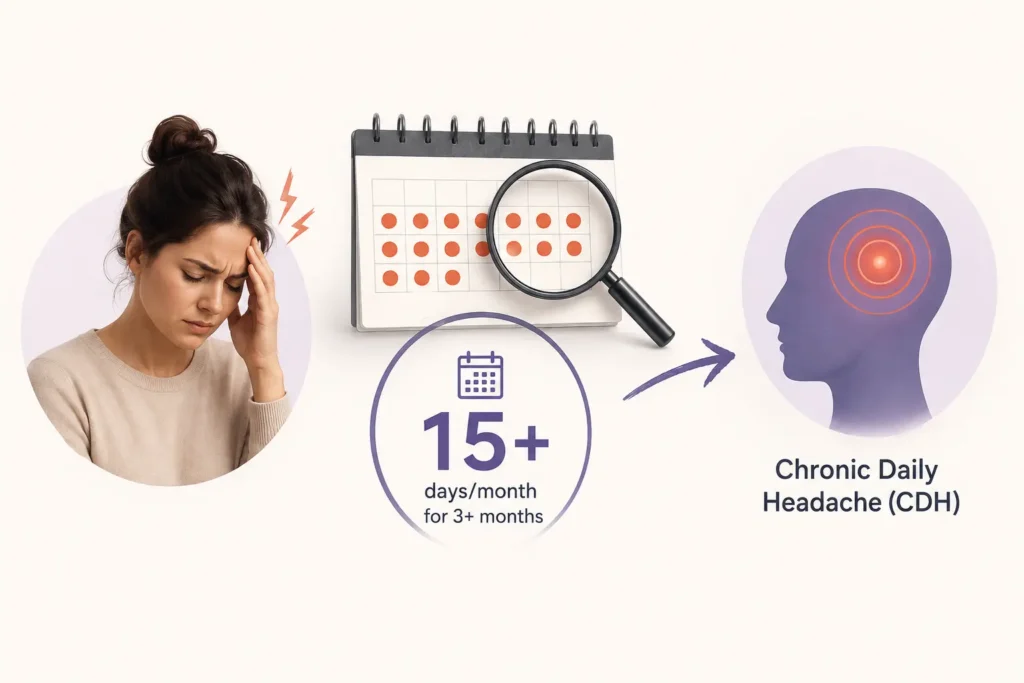
CDH is not one diagnosis. It is an umbrella covering at least four distinct headache types, each with a different cause and a different treatment path:
| Type | Key Feature | Typical Duration per Episode |
|---|---|---|
| Chronic Tension-Type Headache | Pressure band around head, both sides | 30 minutes to several hours |
| Chronic Migraine | Throbbing, often one-sided, nausea present | 4 to 72 hours |
| Medication Overuse Headache | Daily, worse in morning, improves with tablet | Present most of the day |
| New Daily Persistent Headache | Sudden onset, can recall exact date it started | Continuous, does not go away |
Knowing which type you have is not a minor detail. The wrong treatment for the wrong type either does nothing or makes the headache worse. This is precisely why so many people spend years taking painkillers that are quietly turning their occasional headache into a daily one.
Can a headache every day be serious? Most daily headaches are primary, meaning not caused by a dangerous underlying condition. A smaller group are secondary to something else. The distinction is made clinically by a neurologist, not by how severe the pain feels.
The 7 Most Common Causes of Headaches Every Day
1. Tension Headache: The Most Overlooked Daily Headache Cause
Tension-type headache accounts for 34.1% of headache prevalence in India, making it the single most common headache type. When it becomes chronic, the pressure band around the head is there most days, sometimes constant, sometimes building through the day.
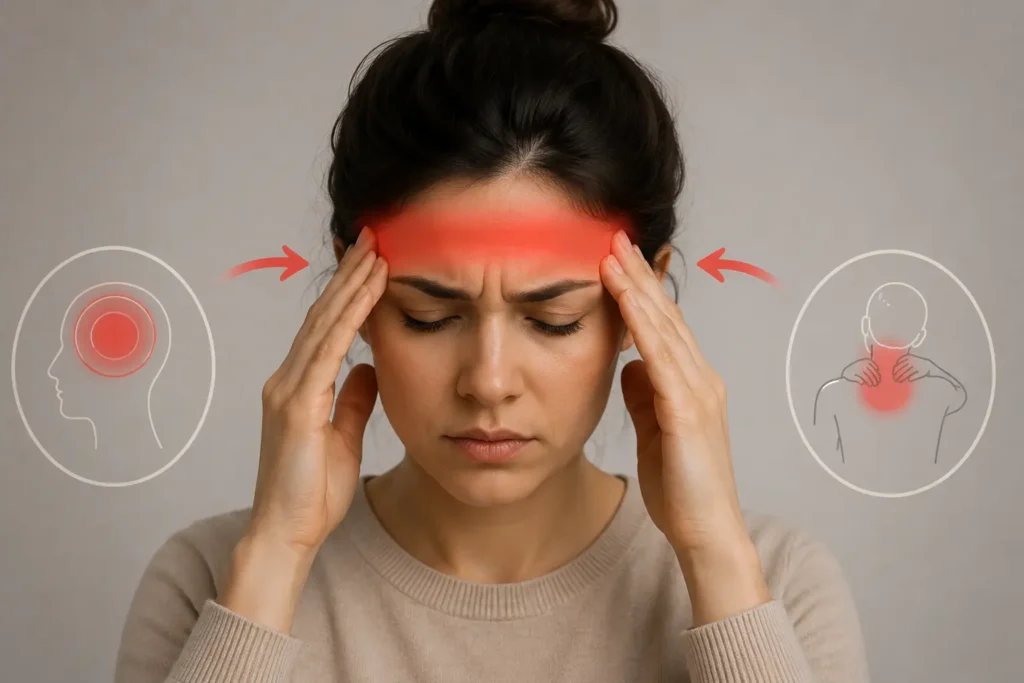
The pain is bilateral, meaning both sides of the head are affected. It feels like tightness, pressure, or a dull ache rather than throbbing. Unlike migraine, it rarely causes nausea and is not worsened significantly by physical activity.
What drives it to become daily:
- Sustained poor posture at a desk or while using a mobile phone, keeping neck and shoulder muscles in constant low-grade contraction
- Unresolved chronic stress, which keeps the nervous system in a state of heightened sensitivity
- More than 6 consecutive hours of screen use without adequate breaks
- Jaw clenching or teeth grinding during sleep, which creates sustained muscle tension radiating to the head
- Skipping meals, dropping blood sugar, and causing a reflexive tightening in the muscles around the skull
Why does my head hurt every day at the back of my head and neck? This pattern, pain starting at the base of the skull and spreading forward, is the most common presentation of chronic tension headache, almost always driven by cervical muscle tension and posture. It is distinct from migraine and usually responds well to physiotherapy targeting the cervical spine.
Dr. Jaspreet Singh Randhawa notes: “The single most common mistake I see with tension headache patients is that they treat the pain but not the posture. A person sitting 8 hours a day with the head forward over a laptop will keep getting daily headaches until that mechanical problem is corrected, regardless of what medication they take.”
People dealing with this pattern often find answers in the article on how to tell migraine apart from a tension headache, since the two are regularly confused and require completely different management.
2. Medication Overuse Headache: The Cause Hidden Inside the Treatment
Many patients searching for answers to “What Causes Headaches Every Day?” are surprised to learn that frequent painkiller use itself can sometimes become the reason headaches turn daily. A 2024 Delhi study found a 3% prevalence of probable medication overuse headache (pMOH) in North India, with women nearly five times more likely to develop it than men.
Here is how it happens. You get a headache. You take a painkiller. It works. The headache comes back the next day. You take another painkiller. Over weeks and months, the brain adapts to the constant presence of the medication. When the drug level drops, the brain interprets this as a signal to produce more pain. You take more medication. The headache becomes daily. The tablet that was treating the headache is now causing it.
The threshold is lower than most people realise:
- Simple analgesics (paracetamol, aspirin, ibuprofen): overuse defined as 15 or more days per month
- Triptans and combination analgesics (tablets containing caffeine): overuse defined as 10 or more days per month
- Opioids: overuse defined as 10 or more days per month
Why does my headache come back every time the tablet wears off? This is medication overuse headache until proven otherwise. The only way to confirm it and break the cycle is under neurological supervision. Stopping the medication abruptly without guidance typically causes a severe rebound headache for several days before improvement begins.
If you suspect this pattern, do not stop your medication without speaking to a doctor. Dr. Jaspreet Singh Randhawa manages medication overuse headache at Medisyn’s headache clinic in Mohali, and the detoxification process is far more manageable with proper guidance than people expect.
3. Chronic Migraine: When Episodic Attacks Become Everyday Pain
Migraine affects 26.3% of adults in North India. Of those, approximately 2 to 3% transition from episodic to chronic migraine every year. Chronic migraine is defined as headache occurring on 15 or more days per month, with at least 8 of those days meeting full migraine criteria: one-sided, throbbing, moderate to severe, accompanied by nausea or sensitivity to light and sound.
The remaining days often feel like tension headaches, which is why many patients with chronic migraine are misdiagnosed and undertreated. They report “a bad headache and a normal headache” happening on different days, not realising both are part of the same condition.
Factors that accelerate the transition from episodic to chronic migraine:
- Medication overuse, the most powerful driver of chronification
- Untreated anxiety or depression, both of which lower the brain’s pain threshold
- Obesity, which is associated with increased inflammatory mediators that sensitise pain pathways
- Caffeine excess, particularly more than 200mg daily (roughly 2 to 3 cups of coffee)
- Irregular sleep, including both insufficient sleep and excessive sleep on weekends
Women with migraine that worsens around their periods, worsens on oral contraceptives, or was severe during a previous pregnancy should read the detailed article on migraine during pregnancy and hormonal triggers for a complete explanation of estrogen’s role in headache frequency.
4. Dehydration: The Daily Headache Cause Most People Dismiss
The brain is cushioned by cerebrospinal fluid and surrounded by tissue that is approximately 75% water. Even a 1 to 2% drop in body hydration level is enough to trigger a measurable change in brain volume, creating tension on the meninges (the membranes surrounding the brain) and causing a headache.
Dehydration headache has a recognisable pattern:
- Dull, throbbing, or pressure-like pain across the entire head
- Worsens when standing or moving, improves slightly when lying down
- Accompanied by dark urine, dry mouth, or a sensation of fatigue
- Often worst in the late afternoon or early evening
- Improves within 30 to 60 minutes of drinking 500ml of water
Why do I always have a headache by evening? If you start the day without much water, have tea or coffee (both mild diuretics) through the morning, skip water during work hours, and then wonder why your head hurts by 4pm, dehydration is almost certainly a significant contributor. Most adults in Punjab, particularly those working in air-conditioned environments, drink far less water than the recommended 2 to 2.5 litres daily.
5. Poor and Irregular Sleep: The Bidirectional Headache Trigger
Sleep and headache have a bidirectional relationship. Poor sleep triggers headaches, and daily headaches disrupt sleep, creating a cycle that gets harder to break the longer it continues.
The pain threshold of the nervous system is reset during deep sleep. When sleep is insufficient (fewer than 6 hours) or fragmented, this reset does not happen properly. Pain-sensitising neurotransmitters accumulate, and the next day the threshold for triggering a headache is lower. This is why a headache on Monday following a short Sunday night is not a coincidence.
Sleep apnea deserves specific mention. It is a frequently missed cause of daily morning headaches. During apneic episodes, oxygen levels drop repeatedly through the night. The resulting carbon dioxide accumulation dilates blood vessels in the brain and causes a headache that is typically worst immediately on waking and improves significantly within 30 minutes of getting up. If your morning headache reliably clears once you are moving around, and you snore or feel unrefreshed despite adequate sleep hours, sleep apnea should be investigated.
6. Caffeine Dependence: The Headache You Are Drinking Into Existence
Caffeine is one of the most widely consumed psychoactive substances in the world, and it has a direct relationship with daily headaches in both directions. In small amounts it constricts blood vessels and can relieve a headache. This is why caffeine is included in many combination headache tablets. But regular consumption above roughly 200mg daily (approximately 2 cups of coffee or 4 cups of strong tea) creates physical dependence.
When the caffeine level in the body drops below the dependent threshold, which happens within 12 to 24 hours of the last intake, a withdrawal headache develops. It is bilateral, throbbing, and often accompanied by irritability and difficulty concentrating. It relieves rapidly with the next cup of tea or coffee, which reinforces the cycle.
Why do I always have a headache in the morning before my first cup of tea? This is caffeine withdrawal. The overnight gap between your last cup the previous evening and the first cup the next morning is long enough to trigger a withdrawal headache in anyone with moderate to high daily caffeine intake. The headache does not mean you need more caffeine. It means you have developed a dependence that needs gradual, structured reduction.
7. Secondary Causes: When a Daily Headache Is a Symptom of Something Else
A smaller but medically important group of daily headaches are caused by an underlying condition. These are called secondary headaches because the headache is a symptom, not the primary problem. Treating the headache alone without identifying the underlying cause will never produce lasting relief.
| Underlying Condition | Headache Pattern | Associated Features |
|---|---|---|
| Chronic Sinusitis | Pressure across forehead and cheeks, worse when bending forward | Nasal congestion, post-nasal drip |
| Hypertension | Occipital (back of head), worse in morning | BP above 180/120 on measurement |
| Hypothyroidism | Diffuse, dull, daily, often with fatigue | Weight gain, cold intolerance, hair loss |
| Anaemia | Dull, persistent, worsens with exertion | Fatigue, pallor, breathlessness |
| Cervicogenic (neck origin) | One-sided, starts at neck, radiates to temple or eye | Neck stiffness, worse with neck movement |
| Intracranial Pressure Change | Positional, worse lying down or straining | Visual changes, pulsatile tinnitus |
Dr. Jaspreet Singh Randhawa explains: “When a patient comes to me with headaches everyday for 6 months, my first job is not to prescribe a painkiller. My first job is to rule out the 10 to 15 conditions that can present as a daily headache before calling it primary. A thyroid test, a blood pressure reading, and a basic blood count take 20 minutes and have changed the diagnosis and treatment plan of more patients than I can count.”
According to Mayo Clinic, chronic daily headaches that persist for 15 or more days monthly require careful evaluation to distinguish primary headache disorders from secondary causes, as the treatment approach differs significantly between the two.
The Pattern That Reveals What Type of Daily Headache You Have
Rather than guessing, matching your headache pattern to the clinical features below gives a strong indication of which cause applies to you:
| Your Headache Pattern | Most Likely Cause |
|---|---|
| Tight band, both sides, worse with stress, screen use | Chronic tension-type headache |
| Daily, worst in morning, relieves 30-60 min after waking | Medication overuse headache or sleep apnea |
| Throbbing, one side, nausea, worse in light or noise | Chronic migraine |
| Starts at back of neck, spreads forward, worse with neck movement | Cervicogenic headache |
| Worse before morning tea, improves within 20 min of drinking it | Caffeine withdrawal headache |
| Present every day since a specific memorable date with no prior history | New Daily Persistent Headache (NDPH) |
| Forehead pressure, worse when bending, associated with blocked nose | Chronic sinusitis |
Why does my head hurt every day even when I am not stressed? Stress is one trigger among many. A headache that persists on days without obvious stress is usually driven by physical factors such as posture, dehydration, sleep quality, caffeine, or medication use, rather than emotional state alone.
6 Warning Signs That Mean Your Daily Headache Needs Urgent Neurological Attention
The following features change a daily headache from a primary pain disorder into a potential medical emergency. If any of these apply, do not wait for a scheduled appointment. Seek neurological evaluation promptly:
- The headache reached its maximum intensity within seconds of starting (thunderclap onset)
- The headache wakes you from sleep at night, particularly in the early morning hours
- The headache is progressively worsening week by week with no plateau
- The headache is accompanied by vision changes, confusion, weakness, slurred speech, or one-sided numbness
- The headache started after a head injury, even a minor one
- The headache has been daily for more than 3 months and has not responded to any form of treatment
These warning signs do not confirm a dangerous cause. They mean the probability of a secondary cause is high enough that investigation cannot be delayed. Research from the 2024 Delhi NCR headache study found that fewer than 25% of people with chronic headache in India had engaged with any healthcare service for their headache in the past year, meaning the majority are self-medicating conditions that may warrant clinical evaluation.
How Dr. Jaspreet Singh Randhawa Evaluates Daily Headaches at Medisyn

A thorough headache evaluation does not require a battery of expensive tests in every case. The clinical history is the most powerful diagnostic tool available. When a patient presents at Medisyn Neuro Centre in Mohali, the evaluation typically proceeds as follows:
- Headache history: Onset, frequency, duration, character of pain, location, severity, associated symptoms, and what makes it better or worse
- Medication review: A complete account of all medications taken for the headache, including frequency and dose, specifically to identify medication overuse
- Neurological examination: Assessment of eye movements, reflexes, coordination, and cognitive function to detect any neurological deficits
- Targeted investigations: Blood tests (thyroid, haemoglobin, blood pressure, blood sugar) where secondary causes are suspected
- Imaging: MRI or CT scan where red flag features are present, the headache pattern is unusual, or neurological signs are detected on examination
The goal is an accurate diagnosis, not a generic headache prescription. The treatment for chronic tension headache, chronic migraine, medication overuse headache, and secondary headache are fundamentally different from each other.
Patients who are also concerned about associated symptoms like dizziness, memory changes, or neurological episodes can find detailed information in the article on neurological symptom patterns and when they warrant investigation.
What Actually Stops Daily Headaches: Treatment That Works
Effective treatment is cause-specific. That said, several principles apply across most types of daily headache:
- Address medication overuse before anything else. If you are taking painkillers on more than 10 days per month, no preventive treatment will be fully effective until this is resolved. Detoxification under medical guidance is the first step.
- Regularise sleep. Consistent sleep and wake times, including weekends, reduce headache frequency measurably within 4 to 6 weeks. The brain’s pain regulation is tightly linked to circadian rhythm.
- Systematic hydration. 2 to 2.5 litres of water daily, not including tea or coffee. Simple, measurable, and underestimated by the majority of patients.
- Physiotherapy for cervicogenic and tension headaches. Targeted cervical mobilisation and posture correction from a qualified physiotherapist produces lasting improvement in patients whose headache originates in neck muscle tension or joint dysfunction.
- Preventive medication where indicated. For chronic migraine and high-frequency tension headache that does not respond to lifestyle changes, evidence-based preventive medications prescribed by a neurologist can reduce headache days by 50% or more within 3 months. These are not painkillers. They are taken daily regardless of whether a headache is present and work by reducing the underlying neurological sensitivity.
- Treat the underlying condition for secondary headaches. Correcting an underactive thyroid, controlling blood pressure, or treating sinusitis resolves the headache without requiring any headache-specific treatment.
For those experiencing headaches that started suddenly and without prior history, the article on why headaches can begin every day without warning covers the specific causes and clinical approach to new-onset daily headache.
For women whose daily headaches follow a cyclical pattern around periods, pregnancy, or perimenopause, the article on what causes headaches every day in females provides a complete breakdown of hormonal and female-specific triggers.
10 Questions People Actually Ask About Daily Headaches
1. Is it normal to have a headache every single day?
No. A headache on most days of the month has a specific medical explanation and a specific treatment. Daily headaches are common, not normal. The distinction matters because common problems that go unaddressed accumulate months and years of unnecessary pain and disability.
2. Why do I wake up with a headache every morning?
Morning headaches on waking are most commonly caused by one of four things: sleep apnea causing overnight oxygen drops, medication overuse headache where the drug level has dropped overnight, caffeine withdrawal if the body is dependent on a morning caffeine dose, or teeth grinding (bruxism) creating sustained jaw and temple muscle tension through the night. All four are diagnosable and treatable.
3. Can stress alone cause headaches every day?
Yes, but rarely in isolation. Chronic stress maintains muscle tension, disrupts sleep, drives caffeine consumption, and often leads to increased painkiller use, meaning stress usually causes daily headaches through three or four mechanisms simultaneously rather than through stress alone.
4. Why does my headache come back a few hours after taking a painkiller?
This is the defining feature of medication overuse headache. The brain has adapted to expect the medication. When blood levels drop, it responds with pain. The cycle requires supervised detoxification to break, not a stronger or different painkiller.
5. What is the difference between a constant headache and a daily headache?
A constant headache is present continuously without any pain-free periods. A daily headache may have brief periods of relief between episodes that recur each day. Truly constant headache with no relief at all raises the possibility of New Daily Persistent Headache or a secondary cause and warrants neurological assessment.
6. Can dehydration cause a headache every day?
Yes, if dehydration is chronic and mild rather than acute and severe. Most adults experiencing this drink fewer than 4 to 5 glasses of water daily and compensate with tea and coffee, which do not provide equivalent hydration and additionally have diuretic effects at higher quantities.
7. Why do I get a headache every day in the evening?
Evening headaches typically reflect accumulated tension from the day: postural strain, screen fatigue, caffeine wearing off, low blood sugar from delayed meals, and emotional decompression after sustained concentration. Addressing all of these simultaneously is more effective than treating the evening headache with a tablet once it arrives.
8. Can a daily headache be a brain tumour?
The vast majority of daily headaches are not caused by brain tumours. Brain tumour headaches typically have specific features: worst in the morning, accompanied by vomiting without significant nausea, worsened by straining or lying down, and often associated with neurological symptoms such as weakness, seizures, or personality change. This is very different from the usual patterns seen in patients searching for answers to “What Causes Headaches Every Day?” A headache that is daily but otherwise stable in character over months without neurological symptoms is very unlikely to have a structural cause. If you are concerned, a neurological assessment will clarify this.
9. How long does it take for daily headaches to get better with treatment?
With the correct diagnosis and treatment plan, most patients with chronic tension headache or medication overuse headache notice significant improvement within 4 to 8 weeks. Chronic migraine prevention typically requires 3 months of consistent preventive medication before full benefit is established. The earlier treatment is started, the faster and more complete the response.
10. When should I go to a neurologist for headaches that happen every day?
If your headaches have been occurring on most days for more than 4 weeks, if over-the-counter medication is no longer consistently effective, if the headaches are interfering with work or daily function, or if any of the 6 warning signs listed earlier apply, a neurological consultation is warranted. At Medisyn in Mohali, Dr. Jaspreet Singh Randhawa can be consulted at Medisyn Neuro Centre on Airport Road, Sector 79, Mohali.
11. What causes headaches every day?
If you are wondering “What Causes Headaches Every Day?”, the answer can vary from person to person. Daily headaches are commonly linked to migraine, tension headaches, poor sleep, cervical spine issues, sinus disease, excessive screen exposure, high blood pressure, or frequent painkiller use. In some patients, persistent headaches may also point toward an underlying neurological condition that needs proper evaluation rather than repeated temporary treatment.