

A family sitting across from a surgeon in Mohali, having already seen two other opinions in Chandigarh and Ludhiana, is one of the most common scenes in spine care across the state. Anyone comparing a spine surgeon Punjab families trust against a distant metro hospital runs into the same fork early on. Punjab has no shortage of hospitals offering spine procedures, and that abundance is exactly why spine surgery in Punjab decisions often come down to something more specific than location: which surgeon has the training, the track record, and the honesty to tell a family when surgery is not yet the right step.
Key Takeaways
- Spine surgery in Punjab covers a wide range of procedures, from endoscopic discectomy to open spinal fusion, chosen based on diagnosis rather than personal preference
- Endoscopic and minimally invasive techniques generally offer shorter hospital stays and faster recovery, with outcomes broadly comparable to open surgery for suitable cases
- Cost depends heavily on the specific procedure, implants used, and hospital stay length, and insurance or PMJAY coverage should be confirmed directly with the treating hospital
- Age alone rarely rules out surgery. What matters more is overall health, bone density, and how the body is expected to tolerate the procedure
- Book a consultation with a spine specialist in Mohali for a direct, imaging based opinion before committing to a surgeon or a procedure
Spine Treatment Punjab Patients Search For: What Spine Surgery Typically Treats
Spine surgery refers to a group of procedures used to relieve pressure on compressed nerves, stabilize an unstable spine, or remove damaged tissue, most commonly for a herniated disc, spinal stenosis, spondylolisthesis, or a spinal deformity. The specific operation chosen depends entirely on the underlying cause identified through imaging and clinical exam, not on how severe the pain feels alone.
Punjab’s spine caseload leans heavily toward disc related sciatica and degenerative stenosis, though a smaller proportion involves trauma, tumors, and complex revision cases where a prior surgery has not resolved the original problem.
Endoscopic Spine Surgery in Punjab: What the Numbers Actually Show
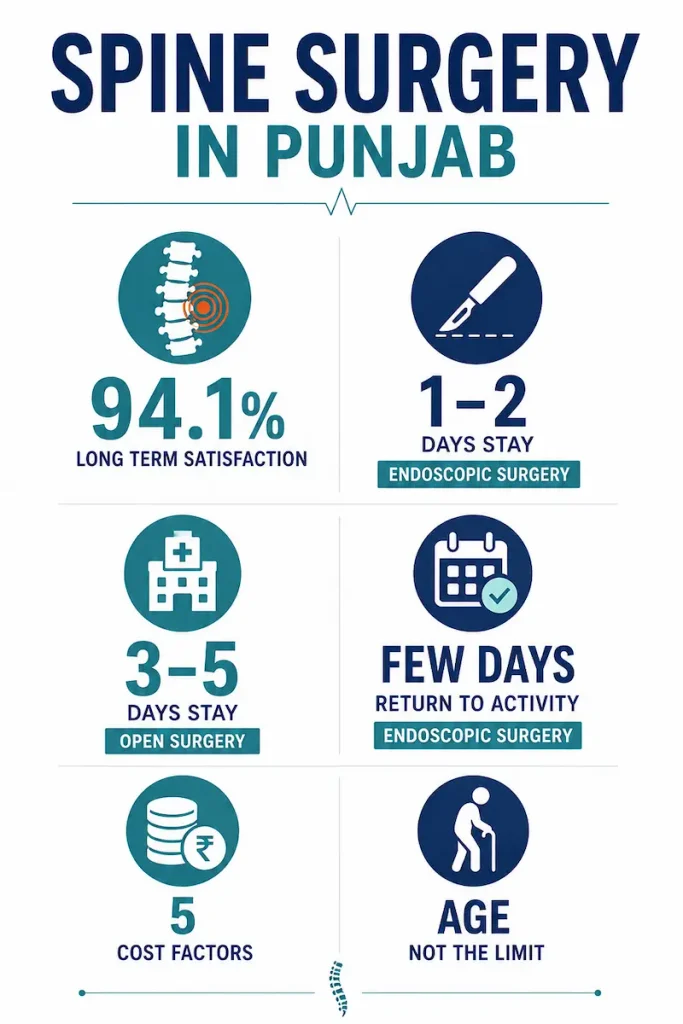
Endoscopic, or keyhole, spine surgery has become a genuinely established option across Punjab’s larger hospitals, not an experimental add on. A long term study following patients for five years after transforaminal endoscopic discectomy reported an overall patient satisfaction rate of 94.1 percent, according to research published on PubMed. Individual outcomes still depend on the specific diagnosis, how long the compression has been present, and the surgeon’s experience with the technique.
| Factor | Endoscopic Spine Surgery | Open Spine Surgery |
|---|---|---|
| Incision size | Often smaller than a coin | Several inches |
| Typical hospital stay | 1 to 2 days | 3 to 5 days or longer |
| Return to light activity | Within a few days | Several weeks |
| Comparable success for suitable cases | Yes, for well selected patients | Yes, for well selected patients |
The endoscopic approach does not suit all spinal conditions, and that judgment depends on the specific diagnosis rather than a general preference for a smaller incision. Cleveland Clinic notes that minimally invasive techniques access the spine through smaller incisions with less disruption to surrounding tissue compared with a traditional open approach.
What Spine Surgery in Punjab Costs and What Affects the Price
Cost is one of the first questions raised in nearly all consultations, and there is no single figure that applies across cases.
- The specific procedure performed, since endoscopic surgery generally involves different equipment and operating time than open surgery
- Whether implants such as screws, rods, or cages are used, which adds directly to the overall cost
- Whether the case involves a single spinal level or multiple levels
- Length of hospital stay, which is often shorter with endoscopic or minimally invasive techniques
- Whether the hospital is empanelled under PMJAY, Ayushman Bharat, or other government or private insurance schemes relevant to your specific policy
Back surgery Punjab cost estimates only become reliable once a hospital reviews your specific case. An individualized quote from the treating hospital is the only reliable way to know the actual cost for your case. Coverage under PMJAY or similar schemes varies by hospital and specific empanelment status, so confirming this directly with the treating hospital’s insurance desk before proceeding is the recommended step, since not all procedures or hospitals fall under the scheme.
Who Should Consider a Spine Surgery Consultation
Age alone is rarely a disqualifying factor for spine surgery. What matters more is overall health, bone density, and how well the body is expected to tolerate surgery and recovery, and a number of patients in their seventies are cleared for surgery successfully once properly evaluated.
Coexisting health conditions add a layer of complexity rather than an automatic barrier. Spine surgery can still proceed for patients with serious conditions such as liver cirrhosis or a history of tuberculosis affecting the spine, though these cases require careful evaluation involving more than one specialist, since additional health conditions raise surgical risk. A responsible surgeon discusses this risk openly with the family so an informed decision can be made based on the specific combination of conditions present.
Infection risk during spine surgery is managed through sterile surgical protocols and proper wound care afterward, not by the season or time of year the procedure is scheduled. Patients with specific timing concerns should still raise them directly with their surgeon.
Special Situations That Complicate Spine Surgery Decisions
A number of scenarios come up often enough in Punjab’s spine clinics to deserve specific mention.
Missing records from a previous surgery. When a family has lost the operation notes or imaging from an earlier spine procedure involving rods or screws, treatment can still proceed, but it becomes harder to plan safely without knowing exactly what hardware is already in place. The recommended first step is attempting to retrieve the original records from the earlier hospital, and if that is not possible, getting fresh imaging done to reassess the current situation before any new procedure is planned.
A spinal injury from decades ago. A spinal cord injury from ten or more years ago does not automatically rule out benefit from surgery now, but these cases are evaluated individually. Some patients see genuine functional improvement from surgery even years later, while others may have reached a point where further surgery offers limited additional gain, which is why fresh imaging and a direct surgical opinion matter more than time elapsed on its own.
How to Choose the Right Spine Specialist Punjab Offers
With numerous hospitals across Punjab offering spine procedures, choosing between them benefits from a specific checklist rather than reputation alone.
- Ask directly about the surgeon’s specific spine training and fellowship experience, not just general orthopedic or neurosurgical qualification
- Ask how often the surgeon performs the exact operation being planned, and how recently
- Ask about complication rates for that specific procedure, since reputable surgeons are generally open to discussing this directly
- Get a second opinion for major decisions such as spinal fusion, particularly when the first recommendation feels rushed or unclear
A consultation with Dr. Jaspreet Singh Randhawa, a neurosurgeon based in Mohali, typically works through this checklist directly, reviewing your specific imaging rather than offering a general recommendation before seeing your case. According to Harvard Health, back surgery decisions should generally follow a genuine trial of nonsurgical treatment, and knowing exactly what is causing the pain matters more than moving quickly toward a specific procedure like fusion.
Spine Surgery in Punjab: Access Across Mohali, Chandigarh and Panchkula
Spinal surgery Punjab wide routes largely through the tri city region for most consultations, where specialist capacity is shared across Mohali, Chandigarh, and Panchkula rather than concentrated in one location. A neurosurgeon in Mohali serves as the primary point of contact for a large share of families, while patients closer to the eastern side of the state often start with a neurosurgeon in Chandigarh or a neurosurgeon in Panchkula before imaging and referral bring the case to the appropriate specialist.
For patients whose pain has not resolved after surgery, or who are managing chronic nerve pain that has not responded to further procedures, spinal cord stimulation is a separate treatment path worth discussing directly with a specialist rather than assuming repeat surgery is the only option.
If you live outside Punjab or outside India, an initial remote review of your MRI or X ray report is often possible through the clinic’s online appointment system, though an in person examination and additional testing are typically still required before finalizing a surgical plan. For patients planning a visit from further within Punjab, the clinic’s contact and location details make it straightforward to plan the trip alongside the appointment itself.
Deciding on spine surgery in Punjab ultimately comes down to an accurate diagnosis and a surgeon willing to explain, in specific terms, why a particular procedure fits your case rather than presenting surgery as the default answer for any back complaint.
Frequently Asked Questions
1. What is the average success rate of endoscopic spine surgery?
Clinical studies generally report favorable outcomes for endoscopic spine surgery, with satisfaction rates often cited around 90 percent or higher in longer term follow up research, and most patients reporting meaningful pain relief and improved mobility. The exact outcome still depends on the specific condition being treated, how long symptoms have been present, and the surgeon’s experience with the technique. These figures describe general clinical patterns rather than a guaranteed result for any individual case, which is why your surgeon will assess your specific imaging and history before giving you a personalized expectation for your own procedure.
2. How long does recovery take after endoscopic spine surgery?
A number of patients return to light activities within a few days and resume regular routines within a couple of weeks, since the procedure causes comparatively minimal muscle and tissue disruption relative to open surgery. Some patients walk comfortably within a day of the procedure and go home shortly after. Recovery still varies based on the specific condition treated, overall health, and how closely postoperative instructions are followed, so these timelines describe common patterns rather than a fixed schedule guaranteed for any patient undergoing the procedure.
3. Is PMJAY or other government health insurance accepted for spine surgery in Punjab?
Coverage varies by hospital and specific empanelment status under PMJAY, Ayushman Bharat, or other schemes, so confirming this directly with the treating hospital’s insurance or PMJAY desk before proceeding is the recommended step. Coverage is not automatic across all procedures or all hospitals under a given scheme, and coverage details can change, which makes a direct confirmation more reliable than assuming either way based on general information. Bringing your specific policy details or PMJAY card to the initial consultation lets the hospital’s insurance desk give you an accurate answer for your exact situation.
4. How much does spine surgery typically cost, and does it depend on hospital stay length?
Cost varies significantly based on the specific procedure, whether it is endoscopic or open, whether it involves a single spinal level or multiple levels, and whether implants such as screws or cages are needed. Hospital stay is generally shorter with minimally invasive or endoscopic techniques, which can also affect the overall cost compared with open surgery requiring a longer admission. An individualized quote directly from the hospital, based on your specific diagnosis and planned procedure, is the only reliable way to know the actual cost for your case, rather than relying on a general figure that may not reflect your situation.
5. Is spine surgery safe for elderly patients, such as someone in their seventies?
Age alone is not usually a disqualifying factor for spine surgery. What matters more is overall health, bone density, and how well the body is expected to tolerate both the surgery itself and the recovery period afterward. A number of elderly patients are cleared for surgery successfully once a thorough evaluation has been completed, covering cardiac health, bone quality, and any other conditions that could affect surgical risk. The decision comes down to a specific risk assessment for that individual rather than a general age cutoff applied uniformly across older patients considering the procedure.
6. My family lost the records from a previous spine surgery. Can treatment still proceed?
Missing prior surgical records make it harder to plan safely, since surgeons need to know exactly what hardware, such as rods or screws, is already in place before planning further treatment. The recommended first step is attempting to retrieve the original operation notes and imaging from the hospital where the earlier surgery was performed. If those records cannot be located, getting fresh imaging done allows the current surgical team to reassess the situation directly rather than proceeding without a clear picture of what has already been done to the spine.
7. Can spine surgery be done for someone with other serious health conditions, like liver cirrhosis or a history of TB affecting the spine?
Yes, but these cases require careful evaluation involving more than one specialist, since additional health conditions increase the overall surgical risk. The treating surgeon typically discusses this risk openly with the family, covering how the specific combination of conditions affects anesthesia tolerance, healing, and recovery, so an informed decision can be made together rather than the family being told simply yes or no. Coordination between the spine surgeon and the specialist managing the other condition, whether a hepatologist for liver disease or a physician managing TB treatment, is a normal part of planning these more complex cases.
8. How do I choose the right spine surgeon or hospital across Punjab?
Reasonable due diligence includes checking the surgeon’s specific spine training and experience, asking directly about complication rates for the exact procedure being planned, and getting a second opinion before committing to a major decision such as spinal fusion. Patient experiences with the same broad category of procedure can vary considerably depending on the specific surgeon and hospital, which is why looking at the individual surgeon’s track record matters more than the hospital’s general reputation alone. A surgeon who answers these questions directly, without hesitation, is generally a stronger indicator of quality care than marketing claims or word of mouth alone.
9. Can spine surgery be planned remotely if I live outside Punjab or outside India?
A number of spine specialists offer an initial remote review of MRI or X ray reports to help guide next steps for patients living outside the region. This can clarify whether the case appears urgent, whether conservative treatment still has room to work, or whether an in person surgical consultation should be prioritized. An in person examination and additional testing are typically still required before finalizing a surgical plan, since a physical exam adds information that imaging alone cannot capture. A remote review works well as a starting point for planning travel and timing, rather than as a substitute for the full evaluation.
10. What is the difference in outcomes between endoscopic and open spine surgery?
Endoscopic techniques generally show outcomes broadly comparable to traditional open surgery for suitable cases, while offering practical advantages such as less blood loss, smaller scars, shorter hospital stays, and a faster return to daily activity. The endoscopic approach does not suit all spinal conditions, and this depends on the specific diagnosis, the location of the problem within the spine, and whether any instability is present alongside the nerve compression. Your surgeon will recommend the approach best suited to your specific imaging and symptoms rather than defaulting to one technique regardless of the underlying cause.