
A missed period gets attention. A pattern of missed pregnancies, month after month, often does not, until a woman finally asks whether endometriosis is the reason. Endometriosis infertility treatment covers a wide range of options, from monitored natural cycles to IVF, and the right starting point depends far more on disease stage, age and how the fallopian tubes and ovaries look on scan than on how painful the periods have been.
Key Takeaways
- Endometriosis infertility treatment is not a single procedure. It is a staged plan that ranges from ovulation tracking to IVF, chosen based on age, disease stage and how long a couple has been trying.
- Pain severity does not predict fertility impact. Some women with mild endometriosis struggle to conceive, while others with advanced disease conceive without intervention.
- A laparoscopy is often both diagnostic and therapeutic, since removing visible endometriosis during the same procedure can improve natural conception chances.
- Egg quality and ovarian reserve testing guide whether a couple should try naturally for a few months or move directly toward IVF.
- Delaying evaluation rarely helps. Reviewing options early with our Endometriosis Treatment in Mohali team keeps the widest range of fertility paths open.
Why Endometriosis Affects Fertility in the First Place
Endometrial tissue that grows outside the uterus can distort the pelvis, block the fallopian tubes, or trigger inflammation that affects egg quality and embryo implantation. Adhesions and cysts, particularly ovarian endometriomas, can also lower the number of eggs available in the ovary over time.
Endometriosis and infertility are linked in roughly one in three women who have difficulty conceiving, though the exact effect on fertility varies widely depending on where the tissue is located and how advanced the disease has become. A woman with mild disease and open tubes may conceive without help, while another with the same pain level but blocked tubes may need assisted conception from the start.
Evaluating Fertility Before Choosing a Treatment Path
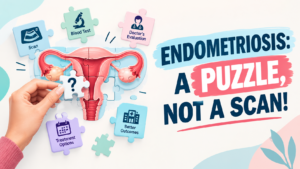
Endometriosis fertility treatment planning generally starts with a structured set of tests rather than a single scan.
- A transvaginal ultrasound to check for endometriomas, uterine shape and adenomyosis.
- Blood tests for ovarian reserve, commonly AMH, alongside a semen analysis for the male partner.
- A hysterosalpingogram or laparoscopy to confirm whether the fallopian tubes are open.
- A review of cycle length and ovulation pattern over two to three months.
- A joint discussion with a fertility specialist once results are back, comparing natural, medical and assisted options.
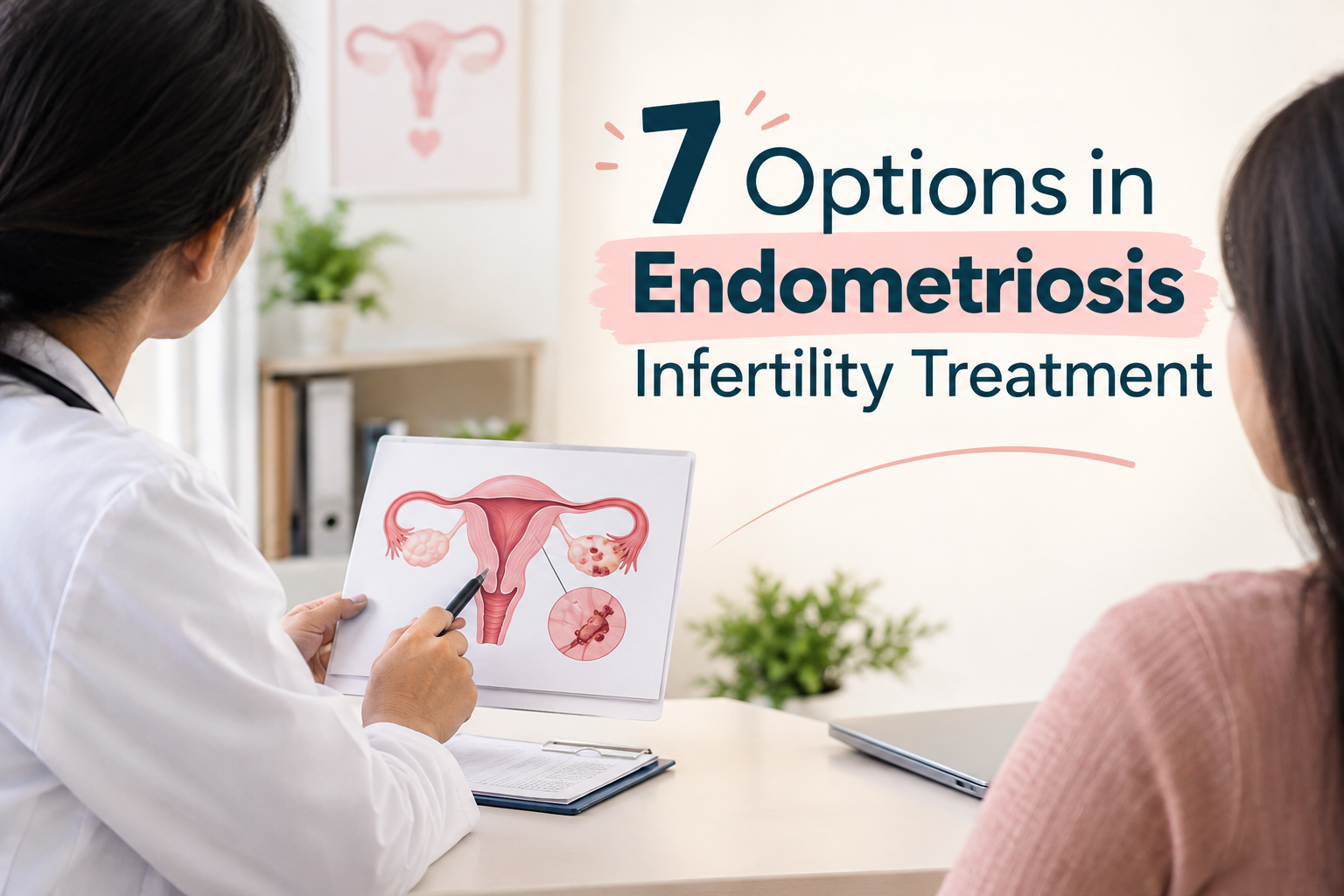
7 Endometriosis Infertility Treatment Options
Once evaluation is complete, treatment usually falls into one of seven categories, often used in combination rather than alone.
| Option | What It Involves | Best Suited For |
|---|---|---|
| Monitored natural cycles | Tracking ovulation timing with scans and hormone checks | Mild disease, open tubes, younger age group |
| Ovulation induction | Medication to stimulate egg release, timed intercourse | Irregular cycles with otherwise normal tubes |
| Laparoscopic surgery | Removing endometriosis tissue, cysts and adhesions | Blocked tubes, endometriomas, distorted pelvic anatomy |
| Intrauterine insemination | Placing prepared sperm directly into the uterus | Mild to moderate disease with at least one open tube |
| IVF | Fertilizing eggs outside the body, transferring the embryo | Advanced disease, blocked tubes, reduced ovarian reserve |
| Egg freezing | Preserving eggs before disease or age reduces reserve further | Younger women delaying pregnancy with known endometriosis |
| Combined medical and surgical care | Hormonal suppression before or after surgery to slow recurrence | Recurrent endometriomas or repeated failed cycles |
When Surgery Helps and When It Can Wait
Laparoscopy is often both diagnostic and therapeutic. Removing visible endometriosis, freeing adhesions and draining or removing an endometrioma during the same procedure can improve the chance of natural conception in the months that follow.
Surgery is not automatically the first step for every woman. Repeated operations on the ovary can reduce ovarian reserve further, so a fertility specialist weighs the benefit of removing disease against the risk to remaining egg supply, particularly in women already close to their late thirties.
According to Mayo Clinic, treatment decisions for endometriosis related infertility depend on age, disease severity and how long a couple has been trying to conceive, rather than a fixed protocol applied to everyone. The NHS also notes that surgery to remove endometriosis tissue can improve the chances of getting pregnant for some women, though results vary by individual case.
Endometriosis Pregnancy Treatment Options When Time Matters
Age changes the calculation. A woman in her late twenties with mild endometriosis has more room to try monitored cycles or one round of IUI before moving to a more intensive endometriosis infertility treatment path. A woman in her late thirties with an endometrioma and reduced ovarian reserve is often guided toward IVF sooner, since egg quantity and quality decline regardless of how the disease itself is managed.
- Ovarian reserve testing helps set a realistic timeline rather than an open ended one.
- IVF can bypass blocked or damaged fallopian tubes entirely.
- Embryo freezing allows treatment of active endometriosis symptoms without discarding a fertility window.
Endometriosis Fertility Treatment in Mohali, Chandigarh and Punjab
Couples across Mohali, Chandigarh and the wider Punjab region are increasingly seeking a combined gynecology and fertility opinion rather than treating pain and fertility as separate problems. An infertility treatment plan built around the specific pattern of disease, rather than a generic protocol, tends to give a clearer picture of realistic timelines.
An accurate diagnosis matters just as much as the treatment itself, since ovarian cyst findings on ultrasound are sometimes mistaken for endometriomas or the reverse, and the two are managed differently.
Frequently Asked Questions
1. Can a woman with endometriosis get pregnant naturally?
Yes, a substantial number of women with endometriosis conceive naturally, particularly with mild to moderate disease and open fallopian tubes. Pain severity does not reliably predict fertility outcome. Some women with significant pain have no trouble conceiving, while others with minimal symptoms find it harder, since the impact depends more on tube patency, ovarian reserve and pelvic anatomy than on how much discomfort the disease causes month to month.
2. How long should a couple try before seeking fertility treatment for endometriosis?
Most fertility specialists suggest evaluation after six months of trying for women over 35, and around twelve months for younger women, though a known endometriosis diagnosis often justifies earlier testing. Waiting without any evaluation can mean losing time that matters more for older patients, so an ultrasound and ovarian reserve check early in the process helps set realistic expectations rather than guessing.
3. Does surgery for endometriosis improve fertility?
For women with blocked tubes, adhesions or endometriomas specifically, surgical removal of disease can improve the chance of natural conception in the months afterward. Surgery is not equally beneficial for everyone, and repeated procedures on the ovary can reduce remaining egg supply, so the decision depends on disease severity, ovarian reserve and age rather than being a default recommendation for every diagnosis.
4. What is the difference between IUI and IVF for endometriosis related infertility?
Intrauterine insemination places prepared sperm directly into the uterus and works best when at least one fallopian tube is open and disease is mild to moderate. IVF fertilizes eggs outside the body before transferring an embryo, and it can bypass blocked tubes entirely, making it the more suitable option for advanced disease, damaged tubes or reduced ovarian reserve. The choice depends on test results rather than personal preference alone.
5. Does an endometrioma need to be removed before trying to conceive?
Not always. Small endometriomas without significant symptoms are sometimes monitored rather than removed, particularly since surgery itself can lower ovarian reserve. Larger cysts, ones causing pain, or those interfering with egg retrieval during IVF are more often removed. This decision is individualized based on cyst size, ovarian reserve testing and whether natural conception or IVF is the planned path forward.
6. Can endometriosis come back after fertility treatment or surgery?
Yes, endometriosis can recur after surgery, and hormonal suppression is sometimes used afterward to slow that process, particularly when pregnancy is not the immediate goal. During active fertility treatment, hormonal suppression is generally paused since it also prevents ovulation, which is why the timing of surgery, medication and conception attempts is planned together rather than treated as separate decisions.
7. Is IVF success lower for women with endometriosis?
IVF outcomes for women with endometriosis vary by disease stage rather than following one fixed pattern. Some studies suggest slightly lower egg yield in advanced disease, while pregnancy rates per embryo transfer can be comparable to other causes of infertility once a good quality embryo is achieved. Individual results depend heavily on age, ovarian reserve and how the specific case has been managed leading up to treatment.
8. Does endometriosis affect egg quality, not just the fallopian tubes?
Endometriosis can affect egg quality through chronic pelvic inflammation and its impact on the surrounding ovarian tissue, separate from any mechanical blockage of the tubes. This is one reason ovarian reserve and egg quality testing are checked directly rather than assuming tube status alone tells the full fertility picture. Two women with identically open tubes can still have very different fertility outlooks based on this inflammatory effect.
9. Should I freeze my eggs if I have endometriosis and I am not ready for pregnancy yet?
Egg freezing is worth discussing for younger women with confirmed endometriosis who want to delay pregnancy, particularly if ovarian reserve testing already shows early decline or if an endometrioma is present. It is not necessary for every diagnosis. The decision depends on age, reserve testing results and family planning timeline, and is best made alongside a fertility specialist rather than as a reaction to the diagnosis alone.
10. Can adenomyosis be mistaken for endometriosis when it comes to fertility problems?
Yes, adenomyosis and endometriosis can coexist and their symptoms overlap significantly, though adenomyosis affects the uterine muscle itself while endometriosis involves tissue outside the uterus. Both can affect implantation and fertility, but the treatment approach differs, which is why an accurate ultrasound or MRI based diagnosis matters before finalizing a fertility treatment plan rather than assuming one condition based on symptoms alone.
A well planned endometriosis infertility treatment works best as a staged conversation rather than a single decision made under pressure. Reviewing ovarian reserve, tube status and disease severity together, ideally with a specialist who treats both the gynecological and fertility side of the condition, keeps more options open for longer and avoids losing time on an approach that was never well matched to the underlying diagnosis.