





Most ovarian cysts are found by accident, during a scan ordered for something else entirely, and most resolve on their own without ever needing treatment. That fact alone causes a specific kind of confusion: when a cyst shows up incidentally, how do you know whether it is one of the harmless ones or one that genuinely needs an ovarian cyst specialist in Mohali to take a closer look?
Key Takeaways
- A large share of ovarian cysts are functional, harmless, and resolve without treatment within a few menstrual cycles
- Specific features on ultrasound, such as a complex or solid appearance, are what actually prompt specialist evaluation, not the presence of a cyst alone
- Sudden, severe pelvic pain alongside fever, vomiting, or dizziness needs emergency evaluation, since it can signal a ruptured cyst or ovarian torsion
- Postmenopausal women with a new ovarian cyst generally warrant more thorough evaluation than premenopausal women with a similar result
- If your cyst has not resolved, or shows features worth a closer look, reviewing our Ovarian Cyst Diagnosis guide alongside a consultation with an ovarian cyst specialist in Mohali is a reasonable next step
What an Ovarian Cyst Doctor in Mohali Actually Evaluates
An ovarian cyst specialist is a gynecologist with focused experience assessing cyst type, size, and specific ultrasound features to determine whether a cyst is functional and self resolving or requires closer monitoring, medication, or surgery. The distinction matters because the overwhelming majority of ovarian cysts are benign and temporary, while a smaller number carry features that genuinely warrant a more careful evaluation. According to Cleveland Clinic, most ovarian cysts are harmless, cause no symptoms, and resolve without treatment, though rare complications can require a specialist’s attention.
Ovarian cysts are extremely common. A significant share of women experience at least one during their lifetime, and a large number never know it happened, since the cyst resolved on its own before causing any symptoms. This is exactly why a general result of “cyst present” on a scan is not, by itself, a reason for alarm, but it is also not something to dismiss automatically without knowing what specific features were noted.
Ovarian Cyst Specialist in Mohali: 7 Reasons to See One
A specific set of situations moves a cyst from routine monitoring into the category that benefits from specialist evaluation.
- The ultrasound describes the cyst as complex or solid, rather than simple and fluid filled
- The cyst is large, or has grown noticeably on a repeat scan
- Pelvic pain, bloating, or pressure has persisted beyond a few menstrual cycles
- Symptoms include pain during intercourse or noticeable changes in bleeding pattern
- You are postmenopausal and a new cyst has been found
- You are experiencing difficulty conceiving alongside a known or suspected cyst
- A blood test such as CA 125 has been recommended, or has come back with an abnormal result
A cyst being present on a scan does not by itself indicate anything serious. The specific features of that cyst, combined with your symptoms and personal risk factors, are what a specialist actually evaluates before recommending a plan.
Ovarian Cyst Specialist in Mohali: Simple vs Complex Cysts
Ultrasound reports describe cysts using specific language, and knowing the general categories helps make sense of what a specialist is actually looking for.
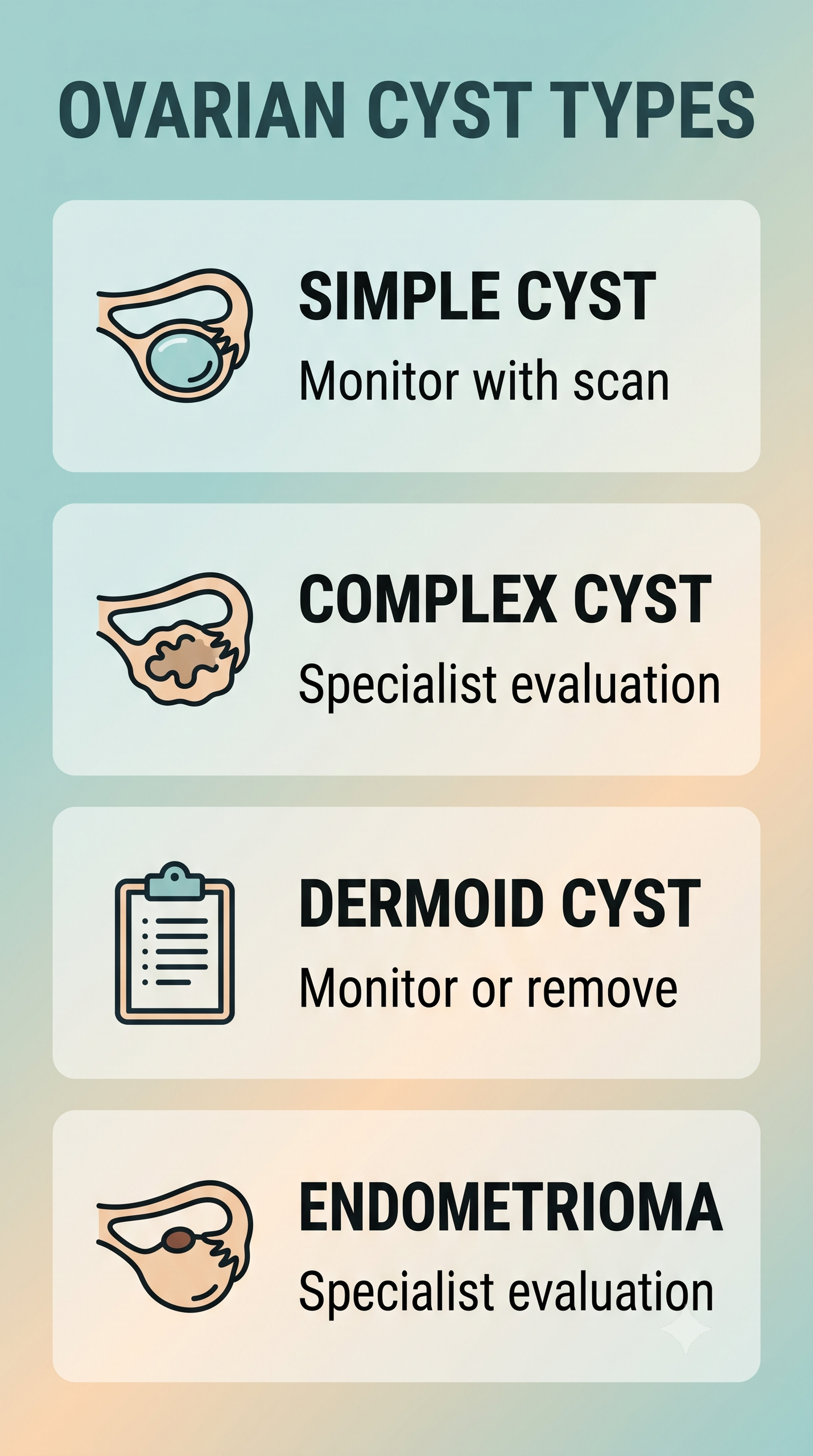
| Cyst Type | General Description | Typical Next Step |
|---|---|---|
| Simple functional cyst | Fluid filled, thin walled, no solid areas | Often monitored with a repeat scan |
| Complex cyst | Contains solid areas, septations, or irregular walls | Generally warrants specialist evaluation |
| Dermoid cyst | Contains tissue such as fat or hair, present from birth | Often monitored, sometimes removed if large or symptomatic |
| Endometrioma | Blood filled cyst linked to endometriosis | Specialist evaluation, particularly if fertility is a concern |
A simple cyst found incidentally on a scan for an unrelated reason is generally a low concern result, particularly in a woman of reproductive age. A complex cyst, regardless of the reason it was found, is the result that most reliably prompts a specialist referral, since its features cannot be fully assessed from a routine scan alone.
Ovarian Cyst Doctor Mohali Patients Call in an Emergency
Most ovarian cysts never become urgent. A specific, recognizable pattern of symptoms is the exception, and it deserves immediate attention rather than a scheduled appointment.
Sudden, severe pelvic pain, particularly on one side, combined with fever, nausea, vomiting, or dizziness needs emergency evaluation. This combination can indicate a ruptured cyst or ovarian torsion, a condition where the ovary twists on its supporting tissue and cuts off its own blood supply. According to Cleveland Clinic, most cases involve a large cyst causing the ovary to twist, and without emergency care the twisting can stop blood flow entirely, causing the tissue to die.
This is different from the more common, gradual pelvic discomfort a number of women experience with a functional cyst, and the distinction is worth taking seriously rather than waiting to see if sudden severe pain settles on its own.
Ovarian Cyst Gynecologist Mohali Visits: What Actually Happens
A specialist evaluation follows a structured sequence rather than jumping directly to a treatment recommendation.
- A detailed history covering your symptoms, menstrual pattern, and any personal or family history relevant to gynecologic conditions
- A pelvic examination to check for tenderness, size, or anything unusual on palpation
- Transvaginal ultrasound to assess the cyst’s size, structure, and specific features
- A CA 125 blood test in select cases, particularly for postmenopausal women or complex cyst findings
- A specific recommendation based on these findings, whether continued monitoring, medication, or surgical evaluation
Self diagnosis from symptoms alone is genuinely unreliable for ovarian cysts, since the majority cause no symptoms at all, and the ones that do cause symptoms overlap considerably with several other conditions. A proper evaluation, not a symptom checklist, is what actually confirms whether a cyst needs attention beyond routine monitoring.
Age Changes the Picture More Than Patients Expect
An ovarian cyst found in a woman in her twenties carries a different clinical significance than the same result in a postmenopausal woman, even when the ultrasound description looks similar on paper.
Postmenopausal women with a new ovarian cyst are generally evaluated more thoroughly, since the risk profile changes after menopause. This does not mean each postmenopausal cyst is concerning, since a number of them remain entirely benign, but the threshold for specialist referral and closer evaluation is appropriately lower in this age group. If you are postmenopausal and a cyst has been found on a routine scan, specialist evaluation is a reasonable step rather than assuming it will resolve the way a premenopausal functional cyst typically does.
Ovarian Cyst Specialist in Mohali: Fertility Considerations
For women trying to conceive, an ovarian cyst raises specific questions that go beyond whether the cyst itself is dangerous.
Certain cyst types, particularly endometriomas linked to endometriosis, can affect ovarian reserve and complicate fertility planning, which is one reason fertility specialists screen for cysts specifically before starting treatment such as IVF. A cyst discovered during a fertility workup is evaluated somewhat differently from one found incidentally during an unrelated scan, since the treatment decision has to account for how any intervention, including surgery, might affect future fertility rather than focusing purely on the cyst itself. An infertility specialist in Mohali working alongside a gynecologist experienced with ovarian cysts can help clarify whether a specific cyst needs treatment before proceeding with fertility care, or whether it can be monitored safely alongside ongoing fertility treatment.
Ovarian Cyst Specialist in Mohali: Where to Start
A productive first ovarian cyst consultation generally begins with bringing whatever imaging or reports you already have, even if the result was described as minor or incidental.
- Bring copies of any prior ultrasound reports, even ones marked as normal or unremarkable
- Note when symptoms started, if any, and how they have changed over time
- Mention any personal or family history of ovarian conditions, including cancer
- Ask directly what specific features of your cyst prompted the recommendation for further evaluation
Women comparing an ovarian cyst specialist Chandigarh consultation against a Mohali based clinic, or searching more broadly for an ovarian cyst doctor Punjab wide with specific experience in complex cases, generally benefit from choosing a specialist who reviews imaging directly rather than relying on a general report summary. An ovarian cyst gynecologist in Mohali with specific experience distinguishing between functional and complex cysts can walk through your specific imaging findings rather than treating all cysts the same way.
Reaching the right ovarian cyst specialist in Mohali, and arriving at a clear answer on whether your case needs treatment or simply continued monitoring, depends on this same principle: a specific, individualized evaluation with an ovarian cyst specialist in Mohali, rather than a general reassurance based on the word cyst alone. Booking directly through the clinic’s appointment page is the most direct way to get that evaluation started.
Frequently Asked Questions About Seeing an Ovarian Cyst Specialist
1. When should I actually see a specialist for an ovarian cyst instead of just monitoring it?
Specialist evaluation is generally warranted when an ultrasound describes the cyst as complex or solid rather than simple, when the cyst is large or growing on repeat scans, or when pelvic pain, bloating, or pressure has persisted beyond a few menstrual cycles. Postmenopausal status, difficulty conceiving, or an abnormal CA 125 blood test result are additional reasons to pursue specialist evaluation rather than routine monitoring. A simple, small cyst found incidentally in a woman of reproductive age is often reasonably managed with a repeat scan first. The specific features noted on your ultrasound, not the presence of a cyst alone, are what actually determine whether specialist evaluation makes sense for your case.
2. Can an ovarian cyst be cancerous, and how would I know?
Most ovarian cysts are benign, particularly in women of reproductive age, but a small proportion can be cancerous or require further evaluation to rule out malignancy, especially in postmenopausal women. Features that raise concern include a complex or solid appearance on ultrasound, rapid growth, an abnormal CA 125 blood test, or a family history of ovarian or breast cancer. You cannot reliably tell whether a cyst is cancerous from symptoms alone, since early ovarian cancer often causes vague or no symptoms at all. This is exactly why specific ultrasound features and, in some cases, blood testing are used to assess risk rather than relying on how a cyst feels or how much pain it causes.
3. What is the difference between a simple cyst and a complex cyst on ultrasound?
A simple cyst appears as a fluid filled sac with thin, smooth walls and no solid areas on ultrasound, which is the typical appearance of a functional cyst related to the normal menstrual cycle. A complex cyst contains solid components, internal septations, or an irregular wall structure, which changes how it needs to be evaluated. Simple cysts are generally lower risk and often monitored with a repeat scan to confirm resolution. Complex cysts warrant closer evaluation, sometimes including additional imaging or blood tests, since their structure cannot be fully characterized from the ultrasound description alone and needs a specialist’s direct review.
4. Is ovarian torsion always an emergency, and what does it feel like?
Yes, ovarian torsion is treated as a surgical emergency, since the ovary twisting on its supporting tissue cuts off its own blood supply, and delayed treatment can affect the ovary’s long term function. It typically feels like sudden, severe pelvic pain on one side, often significantly more intense and abrupt than typical period related discomfort, and it is frequently accompanied by nausea or vomiting. This pattern is different from the gradual, milder discomfort a number of women experience with an ordinary functional cyst. If you experience sudden, severe one sided pelvic pain, particularly with nausea or vomiting, seeking emergency care immediately is the appropriate response rather than waiting to see if it passes.
5. My cyst was found incidentally. Should I still see a specialist?
It depends on the specific features described in the report rather than the fact that it was found incidentally. A small, simple cyst discovered during a scan for an unrelated reason is often a low concern result, particularly in a woman of reproductive age, and may simply be monitored with a repeat scan. If the report describes the cyst as complex, notes any solid components, or if you are postmenopausal, specialist evaluation is reasonable even though the cyst was found by chance. Reading the specific wording of your ultrasound report, or asking your referring doctor to explain it directly, helps clarify which category your particular result falls into.
6. Can an ovarian cyst affect my ability to get pregnant?
It depends on the type and size of the cyst. A large share of functional cysts have no meaningful impact on fertility and resolve without any treatment needed. Certain types, particularly endometriomas linked to endometriosis, can affect ovarian reserve and complicate conception, which is why fertility specialists specifically screen for cysts before starting treatments such as IVF. Large cysts can also occasionally affect ovulation or tubal function depending on their location and size. If you are trying to conceive and a cyst has been identified, a joint evaluation between a fertility specialist and a gynecologist experienced with ovarian cysts gives a clearer picture than assuming the cyst is automatically a barrier to pregnancy.
7. How often should ovarian cysts be monitored before seeing a specialist?
A commonly used approach for a simple, asymptomatic cyst is a repeat ultrasound after a defined interval, often a few menstrual cycles, to check whether it has resolved on its own, which the majority of functional cysts do. If the cyst persists beyond that monitoring period, grows larger, or develops complex features on the repeat scan, specialist evaluation is the reasonable next step rather than continuing indefinite monitoring. The specific interval and number of monitoring scans recommended can vary based on your individual case, age, and symptoms, so following the specific timeline your doctor recommends is more useful than applying a general rule to your own situation.
8. Should I be more worried about a cyst if I am past menopause?
Yes, to some degree. A new ovarian cyst found after menopause is generally evaluated more thoroughly than a similar result in a premenopausal woman, since the risk profile for malignancy increases with age and postmenopausal ovaries are not expected to be producing functional cysts related to ovulation. This does not mean each postmenopausal cyst is dangerous, since a number remain entirely benign after proper evaluation. It does mean that specialist assessment, often including a CA 125 blood test alongside imaging, is a reasonable and commonly recommended step for postmenopausal women with a new cyst result, rather than a wait and monitor approach applied by default.
9. What tests will a specialist actually run to evaluate my cyst?
A specialist evaluation typically starts with a detailed history and pelvic examination, followed by a transvaginal ultrasound to assess the cyst’s size, structure, and specific features. Depending on those findings, a CA 125 blood test may be recommended, particularly for postmenopausal women or cysts with complex features, to help assess risk alongside the imaging. In select cases, additional imaging such as an MRI may be used for a clearer anatomical picture when ultrasound findings are inconclusive. Not each case requires the full set of tests, and your specialist will recommend the specific combination that makes sense based on your age, symptoms, and initial ultrasound findings rather than running the full set of tests as a default.
10. Can ovarian cysts come back after treatment or surgery?
Yes, particularly certain types of cysts, such as those linked to endometriosis, which can recur even after surgical removal since the underlying condition driving cyst formation is not eliminated by removing a single cyst. Functional cysts related to the normal menstrual cycle can also recur in future cycles, independent of any prior treatment, since they form as part of ovulation itself. Recurrence does not necessarily mean the original treatment failed, since it often reflects the underlying tendency of certain conditions to produce new cysts over time. Ongoing monitoring after treatment, at a frequency your specialist recommends based on your specific history, helps catch any recurrence early rather than assuming one successful treatment prevents future cysts entirely.