


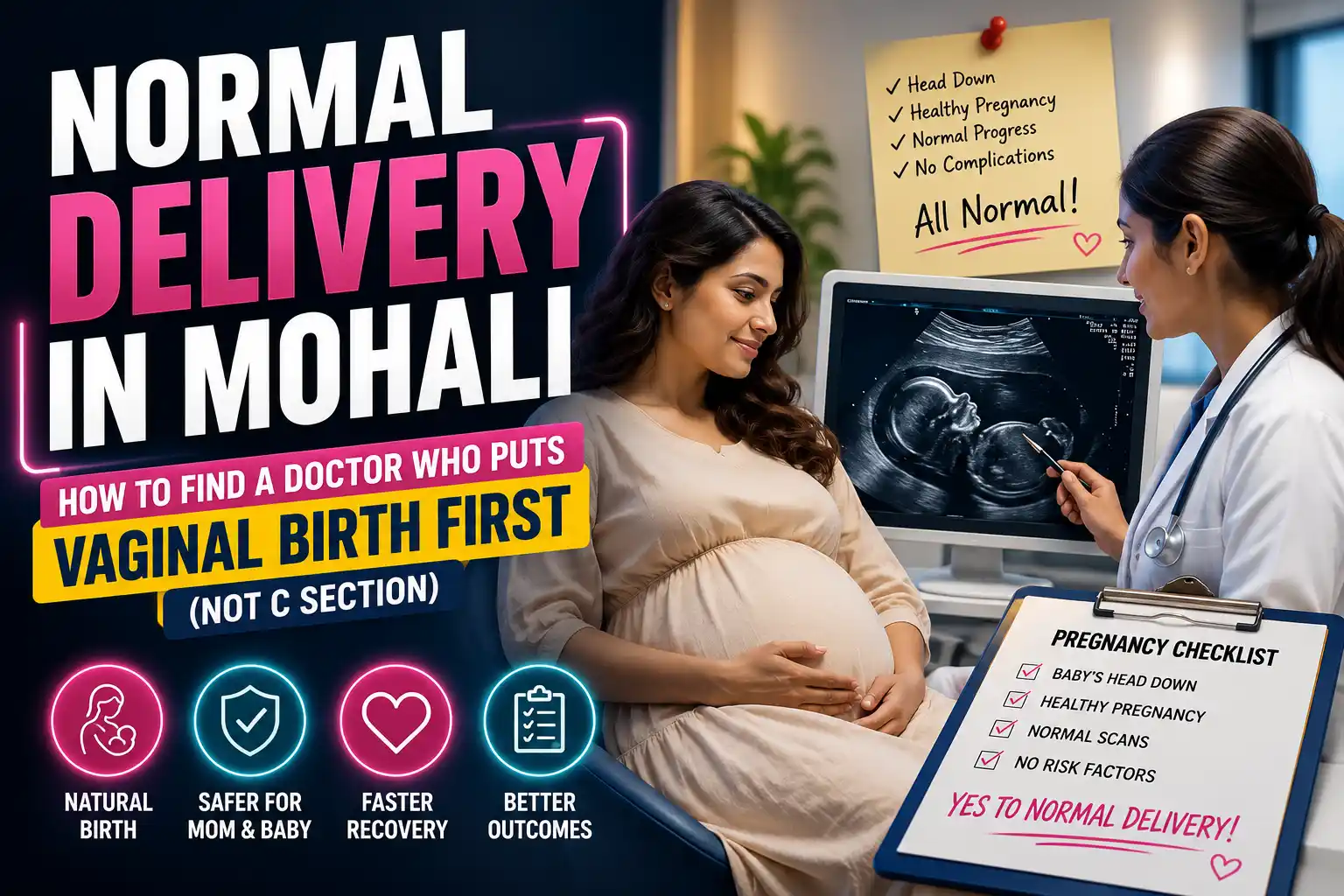
A woman in her eighth month sat across from her gynecologist at a well known Mohali hospital. Everything about her pregnancy was textbook: baby’s head was down, weight was on track, no complications, no gestational diabetes, no preeclampsia. She asked one question: “Doctor, can I have a normal delivery?”
The answer she got: “Let us see. Sometimes things don’t go as planned. We should be ready for anything.”
That sentence sounds reasonable. Responsible, even. But here is what it actually means in too many private hospitals across Punjab: the doctor has not committed to trying vaginal birth. The door to a cesarean is already open, and it will take very little to walk through it.
This article exists because normal delivery in Mohali is absolutely possible for the majority of healthy pregnancies, but only when the woman and her family know what to look for in a doctor, what questions to ask, and what signals suggest that the system around them is leaning toward surgery before labour has even started. The numbers tell a story most hospitals would rather you did not hear.
Key Takeaways
- Punjab’s C section rate in private hospitals is 47%, more than three times the WHO recommended ceiling of 10 to 15%
- In Indian private hospitals nationally, 54 out of every 100 deliveries are now cesarean; in public hospitals, only 17 out of 100
- The single biggest factor determining whether a woman gets a normal delivery or a C section is not her body. It is her doctor’s philosophy and practice pattern
- Seven specific questions, asked during the third trimester, reveal whether your doctor genuinely supports vaginal birth or defaults to surgery
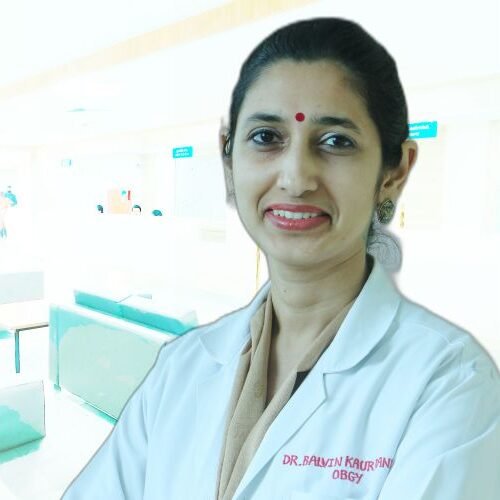
- Dr. Balvin Kaur Ghai at Medisyn Clinic, Mohali, is known for maintaining significantly higher vaginal birth rates than the Punjab average through active labour management and patient preparation
The Numbers Nobody in Punjab’s Private Hospitals Talks About
According to the latest National Family Health Survey (NFHS 6, 2023 to 2024), India’s overall C section rate has climbed from 21.5% to 27.2% in just five years. That national number hides a far more alarming pattern: in private hospitals, 54% of all deliveries are cesarean. In Punjab specifically, the C section rate stands at 47%.
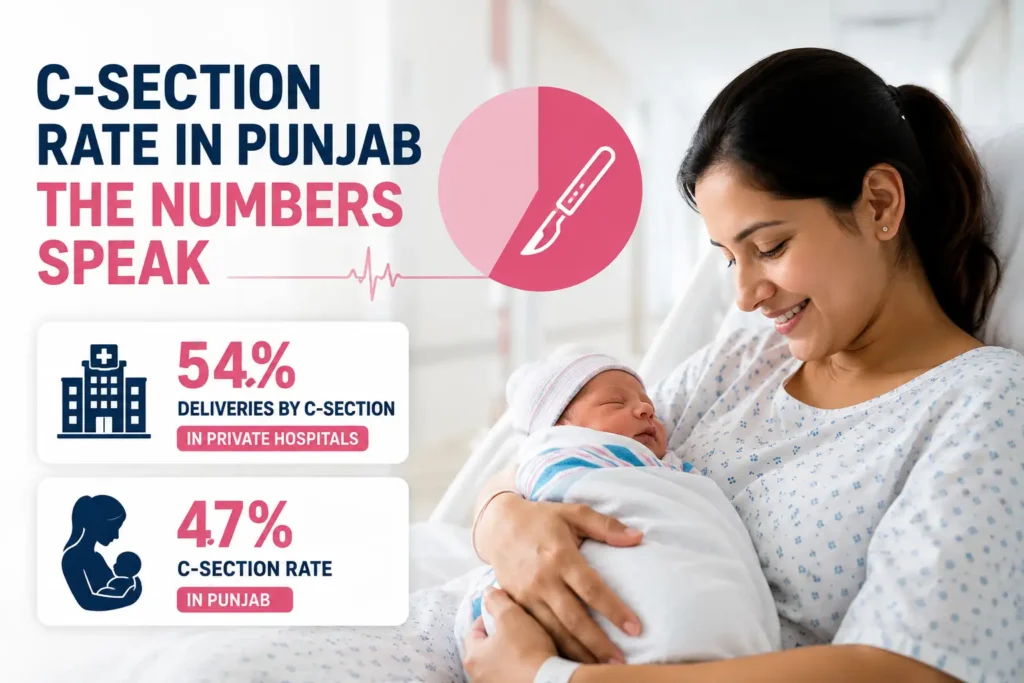
The World Health Organization’s position, based on decades of global data, is unambiguous: C section rates above 10 to 15% at the population level do not reduce maternal or newborn mortality. At 47%, Punjab is not saving more mothers and babies. A published quality improvement study at an Indian private hospital demonstrated that a structured programme reduced the cesarean rate from 52% to 18% without any increase in complications for mothers or babies. The mothers were the same. The babies were the same. What changed was the system around them.
This is not an argument against C sections. Cesarean delivery saves lives when genuinely needed, in cases of placenta previa, cord prolapse, true fetal distress, or complete breech presentation that cannot be safely managed. But when nearly half of all deliveries in a state end in surgery, the question is no longer medical. It is systemic.
For women in Mohali who want normal delivery, understanding this context is the first step toward making it happen.
Why C Section Rates Are So High in Mohali’s Private Hospitals: The Real Reasons
The reasons are not what most families assume. It is rarely because “the baby was too big” or “the pelvis was too narrow.” Those genuine indications exist, but they explain a tiny fraction of the gap between Punjab’s 47% and the WHO’s 15% ceiling. Here is what actually drives the numbers:
1. Time Pressure on the Doctor
Normal labour takes time. A first time mother can be in active labour for 8 to 12 hours, sometimes longer. A busy private practitioner running a clinic, an OPD, and a hospital practice simultaneously cannot stay with one patient for 12 hours. A C section takes 45 minutes and is schedulable. Labour is neither.
2. Financial Incentive
In most private hospitals, a C section generates higher revenue than a normal delivery: higher surgical charges, more expensive consumables, longer hospital stay (3 to 5 days versus 1 to 2 days), and higher room charges. The hospital makes more money. The doctor’s surgical fee is higher. The patient and the insurer pay more. The incentive structure quietly favours surgery.
3. Fear of Litigation
Obstetric lawsuits in India are increasing. A baby born with any complication after a prolonged labour invites scrutiny. A baby born by C section at the first sign of any abnormality on the fetal heart monitor provides legal cover. Many doctors choose the legally safer path, even when the medically appropriate path is to let labour continue.
4. Lack of Continuous Labour Support
Normal delivery requires continuous monitoring: tracking fetal heart rate, assessing cervical dilation progress, managing pain, encouraging the mother, and making real time decisions. This requires a trained team that stays with the patient throughout labour. Many private hospitals in Mohali do not have this infrastructure. When continuous support is absent, the threshold for calling a C section drops dramatically.
5. Patient Demand (Less Common Than You Think)
Some families do request elective cesareans out of fear of labour pain or concern about timing. But research consistently shows that this accounts for a small fraction of the excess C sections. The majority are doctor initiated or system initiated, not patient demanded.
7 Questions That Reveal Whether Your Doctor Supports Normal Delivery (Ask These Before Week 36)
The difference between a doctor who genuinely tries for normal delivery in Mohali and one who defaults to C section is not visible in their qualifications or their hospital’s brochure. It is visible in how they answer these seven questions:
1. “What is your personal vaginal delivery rate?”
This is the most important question you will ever ask your gynecologist, and the one most women never think to ask. A doctor whose vaginal birth rate is 60% or higher is actively working to support normal delivery. A rate below 40% in a practice that handles low risk pregnancies suggests a pattern of defaulting to surgery. If your doctor cannot answer this question or becomes uncomfortable, that itself is an answer.
2. “Under what specific circumstances would you recommend a C section for me?”
A doctor who supports normal delivery will give specific, medical answers: true fetal distress that does not improve with position change and oxygen, complete placenta previa, cord prolapse, failed induction after a reasonable trial. A doctor who gives vague answers (“we will see how things go,” “it depends on how the baby responds”) is keeping options open for a surgical decision that may not be strictly necessary.
3. “Will you personally be present during my labour, or will a junior doctor or resident manage it?”
Continuous senior doctor presence during labour dramatically affects outcomes. If your consultant will only arrive when the delivery is imminent (or when the decision for C section has been made by a resident), you are less likely to get normal delivery. The doctor who will be there through the process is the doctor who has committed to it.
4. “What is your protocol when labour is progressing slowly?”
This question separates patience from panic. A normal delivery supportive doctor will describe a stepwise approach: changing the mother’s position, allowing movement and walking, augmenting with controlled oxytocin if needed, reassessing over hours rather than minutes. A doctor whose answer jumps quickly to “if things don’t move, we will go for surgery” has a low threshold for C section.
5. “Do you support written birth plans?”
A birth plan is not a rigid contract. It is a document that communicates the mother’s preferences: desire for normal delivery, pain management choices (epidural or natural), preferences about episiotomy, delayed cord clamping, and immediate skin to skin contact. A doctor who welcomes a birth plan discussion is a doctor who sees the mother as a partner in the process. A doctor who dismisses it (“just leave the medical decisions to me”) may not prioritize your preferences.
6. “What pain management options do you offer during labour?”
Many women who end up with C sections cite fear of labour pain as the reason they “chose” surgery. But the choice between “unbearable pain” and “painless surgery” is a false one. Epidural analgesia provides significant pain relief during vaginal delivery, letting the mother remain awake, aware, and able to push when needed. A doctor who offers epidural access gives women a real alternative to choosing C section out of fear.
7. “Can I have immediate skin to skin contact and breastfeeding after a normal delivery?”
This question tests the doctor’s philosophy about the post delivery experience. A doctor committed to normal delivery also values the golden hour: uninterrupted skin to skin contact, delayed cord clamping, and early breastfeeding initiation. These practices benefit both mother and baby and are standard in evidence based obstetric care. If the answer is “the baby will be taken to the nursery first,” the practice may not be fully aligned with current guidelines.
“When a pregnant woman asks me whether she can have a normal delivery, I tell her: my job is to make sure you do, unless your body or your baby tells us otherwise during labour. That is a fundamentally different starting point from ‘let us see.’ Every pregnancy at Medisyn begins with the assumption that vaginal birth is the goal. We prepare for it, we monitor for it, and we commit to it. A C section is always available if genuinely needed, but it is never the default.”
Dr. Balvin Kaur Ghai, Chief Gynecologist, Medisyn Clinic, Mohali
What Makes a Doctor Genuinely Good at Normal Delivery? 5 Clinical Skills That Matter
Supporting normal delivery is not just about wanting it. It requires specific clinical skills that not every gynecologist practises equally. When looking for the best doctor for normal delivery in Mohali, look for these five capabilities:
1. Active Labour Management
Active management means monitoring the mother and baby continuously, using partograph charting to track labour progress, recognizing when labour is genuinely stalling versus when it needs more time, and using oxytocin augmentation judiciously. A doctor skilled in active management can navigate a slow labour safely toward vaginal delivery instead of calling for surgery at the first sign of delay.
2. Accurate Fetal Heart Rate Interpretation
The CTG (cardiotocography) monitor is the most common tool used during labour. It tracks the baby’s heart rate and the mother’s contractions. The problem? CTG interpretation is subjective. A normal heart rate deceleration that recovers quickly is not fetal distress, but an inexperienced or risk averse doctor may read it as one and call for emergency C section. A doctor with strong CTG interpretation skills avoids unnecessary surgical interventions based on misread tracings.
3. Hands on Delivery Skills
When the baby’s head is crowning, the doctor’s hands determine whether the delivery proceeds smoothly or ends in an episiotomy, a vacuum extraction, or a last minute C section. According to Mayo Clinic, a cesarean is sometimes performed after labour has begun when complications arise, but many of these situations can be managed by a doctor with strong hands on delivery skills, including optimal positioning guidance, controlled pushing technique, and perineal support.
4. Patience During the First Stage
The first stage of labour (cervical dilation from 0 to 10 cm) is the longest and the most variable. In first time mothers, it can last 6 to 12 hours or more. A doctor who is patient during this stage and does not impose arbitrary time limits gives the mother’s body the time it needs. Many C sections are performed because a doctor decided “it is taking too long” at hour 8 when the labour might have progressed to full dilation by hour 10.
5. Prenatal Preparation for Vaginal Birth
Normal delivery success starts months before labour. A doctor who prepares patients for vaginal birth through regular prenatal care, third trimester pelvic assessment, baby position checks, perineal massage guidance, and breathing technique education is setting the stage for vaginal birth long before the first contraction. The research study referenced earlier showed that when antenatal preparation was prioritized, the trial of labour rate jumped from 28% to 79%.
Who Should NOT Expect Normal Delivery? When C Section Is Genuinely Necessary
This article advocates for normal delivery, but it would be irresponsible not to acknowledge the conditions where cesarean delivery is medically necessary and potentially life saving. No birth plan should override genuine medical need:
- Complete placenta previa: The placenta covers the cervix completely; vaginal delivery would cause dangerous bleeding
- Cord prolapse: The umbilical cord drops through the cervix before the baby; immediate delivery is needed to prevent cord compression
- True fetal distress: Persistent, non recovering abnormalities in fetal heart rate that indicate the baby is not tolerating labour
- Transverse lie: The baby is lying sideways at full term and cannot be turned; vaginal delivery is not possible
- Severe preeclampsia or eclampsia: When the mother’s blood pressure is dangerously high and immediate delivery is the safest option
- Active genital herpes outbreak: Vaginal delivery risks transmitting the infection to the baby
- Previous classical (vertical) uterine incision: The risk of uterine rupture during labour is too high for a safe trial of labour
In these situations, a C section is not failure. It is medicine doing exactly what it should. The problem is not C sections that save lives. The problem is C sections performed when none of these indications exist.
How to Prepare Your Body for Normal Delivery (Practical Steps Starting at Week 28)
Women searching for normal delivery in Mohali often focus entirely on finding the right doctor. That is essential, but preparing your own body is equally important. Here is what to do from week 28 onward:
Week 28 to 32: Build Stamina and Check Baby Position
- Daily walking: 30 minutes of brisk walking improves cardiovascular fitness, strengthens pelvic muscles, and encourages the baby to move into the head down position
- Pelvic floor exercises (Kegels): Strengthen the muscles that support delivery. Contract the pelvic floor for 5 seconds, release for 5 seconds; repeat 10 times, three sets daily
- Hydration: Drink 3 to 4 litres of water daily. Dehydration can trigger premature contractions
- Growth scan: Confirm baby’s size and position. If the baby is breech at 32 weeks, discuss turning techniques with your doctor
Week 32 to 36: Prepare the Perineum and the Mind
- Perineal massage: Starting at week 34, daily perineal massage for 5 to 10 minutes reduces the likelihood of tearing during delivery. Your doctor or a physiotherapist can teach the technique
- Breathing exercises: Practice slow, deep breathing. During labour, controlled breathing manages pain and reduces anxiety significantly
- Birthing class or discussion with your doctor: Understanding the stages of labour removes fear. Fear causes tension, tension causes pain, and pain causes more fear. Breaking this cycle with knowledge is half the battle
Week 36 to 40: Final Checks and Mental Readiness
- Pre delivery scan: Confirm baby is head down, weight is appropriate, amniotic fluid is normal, and placenta is healthy
- Birth plan discussion with your doctor: Confirm your preferences for pain management, episiotomy, delayed cord clamping, and skin to skin contact
- Hospital bag ready: Knowing that the practical details are handled reduces stress, which is important because stress hormones (cortisol, adrenaline) can slow labour
- Partner preparation: The support person should know what to expect during labour, how to encourage the mother, and when to call the doctor
Why Dr. Balvin Kaur Ghai Is the Doctor Mohali Women Trust for Normal Delivery
In a city where nearly half of private hospital deliveries end in surgery, Dr. Balvin Kaur Ghai at Medisyn Clinic has built a reputation for maintaining significantly higher vaginal birth rates than the regional average. Her approach is not ideological. It is clinical: every pregnancy begins with the assumption that normal delivery is the goal, and every decision during labour is made with the aim of achieving it safely.
- MBBS, MS (OB GYN), DNB (New Delhi), MRCOG Part 1 (England): Triple qualified with international standard training
- 25,000+ patients treated; 10,000+ procedures completed: The experience to handle any labour scenario, from straightforward to complex
- Independent laparoscopic surgeon: When surgery IS needed (cesarean, cyst removal, hysterectomy), she leads it herself. You do not get referred elsewhere
- Active labour management: Continuous monitoring, partograph based progress tracking, patience during slow labour, and stepwise intervention only when genuinely indicated
- Two locations: Sector 79 Airport Road, Mohali and Kharar Landran Road (both within 15 minutes of Kharar, Sohana, and Zirakpur)
For delivery services and gynecologist in Mohali details, visit the linked pages. Appointment: +91 9779977155 or +91 9779977016.
Frequently Asked Questions
1. What percentage of deliveries in Punjab are C sections?
According to NFHS 6 (2023 to 2024), Punjab’s overall C section rate is 47%. In private hospitals, the rate is even higher. The World Health Organization states that rates above 10 to 15% do not improve outcomes for mothers or babies.
2. How do I know if my doctor genuinely supports normal delivery?
Ask for their personal vaginal delivery rate. A rate of 60% or above in a low risk practice indicates genuine commitment to normal delivery. Also observe whether they discuss labour preparation, birth plans, and pain management options during your prenatal visits.
3. Can I have normal delivery if this is my first baby?
Yes. First time mothers can absolutely have normal delivery in Mohali or anywhere else. Labour may take longer (8 to 14 hours is common for first births), but with proper prenatal preparation, active labour support, and a patient doctor, the majority of healthy first time mothers deliver vaginally.
4. Is normal delivery possible if the baby is large?
In most cases, yes. Estimated fetal weight on ultrasound has a margin of error of 10 to 15%. A baby estimated at 3.5 kg does not automatically need a C section. The baby’s head moulds during delivery, and the pelvis expands. Your doctor should assess pelvic adequacy rather than making decisions based solely on estimated weight.
5. What if I am afraid of labour pain?
Fear of pain is the most common reason women consider elective C sections. But epidural analgesia provides significant pain relief during vaginal delivery without requiring surgery. Epidural lets you stay awake, feel pressure but not sharp pain, and push when needed. Ask your doctor whether epidural access is available at the hospital where you plan to deliver.
6. Can I have normal delivery after a previous C section (VBAC)?
Many women with one previous lower segment C section are candidates for vaginal birth after cesarean (VBAC). Success rates range from 60 to 80% in properly selected candidates. The decision depends on the reason for the previous C section, the type of uterine incision, and the current pregnancy’s profile. VBAC requires a doctor willing to attempt it and a hospital equipped for emergency intervention if needed.
7. What are the benefits of normal delivery for the baby?
Babies born vaginally benefit from compression through the birth canal, which helps clear fluid from the lungs and reduces respiratory problems. They are exposed to maternal vaginal bacteria during delivery, which kickstarts the gut microbiome and strengthens the immune system. Vaginal birth also allows earlier skin to skin contact and breastfeeding initiation, both of which improve bonding and early nutrition.
8. How long is recovery after normal delivery compared to C section?
Normal delivery recovery is significantly faster: most women can walk within hours, eat normally, and care for their baby within the first day. Hospital stay is typically 1 to 2 days. C section recovery involves surgical wound care, restricted mobility for 2 to 3 weeks, a hospital stay of 3 to 5 days, and full recovery taking 6 to 8 weeks. For working women and mothers with other children at home, this difference is substantial.
9. What should I pack for a normal delivery at the hospital?
Comfortable loose clothing, nursing bras, sanitary pads (heavy flow), toiletries, phone charger, snacks for your support person, baby clothes (2 to 3 sets), baby blanket, diapers, and your pregnancy file with all reports. Also carry your insurance card and ID proof. Having everything ready by week 36 reduces last minute stress.
10. When should I go to the hospital during labour?
Follow the 5 1 1 rule: when contractions are 5 minutes apart, lasting 1 minute each, and this pattern has continued for at least 1 hour, call your doctor and head to the hospital. Also go immediately if your water breaks, if you have heavy bleeding, or if you feel a significant decrease in baby movement.
Normal Delivery Is Your Right. Finding the Right Doctor Makes It Real.
Every healthy pregnant woman in Mohali deserves a genuine chance at normal delivery. Not a token attempt that quickly becomes a C section. Not a “let us see” that means the surgical team is already on standby. But a committed, skilled, patient effort by a doctor who believes that vaginal birth is the default for healthy pregnancies, and who has the clinical skill to make it happen safely.
The data is clear: the difference between a 47% cesarean rate and a 15% cesarean rate is not the mothers. It is the doctors and the systems around them. Finding a gynecologist who genuinely prioritizes normal delivery, who answers the seven questions with confidence and specificity, who prepares you physically and mentally through the third trimester, and who stays with you through labour, that is the single most important decision you will make for your delivery.
At Medisyn Clinic, Mohali, Dr. Balvin Kaur Ghai offers exactly that. A doctor who starts with normal delivery as the goal. A practitioner who uses data, not fear. A surgeon who can perform a C section when genuinely needed, but who works actively to make sure it is not.
Your body was designed for this. The right doctor helps your body do it.
This article is for informational purposes only. All delivery decisions should be made in consultation with your treating gynecologist based on your individual clinical situation.